
An analysis of FDA recall data for 134 non-sterile drug products found that 48% of microbial recalls involved waterborne organisms, most notably Burkholderia cepacia and Pseudomonas species. These findings show that contamination often begins upstream of the batch record, inside the systems that supply the process. Consequently, GMP inspectors assess pharmaceutical utilities as product-critical systems rather than as supporting infrastructure. During an inspection, they typically follow each system from generation to the point of use, compare current drawings with the installed configuration, and review monitoring trends. This level of scrutiny is justified, since manufacturers draw water on demand and do not release it batch by batch, as they do with other materials. For this reason, utility control depends as much on sound pharmaceutical engineering as on quality oversight. This article examines inspection expectations for water, clean steam, HVAC, and process gases, together with the controls that sustain a validated state.
Table of Contents
Pharmaceutical Utilities as the Hidden Ingredient in Every Batch
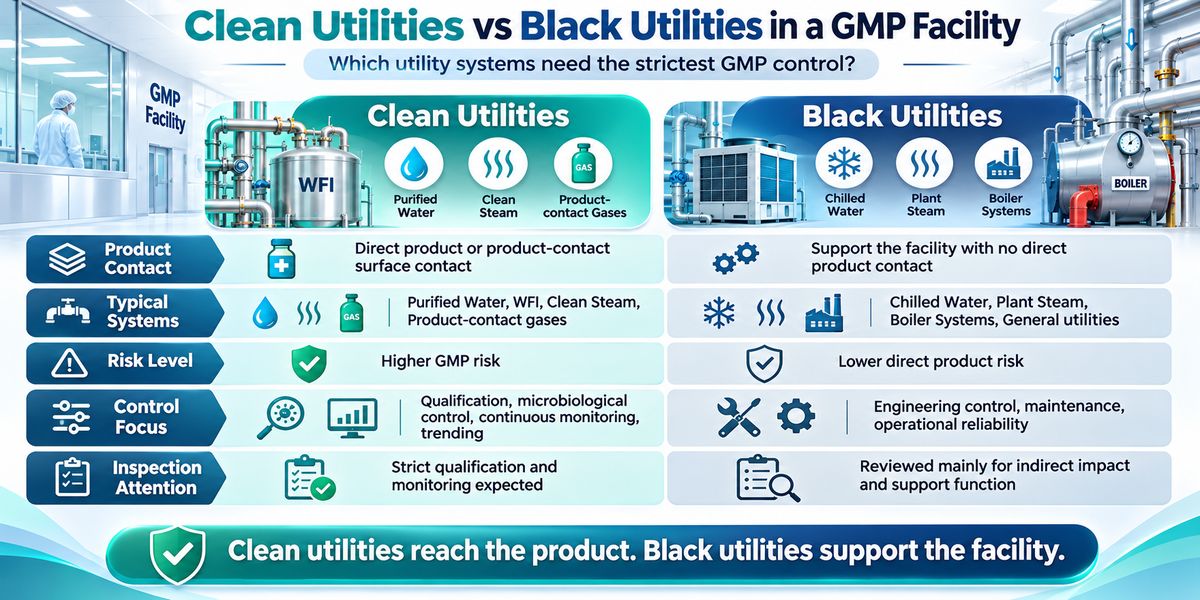
Under GMP, pharmaceutical utilities include the water, steam, air, and gas systems that support manufacturing operations. Their risk to the product, however, varies considerably. For this reason, the industry distinguishes between clean utilities, such as purified water, water for injection, and clean steam, and black utilities, such as chilled water, plant steam, and boiler systems. Clean utilities encounter the product or its contact surfaces, while black utilities serve the facility without direct product contact. HVAC occupies a middle position, since it does not touch the product but determines the quality of the air around it. EU GMP Annex 1 follows the same logic. It identifies utilities that contact the product, its materials, or product-contact surfaces as higher risk, and it expects manufacturers to set the level of control through a risk assessment documented in the contamination control strategy. Water that enters a formulation is, in effect, a starting material, so inspectors examine the system that produces it with the same rigor.
The infographic below compares clean and black utilities by product contact, typical systems, and risk level, so readers can see at a glance which systems need the strictest qualification and monitoring.
How Utility Failures Become Inspection Findings
Utility failures rarely appear as a single dramatic event. More often, they develop gradually, through a falling flow rate or a pressure differential that drifts out of range. Each change raises the risk to the product, yet it remains invisible until someone reviews the data. Inspectors therefore focus on records as closely as on the equipment itself. The PIC/S aide-memoire on utilities, for example, prompts them to request alarm records, deviation reports, and change control files for each system. In addition, EU GMP Annex 1 requires regular trend analysis for high-risk utilities, so an unreviewed trend can become a finding. As a result, observation often reflects a gap in control or documentation, not only a technical fault.
The table below links each critical utility to its key quality attributes, the points inspectors usually examine first, and the gaps that typically lead to an observation.
| Utility | Critical Quality Attributes | What Inspectors Check First | Typical Finding Trigger |
|---|---|---|---|
|
Purified water and water for injection |
Microbial count, endotoxin (for WFI), TOC, conductivity |
Loop drawings compared with the installed system, flow and temperature records, a sampling plan that covers all points of use, continuous TOC and conductivity monitoring on WFI |
Dead legs or poor drainage, sampling that skips outlets, alert or action excursions closed without root cause analysis |
|
Clean steam |
Condensate quality meeting the WFI monograph, non-condensable gases, dryness, superheat |
Feed water quality, the condensate sampling schedule, periodic physical steam tests |
Condensate testing alone, with no checks for dryness, superheat, or non-condensable gases; dead legs or entrainment in distribution |
|
HVAC |
Pressure differentials, filter integrity, airflow, particle levels, temperature, humidity |
Continuous monitoring of critical pressure differences, alarm records, requalification status |
Alarms delayed or overridden without assessment, overdue requalification (6 months for grade A and B, 12 months for grade C and D), final filter changes without requalification |
|
Compressed air and nitrogen |
Particles, water, oil, microbial quality |
ISO 8573-1 purity specification, sterilizing-grade filtration at the point of use for aseptic processes, filter replacement records |
Undefined oil and water limits, no microbial testing at the point of use, unclear line labeling that creates a risk of gas mix-ups |
Critical Utilities Inspectors Trace from Point of Use
Critical utilities in pharma manufacturing differ widely in design, yet they share one essential feature. Their quality matters most where they meet the product. For this reason, regulators judge each system by what it delivers at the outlet, the sterilizer, the cleanroom, or the gas connection, not only by its performance at generation. EU GMP Annex 1 reflects this view, since it requires water sampling at every point of use and periodic microbial testing of process gases where they enter the process. Consequently, a system that meets its specification at the generator can still fail an inspection if its quality declines along the distribution path.
Each of the four systems below carries its own risks at the point of use, and the following sections examine how inspectors assess them in turn.
- Purified Water and Water for Injection Loops (Available PDF)
- Clean Steam Quality at the Sterilizer (Available PDF)
- HVAC Control of Pressure, Air, and Particles (Available PDF)
- Compressed Air, Nitrogen, and Process Gases at Point of Use (Available PDF)
Purified Water and Water for Injection Loops (PDF Available)
Purified water and WFI loops must prevent stagnation and biofilm to stay within specification. Inspectors focus on loop design, sanitization, continuous monitoring, and sampling at every point of use.
Clean Steam Quality at the Sterilizer (PDF Available)
Clean steam sterilizes product-contact surfaces directly, so its quality decides whether a sterilization cycle can be trusted. This section covers condensate testing against the WFI monograph and the periodic checks for non-condensable gases, dryness, and superheat.
HVAC Control of Pressure, Air, and Particles (PDF Available)
HVAC systems protect the product indirectly by controlling filtration, airflow, and the pressure cascade between rooms. This section outlines the parameters inspectors review, from pressure alarms and filter integrity to requalification.
Compressed Air, Nitrogen, and Process Gases at Point of Use (PDF Available)
Compressed air and nitrogen often contact the product or primary containers, yet their quality is easy to overlook between generation and use. This section explains purity specifications under ISO 8573-1, point-of-use filtration, and microbial testing expectations.
Download PIC/S Aide-Memoire: Inspection of Utilities (PI 009-4) Here
Utility Qualification Built on System Impact Assessment
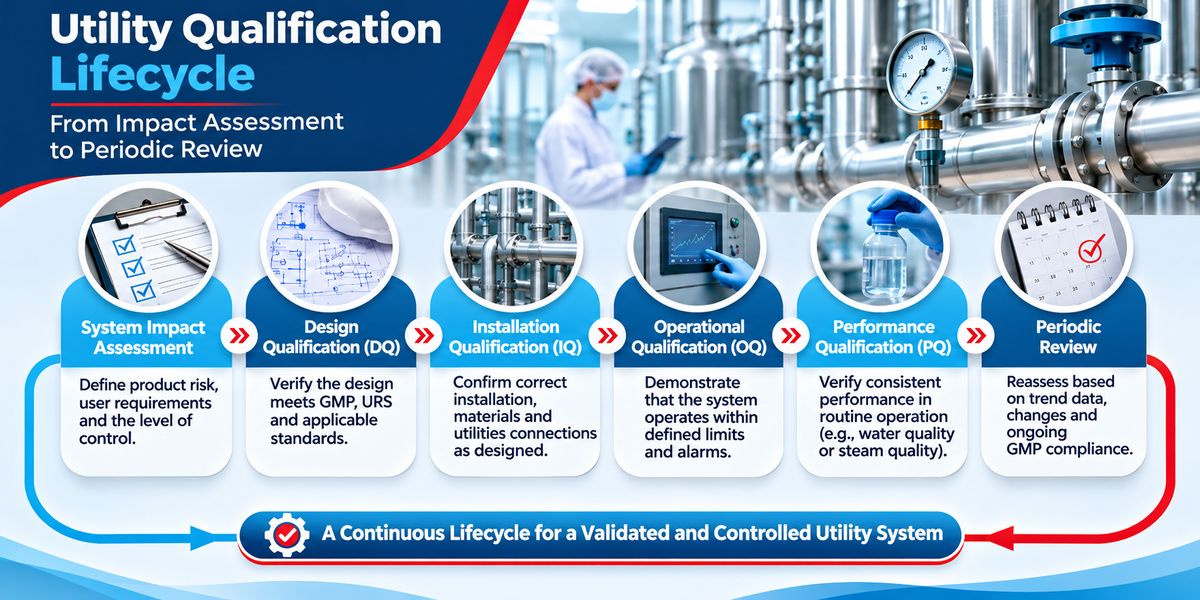
Utility qualification starts with a system impact assessment, which separates direct impact systems that need formal qualification from those covered by good engineering practice. The URS then defines what each system must deliver at the point of use, and DQ, IQ, and OQ confirm that it is designed, built, and operated to that standard. For water, however, PQ runs in three phases over at least twelve months, so the data captures seasonal variation. Afterwards, annual periodic reviews confirm that the system remains in a validated state.
The infographic below maps each stage of the utility qualification lifecycle, from impact assessment to periodic review, and shows how every stage builds the evidence inspectors expect to see.
Keeping Clean Utilities Inside the Contamination Control Strategy
Qualification proves that a utility can perform, but routine control shows that it still does. EU GMP Annex 1 names utilities as a core element of the contamination control strategy, and it expects manufacturers to trend the critical parameters of high-risk systems. Sites should set alert levels from qualification data and reassess them as new data accumulate. When a result crosses an alert level, the site investigates whether the event is isolated or the start of an adverse trend. An action limit excursion, by contrast, calls for a root cause investigation and an assessment of the impact on product. Change control closes the loop, since Annex 1 requires manufacturers to assess every change for its effect on the CCS before and after implementation. Together, these controls keep clean utilities in a state of control long after someone signs the qualification report.
Final Words
Recent enforcement data show that utility control remains a live inspection issue. In FY2024, 24 of the 111 inspection-based FDA warning letters issued to drug and biologics manufacturers cited insufficient control of water systems or water supply. Notably, the gaps behind these letters are familiar ones: dead legs, missing qualification evidence, and inadequate microbial monitoring. For this reason, manufacturers should manage pharmaceutical utilities as qualified, trended, and regularly reviewed systems rather than as fixed infrastructure. A system that passed qualification years ago offers little assurance today without current data to support it. Zamann Pharma Support works with manufacturers to assess and strengthen this lifecycle control across their critical utility systems.

Qualification and Validation for GMP Systems
Our team supports the planning, execution, and maintenance of qualification and validation activities, including IQ, OQ, and PQ, to keep GMP-regulated systems compliant and under control.
FAQ
Utilities need formal qualification when a system impact assessment classifies them as direct impact, meaning they contact the product, its materials, or product-contact surfaces. Typical examples include purified water, water for injection, clean steam, and product-contact gases. Indirect impact systems, such as chilled water, are commissioned under good engineering practice instead.
Performance qualification of a purified water or WFI system takes at least 12 months. WHO guidance describes three phases: at least two weeks of intensive testing with no production use, at least two further weeks under routine SOPs, and a final phase that completes a full year of data across seasonal variation.
Under EU GMP Annex 1, clean steam used for direct sterilization must produce condensates that meets the WFI monograph, although microbial testing of the condensate is not mandatory. Manufacturers must also periodically test non-condensable gases, dryness value, and superheat against validated parameters, using a sampling schedule that ensures representative results.
references

Marco Klinger is Head of Quality Services at Zamann Pharma Support, where he leads consulting teams through complex regulatory and quality-driven projects. He brings more than 15 years of hands-on compliance experience across regulated industries. His work includes close collaboration with companies such as Reckitt, Sanofi, Biotech, Biotest, and others. Marco has deep expertise in medical device development, aseptic manufacturing, and the design, implementation, and management of complete quality management systems within GMP-regulated environments.