
A membrane-based route can use roughly 93% less energy than multiple effect distillation to produce hot water for injection. That number explains why so many sites now question their old stills. Yet energy savings rarely decide an inspection. Since Ph. Eur. 0169 opened the door to cold WFI in 2017, both hot stills and cold membranes can deliver compendial water. As a result, the real question has shifted from which technology is allowed to which one a site can defend with data. In practice, inspectors look past the equipment and follow the microbial control strategy, the monitoring trends and the change control behind every WFI generation system. Ultimately, sound pharmaceutical engineering decides that outcome long before an auditor walks onto the site.
Table of Contents
Pharmacopoeial Ground Rules That Define a WFI Generation System
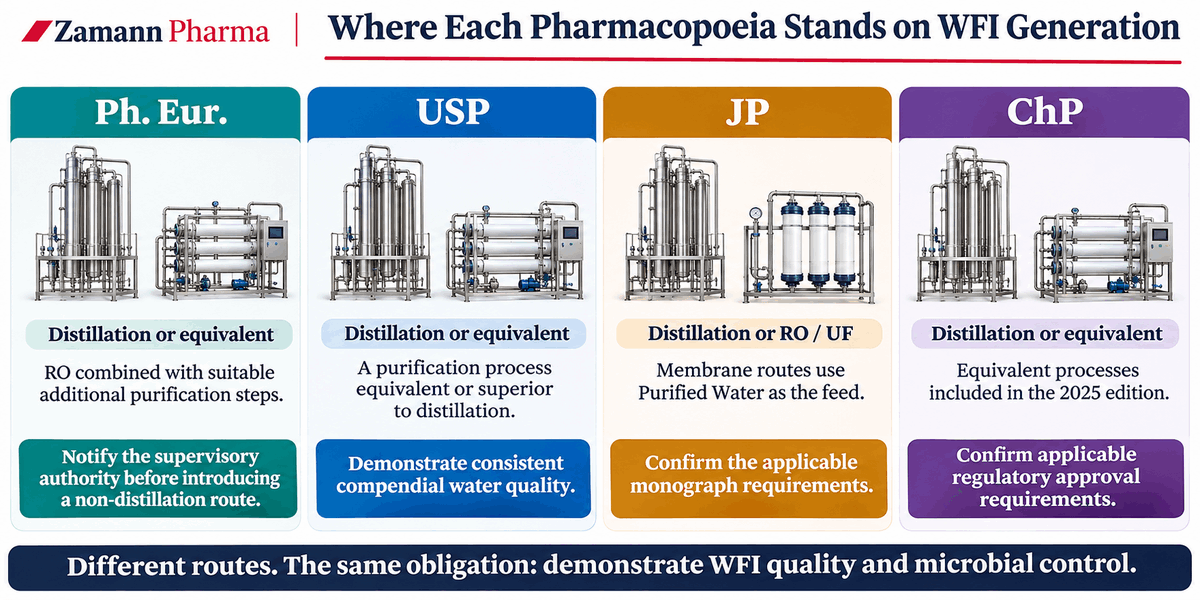
All three major pharmacopoeias now accept two routes to water for injection, but each one phrases the rules differently. Ph. Eur. 0169 allows distillation or a process equivalent to it, such as single-pass or double-pass reverse osmosis combined with electrodeionisation, ultrafiltration or nanofiltration. However, Europe adds a step that is easy to miss: the manufacturer must notify its supervisory authority before it introduces a non-distillation route. By contrast, USP has long accepted any purification process that is equal or superior to distillation. Similarly, JP permits reverse osmosis and ultrafiltration, but only when Purified Water feeds the system. Either way, the water must meet the same limits, including an endotoxin limit below 0.25 IU/mL. Meanwhile, the Chinese Pharmacopoeia 2025 has also accepted an equivalent process since 1 October 2025, subject to regulatory approval. As a result, the route itself rarely fails an inspection; missing proof of equivalence does.
The infographic below maps how Ph. Eur., USP, JP and the Chinese Pharmacopoeia now treat distillation and membrane routes, so you can check every target market before you commit to a technology.
Inspectors Read the Generator Through Its Microbial Control Strategy
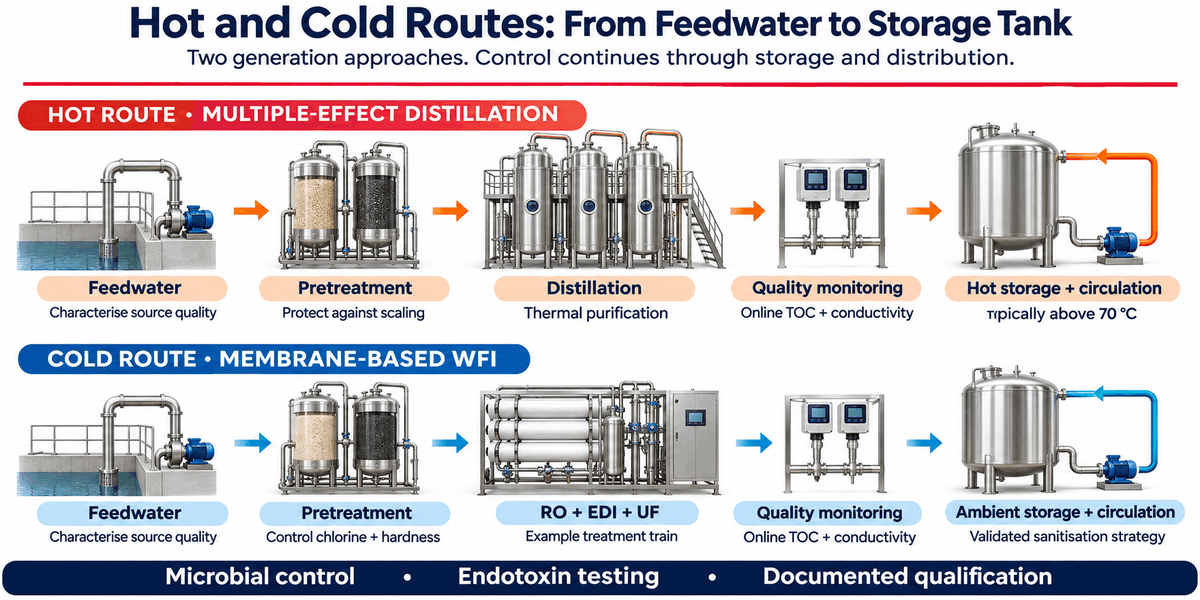
Inspectors rarely start with the still or the membrane skid; instead, they start with the microbial control strategy behind it. EU GMP Annex 1 sets the baseline, since it expects storage that limits microbial growth, such as circulation above 70 °C, and continuous monitoring of TOC and conductivity. For cold routes, however, the EMA Q&A raises the bar further. It warns that ambient reverse osmosis offers an ideal environment for biofilm, so inspectors expect membranes that withstand routine hot sanitisation. In addition, they look for defined maximum service lives for RO membranes and for online TOC and conductivity probes placed on a risk basis. During qualification, the site should even consider destructive analysis of used RO membranes. Hot systems, by contrast, start with a natural advantage, because FDA has long treated loops at 65 to 80 °C as self-sanitising. Even so, a hot still cannot hide weak endotoxin trending or a missing sanitisation record.
Hot Distillation Versus Cold Membranes Across the Lifecycle
Both routes deliver compendial water for injection, yet they place risk in very different parts of the lifecycle. Hot distillation concentrates that risk at the front end, in steam supply, cooling water and rouge on stainless surfaces. By contrast, cold membranes move the risk downstream, where biofilm control, sanitisation frequency and membrane life decide the outcome. The economics shift as well. For example, one independent engineering comparison found that vapor compression distillation used about 30% less energy each year than multiple effect distillation for hot WFI, while membrane equipment cost 44% less than an MED system. Therefore, the right choice depends less on the technology itself and more on which risks a site can monitor, document and defend over decades of operation.
The four checkpoints below follow that risk from the classic multiple effect still to the moment a site decides to retire it.
- Multiple Effect Stills and Their Hidden Utility Costs (Available PDF)
- Vapor Compression for High-Demand Sites (Available PDF)
- Membrane Trains Built Around Reverse Osmosis (Available PDF)
- Replacing a Still Without Losing Validated Status (Available PDF)
The infographic below traces both routes from feedwater to storage tank and marks where inspectors usually look first at each stage.
Multiple Effect Stills and Their Hidden Utility Costs (Available PDF)
Multiple effect stills deliver reliable hot WFI, but they demand steam, cooling water and rouge control.
Vapor Compression for High-Demand Sites (Available PDF)
Vapor compression needs little steam and no cooling water. Its main risk is compressor reliability.
Membrane Trains Built Around Reverse Osmosis (Available PDF)
Cold WFI uses RO, EDI and ultrafiltration. Inspectors focus on endotoxin removal and biofilm control.
Replacing a Still Without Losing Validated Status (Available PDF)
A switch needs change control and authority notice then follows a 12-month, three-phase qualification.
Evidence Each Generation Route Must Show an Inspector
Inspectors rarely ask which technology a site bought; instead, they ask what proves it works every day. Each route fails in its own way, so each one needs its own evidence. A multiple effect still rarely struggles with biofilm, yet scale and rouge can quietly build up inside it. By contrast, a membrane train runs at ambient temperature, which makes biofilm its constant threat. Therefore, a strong control strategy names the main risk of each route and links it to records an auditor can check in minutes. Ultimately, those records protect the validated status of the whole system.
The table below maps each generation route to its main risk, the checks inspectors focus on and the records that close the gap.
| Generation route | Main risk | What the inspector checks | Records that close the gap |
|---|---|---|---|
|
Multiple effect distillation |
Scaling and rouge on hot stainless surfaces, plus chlorine damage from weak pretreatment |
Feedwater quality, TOC and conductivity trends, endotoxin results |
Feedwater analyses, derouging and passivation records, TOC and endotoxin trend reports |
|
Vapor compression distillation |
Compressor wear and scaling from hardness or silica |
Softener performance, compressor maintenance, conductivity trends |
Hardness checks before regeneration, vibration and maintenance logs, conductivity trend data |
|
Membrane-based WFI (RO, EDI, UF) |
Biofilm at ambient temperature and membrane integrity breaches |
Sanitisation frequency, online TOC and conductivity, pre and post RO sampling, membrane service life |
Sanitisation records, permeate conductivity and differential pressure trends, membrane replacement log, destructive membrane analysis |
|
Changeover from still to membrane |
Loss of validated status during the switch |
Change control impact assessment, authority notice under Ph. Eur. 0169, seasonal qualification data |
Approved change control, notification record, three-phase PQ report covering at least 12 months |
Site Factors That Determine WFI Technology Choice
The best WFI technology depends on how a facility operates. Compare each option against actual production needs, available utilities and maintenance resources.
- Demand: Size generation and storage together to meet peak demand without excessive cycling.
- Feedwater: Track seasonal quality changes to define pretreatment and protect system performance.
- Utilities: Compare energy and utility costs across production, standby and sanitisation.
- Space: Allow room for pretreatment, maintenance access and future capacity expansion.
- Storage: Coordinate generation and storage temperatures with microbial control and sanitisation needs.
- Markets: Verify pharmacopoeial requirements, regulatory approvals and notifications for each target market.
- Expertise: Assess staff skills, maintenance resources and spare-part availability before selecting the system.
Final Words
Inspection data keep pointing to the same weak spot. In FDA’s fiscal year 2025 observations, cleaning, sanitising and maintenance failures under 21 CFR 211.67(a) appeared 95 times, which made them the fifth most cited drug GMP finding. These citations cover all equipment, yet they describe exactly the evidence a water system depends on sanitisation records, membrane replacements and maintenance logs. In other words, inspectors rarely fault the still or the membrane itself. Instead, they fault the gap between what a site does and what it can prove. Therefore, whichever route you choose, build the records first, and your WFI generation system will speak for itself when an auditor asks.

Qualification and Validation for GMP Systems
Our team supports the planning, execution, and maintenance of qualification and validation activities, including IQ, OQ, and PQ, to keep GMP-regulated systems compliant and under control.
FAQ
Yes. Ph. Eur. 0169 requires notice to the supervisory authority before a non-distillation route goes live. For EU sites, that is the national GMP inspectorate. For non-EU sites exporting to the EU, it is usually the authority in the EU importer’s Member State.
Combine routine hot water sanitisation with periodic chemical sanitisation, and use membranes rated for heat. In addition, place online TOC and conductivity probes on a risk basis, sample before and after the RO, and set a maximum service life for every membrane. Inspectors expect all of this to appear in a documented control strategy.
Plan for a three-phase qualification that covers at least 12 months, so the data capture seasonal changes in feedwater. Phase 1 runs for at least two weeks with no product use. After that, water can be used under QA approval while monitoring continues through the full year.
References

Marco Klinger is Head of Quality Services at Zamann Pharma Support, where he leads consulting teams through complex regulatory and quality-driven projects. He brings more than 15 years of hands-on compliance experience across regulated industries. His work includes close collaboration with companies such as Reckitt, Sanofi, Biotech, Biotest, and others. Marco has deep expertise in medical device development, aseptic manufacturing, and the design, implementation, and management of complete quality management systems within GMP-regulated environments.