
At one FDA-cited manufacturer, water-system data collection ended approximately 21 months before QA approved the PQ report. Yet approval did not resolve the underlying problem: the qualification omitted essential water-quality tests. For pharmaceutical engineering teams, this case raises a practical question: what evidence justifies releasing a utility for GMP use? Utility qualification in pharma starts with defined requirements and carries through commissioning, IQ, OQ and PQ. Therefore, teams must assess which commissioning results support qualification, investigate deviations and demonstrate consistent performance under intended operating conditions before approving the handover.
Table of Contents
Utility Qualification in Pharma as Regulators Define It
Utility qualification in pharma provides documented evidence that a utility is suitable for its intended GMP use. EU GMP Annex 15, Section 8, requires manufacturers to confirm the quality of water, steam, air and other gases after installation. Importantly, the qualification period and scope should reflect intended use and relevant seasonal changes. It also calls for a risk assessment where utilities may contact products directly or indirectly. Although teams often use “utility validation” for overlapping activities, Annex 15 names this work “qualification of utilities.” The practical test remains whether the evidence supports the utility’s actual manufacturing use.
Inspectors Read Utility Qualification as Evidence of Control
Inspectors assess the qualification of utilities by tracing how identified risks lead to tests, results and an authorised release. Records to have ready include the impact assessment, user requirements specification (URS), approved protocol, executed test data and qualification report. Together, these should show why the tests were selected, whether results met acceptance criteria, and who approved the conclusions. However, a signed report cannot compensate for missing data or unexplained failures. Any outstanding deviations must have a documented assessment supporting the release decision, with clear responsibility for follow-up.
Commissioning and Qualification as One Evidence Chain
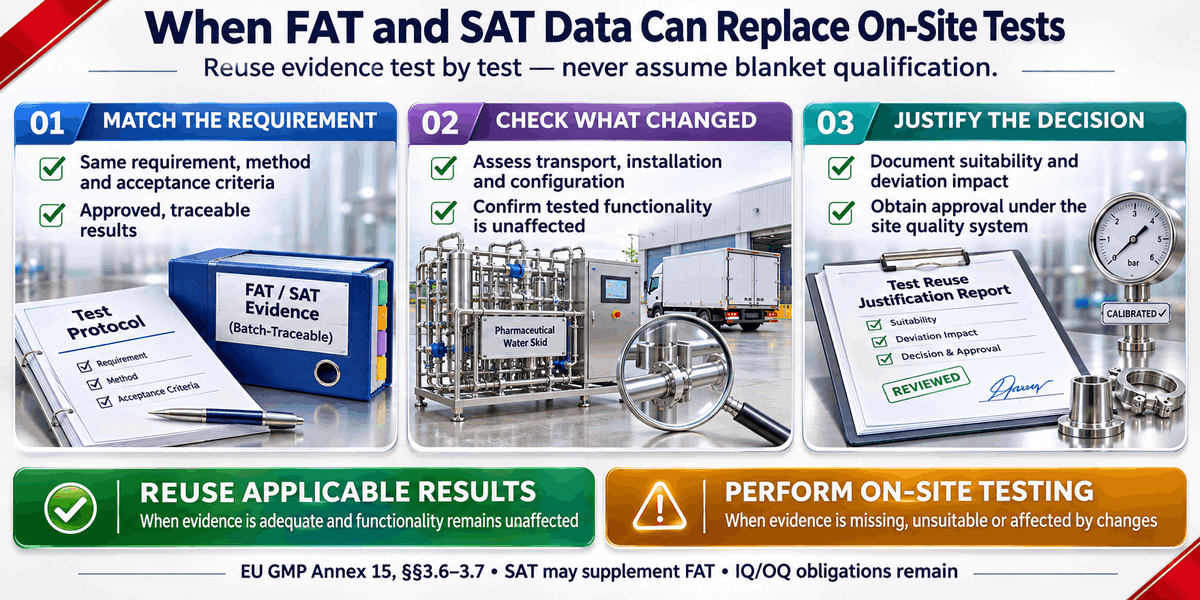
Commissioning and qualification connect engineering checks with documented evidence of suitability for GMP use. The handover should preserve that connection through traceable requirements, test results and clear approval responsibilities. Where justified, teams can reuse FAT and SAT data if transport and installation have not affected the tested functionality. However, each result must meet the relevant acceptance criteria and remain traceable to its source. This approach avoids unnecessary repeat testing while keeping the release decision grounded in evidence.
Four practical controls determine whether the handover evidence can support qualification and formal GMP release.
- Impact-Based Scoping at the Engineering Handover (Available PDF)
- A Utility Qualification Protocol Approved Before Execution (Available PDF)
- FAT and SAT Data Under Good Engineering Practice (Available PDF)
- Deviations, Punch-List Items, and Formal GMP Release (Available PDF)
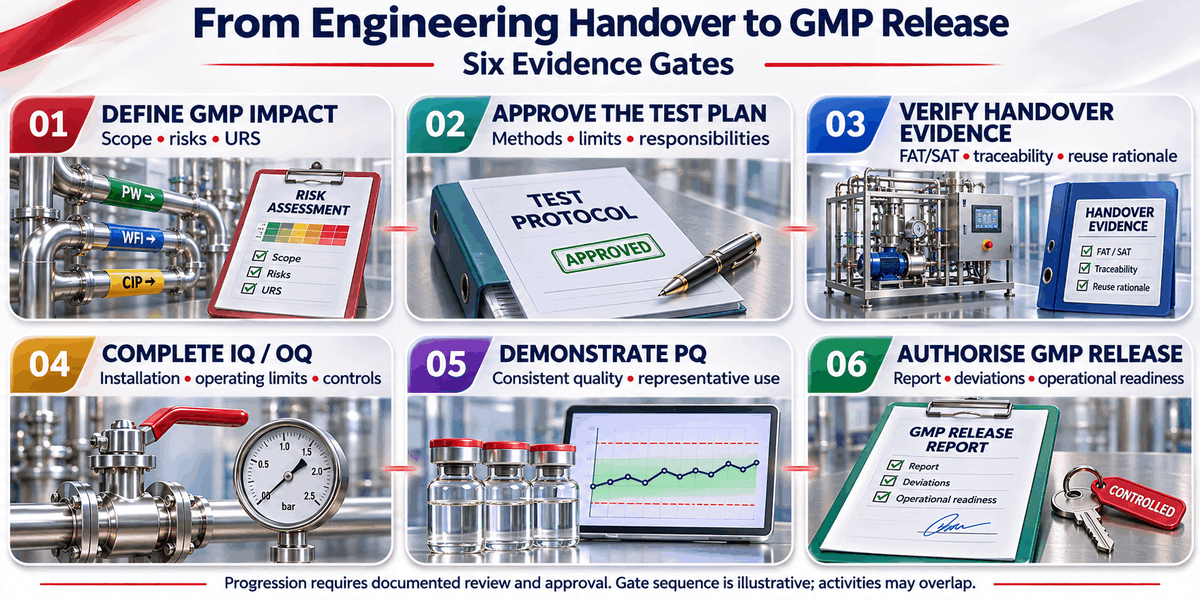
This infographic maps six evidence gates from engineering handover to GMP release, showing how each supports a documented utility release decision.
Impact-Based Scoping at the Engineering Handover (Available PDF)
At engineering handover, confirm how each utility could affect product quality and patient safety. Use that assessment to define qualification boundaries, critical functions and the evidence still required.
A Utility Qualification Protocol Approved Before Execution (Available PDF)
Approve the utility qualification protocol before testing, with defined responsibilities, methods and acceptance criteria. This establishes how teams will evaluate results and manage deviations before they collect the evidence.
Download Good manufacturing practices: guidelines on validation Here
FAT and SAT Data Under Good Engineering Practice (Available PDF)
Record FAT and SAT methods, results and conclusions so the evidence remains traceable during qualification. Reuse applicable tests only with documented justification that transport and installation have not affected the verified functionality.
Download Annex 15: Qualification and Validation Here
This infographic shows when FAT and SAT results can support qualification without repeat on-site testing, helping teams avoid duplication while maintaining justified GMP evidence.
Deviations, Punch-List Items, and Formal GMP Release (Available PDF)
Assess open punch-list items for GMP impact and investigate qualification results that fail acceptance criteria. Document their disposition and obtain authorised release; conditional progression requires evidence that outstanding issues will not significantly affect the next activity.
IQ OQ PQ for Utilities Traced From URS to Release
IQ OQ PQ for utilities should answer three practical questions: was the system installed correctly, does it operate within defined limits, and does it perform consistently in use? Each answer must trace back to the user requirements specification (URS) and approved acceptance criteria. However, passing individual tests does not automatically justify release. Teams must also assess deviations and confirm that operating procedures, training and maintenance arrangements are ready.
The table follows this evidence trail from requirements to release, showing what each stage proves and the typical approval roles.
| Stage | Evidence | Inspection Check | Approver |
|---|---|---|---|
|
URS, risk assessment and DQ |
Approved requirements, risk assessment and design review |
Does the design address intended use and GMP risks? |
System owner, engineering and Quality |
|
IQ |
Installation records, drawings and calibration certificates |
Does installation match approved specifications? |
Designated qualification approvers and Quality |
|
OQ |
Operating-range, control and alarm test results |
Does the utility operate within justified limits? |
Designated qualification approvers and Quality |
|
PQ and release |
Performance data, approved report and deviation assessments |
Does consistent performance justify release for intended use? |
Authorised site personnel, including Quality |
Common Handover Gaps That Turn Into Inspection Findings
Utility qualification handovers leave gaps when teams transfer records without checking what they prove. A completed test may lack a justified scope, while a signed report may overlook failed results. Consequently, inspectors may question whether the utility is suitable for its intended GMP use. Before release, teams should check for these gaps:
- Unjustified FAT reuse: No assessment of transport or installation effects leaves site qualification insufficiently supported.
- Unevaluated PQ data: Collected results without timely review leave consistent utility performance unproven.
- Missing quality tests: Omitting relevant chemical or microbial attributes leaves intended-use suitability inadequately assessed.
- Unresolved failures: Closing deviations without investigation or product-impact assessment leaves contamination risks unexplained.
- Unsupported release: Outstanding items without documented impact assessments leave the decision to proceed inadequately justified.
These gaps can support findings of inadequate qualification, investigation or release controls; the finding depends on the evidence and applicable requirements.
Final Words
Recent FDA warning letters highlight a recurring concern: manufacturers collect utility data but fail to act on it. In July 2026, FDA cited one manufacturer for inadequately investigating 51 out-of-limit or out-of-specification water-testing results. For utility qualification in pharma, the lesson extends beyond the handover: reviewed data, effective investigations and ongoing monitoring must sustain the release decision. Otherwise, a completed qualification package offers little assurance that the utility remains under control.

Qualification and Validation for GMP Systems
Our team supports the planning, execution, and maintenance of qualification and validation activities, including IQ, OQ, and PQ, to keep GMP-regulated systems compliant and under control.
FAQ
Yes, where documented justification shows that the results meet qualification requirements and transport or installation has not affected the tested functionality. FAT and SAT do not automatically replace the entire IQ or OQ programme.
Yes, conditional progression is possible when an approved, documented assessment shows that outstanding items have no significant impact on PQ. Record the justification, required actions and responsibilities before authorising progression.
There is no single duration for every system. The qualification period must demonstrate consistent water quality for the intended use and account for relevant seasonal variations. Define and justify the sampling locations, frequency and duration in an approved protocol.
References
- EU GMP Annex 15: Qualification and Validation
- PIC/S PI 006-4: Recommendations on Qualification and Validation
- WHO: Good Manufacturing Practices—Guidelines on Validation
- Health Canada: Guide to Validation—Drugs and Supporting Activities
- WHO: Good Manufacturing Practices—Water for Pharmaceutical Use
- FDA Warning Letter: Colgate-Palmolive/Tom’s of Maine
- FDA Warning Letter: Spa De Soleil

Marco Klinger is Head of Quality Services at Zamann Pharma Support, where he leads consulting teams through complex regulatory and quality-driven projects. He brings more than 15 years of hands-on compliance experience across regulated industries. His work includes close collaboration with companies such as Reckitt, Sanofi, Biotech, Biotest, and others. Marco has deep expertise in medical device development, aseptic manufacturing, and the design, implementation, and management of complete quality management systems within GMP-regulated environments.