
In June 2026, the FDA classified a recall of nearly 36,000 boxes of an over-the-counter softgel as Class I, its highest risk level. The cause was neither a faulty ingredient nor a labeling mix-up. Instead, a diluted propylene glycol coolant leaked from a packaging machine and reached the product. Inspectors recognize this pattern well, because contamination often enters through systems that never touch the product by design. Clean utilities in pharma carry the same exposure, since plant steam, chilled water and potable feed water reach them through a heat exchanger tube, a gasket or a feed line. Consequently, sound pharmaceutical engineering at each of these interfaces matters as much as the monitoring data a quality unit review. This article therefore traces every point where black utility risk enters a clean system and explains the controls inspectors expect to find there.
Table of Contents
Clean Utilities in Pharma Rely on Black Utilities Behind the Wall
GMP practice sorts of pharmaceutical utilities by one simple question: does the medium touch the product? Purified water, water for injection, clean steam and process gases do, either directly or through product-contact surfaces, so manufacturers qualify them as clean utilities. Plant steam, chilled water and potable water do not, and therefore most impact assessments classify them as indirect impact systems. However, the split between clean and black utilities describes intended contact, not physical separation. Plant steam heats the clean steam generator, chilled water cools the WFI loop at point-of-use heat exchangers, and potable water supplies the pretreatment of every purified water system. Consequently, black utilities in pharma sit only one tube wall or valve seat away from the product, and their failures travel much further than their classification suggests.
Inspectors Trace Contamination Beyond the Clean Utility Boundary
An inspector rarely stops at the sampling valve. Instead, a failing endotoxin result or an unexplained microbial trend sends the investigation upstream, through the distribution loop, and into the systems that heat, cool, and feed it. At that stage, the inspector asks for current drawings and walks the plant room to compare them with the installed equipment. Attention falls on every point where plant steam, chilled water, or feed water sits next to a clean medium. Where a site has not installed a double tubesheet heat exchanger, it must show that the clean side always holds the higher pressure and that a gauge or sensor monitors that difference. Otherwise, the inspector treats the interface as an open cross-contamination path, even when routine results stay within limits. In other words, the burden of proof shifts to the site, and missing evidence becomes a finding on its own.
4 Points Where Black Utility Risk Enters Clean Systems
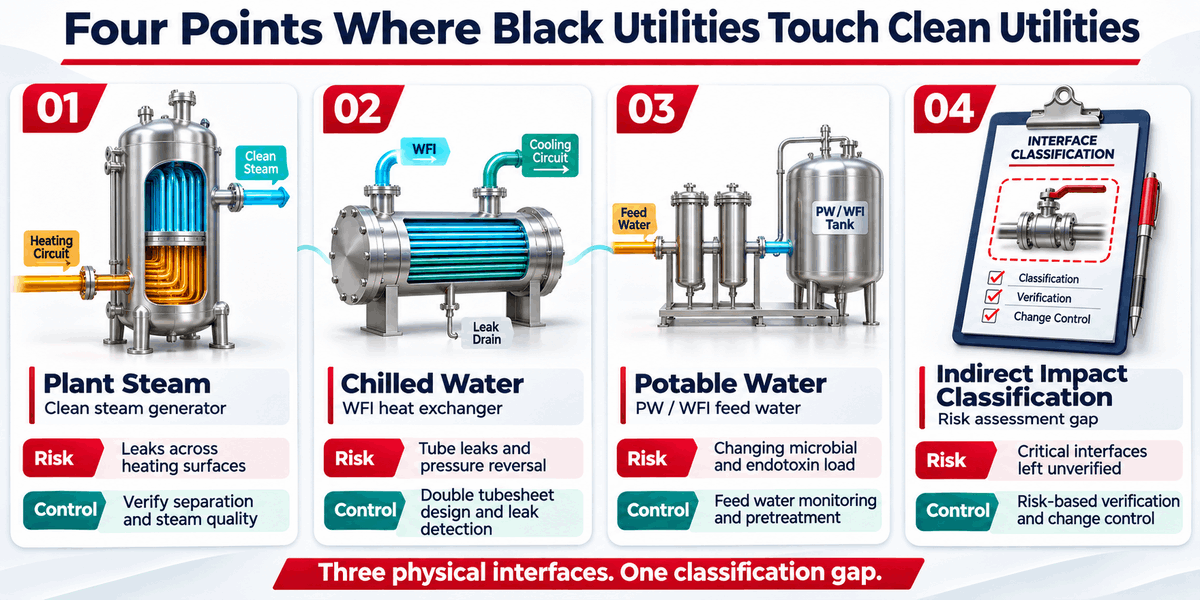
Black utility risk does not spread evenly across a facility. Instead, it concentrates at a small number of interfaces where a non-GMP medium meets a qualified clean system. Each interface fails in its own way, whether through a leaking clean steam generator, a cracked tube-to-tubesheet joint in a WFI cooler, or shifting feed water quality. Moreover, the fourth point sits on paper rather than in pipework, since an indirect impact classification can leave a real interface without the verification it needs. Mapping these four points therefore gives QA and engineering teams a shared starting point for inspection readiness.
The sections below follow black utility risk from the plant room to the product, starting with the steam that drives clean steam generation.
- Plant Steam Behind the Clean Steam Generator (Available PDF)
- Chilled Water on the Far Side of the Heat Exchanger (Available PDF)
- Potable Water at the Start of the Water for Injection System (Available PDF)
- Indirect Impact Systems with Direct Product Consequences (Available PDF)
The infographic below maps where plant steam, chilled water, potable water and an indirect impact classification meet the clean side, so teams can see at a glance which interfaces need the strongest controls.
Plant Steam Behind the Clean Steam Generator (Available PDF)
Plant steam heats the clean steam generator, so its boiler chemistry and pressure sit only one exchanger wall away from the steam that sterilizes product-contact surfaces. This section explains how an internal leak or poor feedwater shows up in condensate, non-condensable gas, dryness and superheat results.
Download EudraLex Volume 4, Annex 1: Manufacture of Sterile Medicinal Products Here
Chilled Water on the Far Side of the Heat Exchanger (Available PDF)
Chilled water cools WFI at points of use, and a single failed tube joint can draw it into the loop when pressures reverse. This section covers double tubesheet design, pressure differential monitoring and the leak checks inspectors ask to see.
Potable Water at the Start of the Water for Injection System (Available PDF)
Every water for injection system starts with mains water, a black utility whose quality shifts with season and supply. This section shows how feed water quality sets the bioburden and endotoxin load that pretreatment and distillation must then remove.
Indirect Impact Systems with Direct Product Consequences (Available PDF)
Impact assessments often classify black utilities as indirect impact systems and commission them under good engineering practice. This section explains why their interface components still need risk-based verification, and how Annex 15 frames that decision.
Download EudraLex Volume 4, Annex 15: Qualification and Validation Here
Interface Failure Modes and the Controls That Prevent Them
Each black-to-clean interface fails in a different way, yet inspectors judge all four by the same test: can the site prove that the barrier still holds? Plant steam, for example, carries boiler additives that must never reach the steam used for sterilization. Chilled water, meanwhile, waits on the other side of a tube wall that can crack without warning. Potable water shifts with the season, while an indirect impact label can quietly remove an interface from the qualification scope. For this reason, the strongest sites pair every interface with one engineered control and one piece of routine evidence, so a single record answers the inspector’s question.
The table below shows, for each interface, the clean system at risk, the typical failure mode, the control that prevents it, and the evidence inspectors expect to review.
| Black Utility | Clean System at Risk | Typical Failure Mode | Engineered Control | Inspection Evidence |
|---|---|---|---|---|
|
Plant steam |
Clean steam generator and the steam that sterilizes product-contact surfaces |
An internal leak lets boiler steam, treated with additives such as amines or hydrazines, reach the clean side; poor feedwater carries endotoxin into the steam |
Additive-free clean steam made from appropriately purified feedwater; positive pressure on the clean side or a double tubesheet design |
Condensate tested against the WFI monograph, plus periodic dryness, non-condensable gas and superheat tests (EN 285: dryness at least 0.95, gases no more than 3.5 mL per 100 mL of condensate, superheat below 25 °C) |
|
Chilled water |
WFI loop at point-of-use coolers |
A failed tube-to-tubesheet joint or pinhole draws chilled water into WFI when pressures reverse |
Double tubesheet or double-concentric-tube heat exchanger; otherwise a monitored pressure differential that keeps the higher pressure on the WFI side |
Visible leak-detection ports and inspection records, pressure differential trends and alarm logs, exchanger shown on current drawings |
|
Potable water |
Purified water and WFI generation |
Seasonal or supply changes raise bioburden and endotoxin beyond the pretreatment design; tanker-delivered water picks up contamination in transport |
Feed water specified to drinking water standards, pretreatment sized for worst-case feed, controls on bulk water delivery |
Routine feed water results against drinking water limits, seasonal trend data, a full year of qualification data |
|
Any utility classified as indirect impact |
Every clean system it heats, cools or feeds |
The impact assessment classifies the whole system as indirect and leaves its interface components unverified |
A documented risk assessment of direct and indirect product contact, with system boundaries and interface components named; change control covering black utility modifications |
The impact assessment record, verification records for interface components, change control history |
Design Choices That Keep Black Utilities on Their Side
Good design keeps black utilities on their side of the wall long before monitoring has to catch a failure. In practice, the controls inspectors respect most are simple, visible and documented, so a reviewer can verify them in minutes rather than days. Moreover, each one closes a specific path described in the table above. The following design choices therefore form the backbone of a defensible interface strategy:
- Hygienic design: Specify ASME BPE fittings, slopes and surface finishes at every interface, so clean-side piping drains fully and leaves no dead legs where contamination can settle.
- Pressure differential monitoring: Keep the clean side at the higher pressure and log the difference continuously, since a reversed gradient turns a pinhole into an entry point.
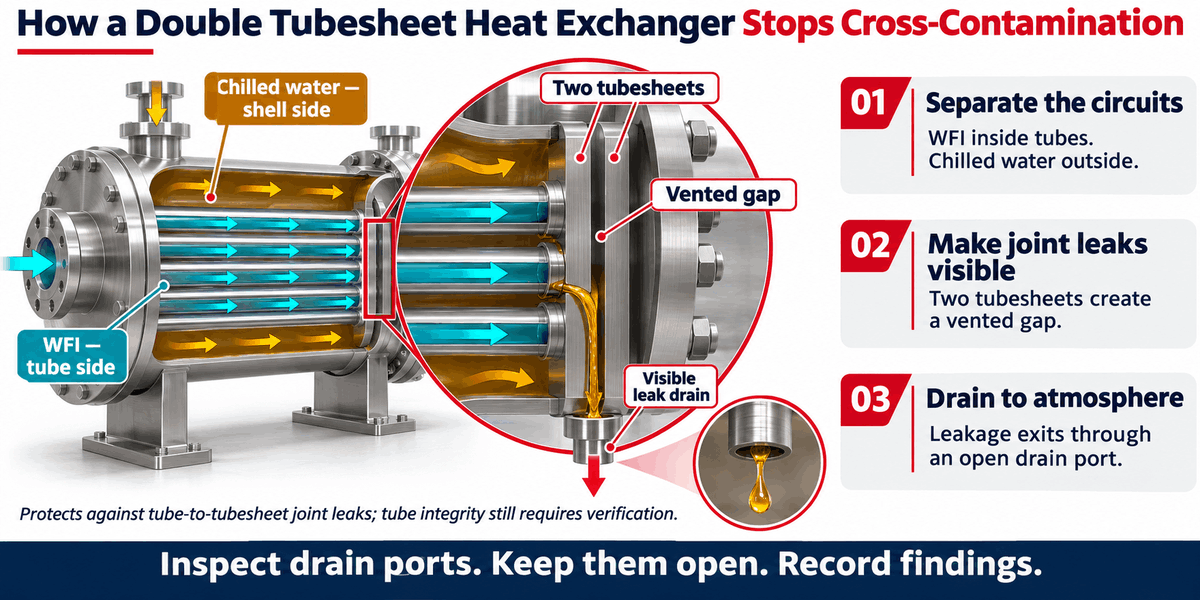
- Leak detection at heat exchangers: Choose a double tubesheet heat exchanger where possible, then inspect its drain ports on a fixed schedule and record every finding.
- Change control on black utilities: Route boiler additive changes, chiller replacements and feed water rerouting through change control, because each one can alter the risk on the clean side.
- Alarm trending: Review pressure, temperature and leak alarms as trends rather than single events, so a slow drift shows up before it becomes a deviation.
The infographic below shows how a double tubesheet heat exchanger separates the WFI side from the chilled water side with a vented gap, so any leak drains visibly to atmosphere instead of crossing into the product stream.
Final Words
Enforcement pressure has risen sharply. In fiscal year 2025, the director of CDER’s Office of Compliance reported a 50% jump in drug warning letters, while inspection-based letters rose for the third consecutive year. As scrutiny grows, gaps that once passed quietly are more likely to surface, and an undocumented black utility interface is exactly that kind of gap. Clean utilities in pharma, therefore, are only as reliable as the plant steam, chilled water and feed water behind them. For this reason, the most useful step before the next inspection is to walk every interface, confirm that each indirect impact system has a verified boundary, and check that the evidence against cross-contamination is current rather than inherited from the original qualification. Zamann Pharma Support helps manufacturers map and close these interface gaps across their critical utility systems.

Qualification and Validation for GMP Systems
Our team supports the planning, execution, and maintenance of qualification and validation activities, including IQ, OQ, and PQ, to keep GMP-regulated systems compliant and under control.
FAQ
No, not as a design requirement. FDA expects pressure differential monitoring only on heat exchangers that are not of the double tubesheet or welded double-concentric-tube type. A double tubesheet design instead makes any leak visible through the gap and drain ports between the two tubesheets, so sites must inspect and record those ports on a fixed schedule.
Usually not in full. Most impact assessments classify black utilities as indirect impact systems and commission them under good engineering practice. However, EU GMP Annex 15 expects a risk assessment of each utility’s direct or indirect product contact, so the components where a black utility meets a clean system still need documented verification.
Plant steam can contaminate clean steam through an internal leak in the clean steam generator, which lets boiler steam treated with amines or hydrazines reach the clean side. Poor feedwater can also carry endotoxin into the steam. EU GMP Annex 1 therefore requires purified feedwater, condensate that meets the WFI monograph, and periodic dryness, non-condensable gas and superheat tests.
references

Marco Klinger is Head of Quality Services at Zamann Pharma Support, where he leads consulting teams through complex regulatory and quality-driven projects. He brings more than 15 years of hands-on compliance experience across regulated industries. His work includes close collaboration with companies such as Reckitt, Sanofi, Biotech, Biotest, and others. Marco has deep expertise in medical device development, aseptic manufacturing, and the design, implementation, and management of complete quality management systems within GMP-regulated environments.