
A HEPA filter can leave the factory rated to trap 99.97% of particles at 0.3 µm and still fail inside your cleanroom. In fact, FDA treats a single probe reading of just 0.01% of the upstream challenge as a significant leak. That tiny number decides whether a Grade A zone stays protected or becomes an inspection finding. Moreover, the risk rarely sits in the filter media alone. Instead, leaks hide in crushed gaskets, bent frames and rushed installations, which is exactly where pharmaceutical engineering meets GMP compliance. For that reason, inspectors look well past the pass stamp on every HEPA filter integrity test report. So below, we break down how the test works, what counts as a pass, and how to defend your results.
Inhaltsverzeichnis
Where the Factory Rating Ends and the HEPA Filter Integrity Test Begins?
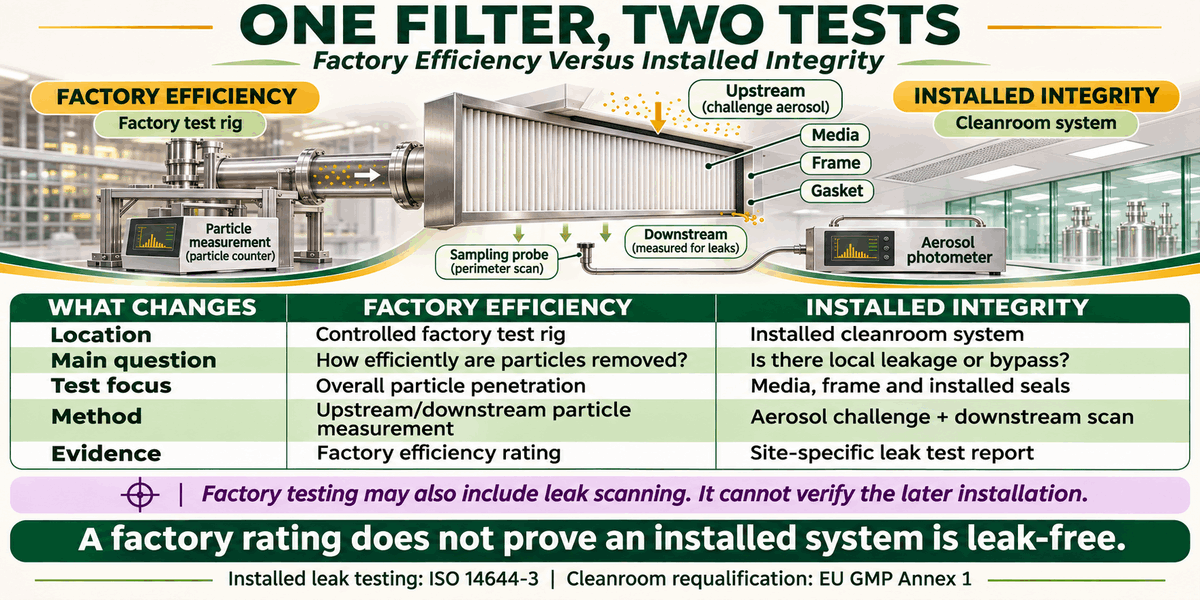
The 99.97% figure on a HEPA filter label comes from the factory, where technicians test the media under tightly controlled conditions. In that efficiency test, the result reflects an average across the whole filter surface, so it was never designed to find a single pinhole. Once the filter ships, however, the real risks begin. Transport can crack the media, and a hurried installation can crush a gasket or leave a gap at the frame. This is exactly the gap the HEPA filter integrity test closes. Following ISO 14644-3, the tester releases an aerosol upstream and then scans the downstream face, frame, and seal in place. In short, the factory rating tells you what the filter can do, while the installed test proves what it does above your process.
The infographic below sets the factory efficiency test beside the installed leak test, showing what each one checks and why only the second protects your Grade A zone.
How Inspectors Read a HEPA Leak Test Report
An inspector rarely stops at the word “pass” on a HEPA filter leak test report. Instead, they work backwards through the evidence. First, they check whether an approved protocol defined the scan method, the aerosol and the acceptance limit before testing began. Next, they compare the recorded upstream challenge concentration with what the photometer needed to detect a 0.01% leak. Then they ask for the calibration certificate of every instrument used on the job. Under EU GMP Annex 1, this record also feeds cleanroom requalification, so a gap here can quickly grow into a wider finding. And if a contractor ran the test, the questions stay the same. FDA states plainly that the manufacturer, not the service company, owns the specifications, test methods and acceptance criteria. In other words, outsourcing the test never outsources the accountability.
4 Decisions That Make or Break a Leak Scan
From the cleanroom floor, a leak scan looks simply: one technician, one probe, one filter face. The result depends on choices the team makes long before the probe moves. Some of these choices protect the data, while others quietly weaken it. For example, the wrong aerosol or a rushed scan can hide a leak that a careful test would catch. That is why experienced validation teams treat every scan as a chain of four connected decisions, not as a single measurement.
The sections below follow those decisions in the order they happen, starting with the aerosol you release upstream, moving through the detector and the pass line, and ending with what you do when a filter fails.
- Choosing the Challenge Aerosol, From Legacy DOP to PAO and DEHS (Available PDF)
- Photometer Scan or Particle Counter Method (Available PDF)
- Reading the 0.01% Line Without Rounding Down (Available PDF)
- Repairs, Retests and the Requalification Trail (Available PDF)
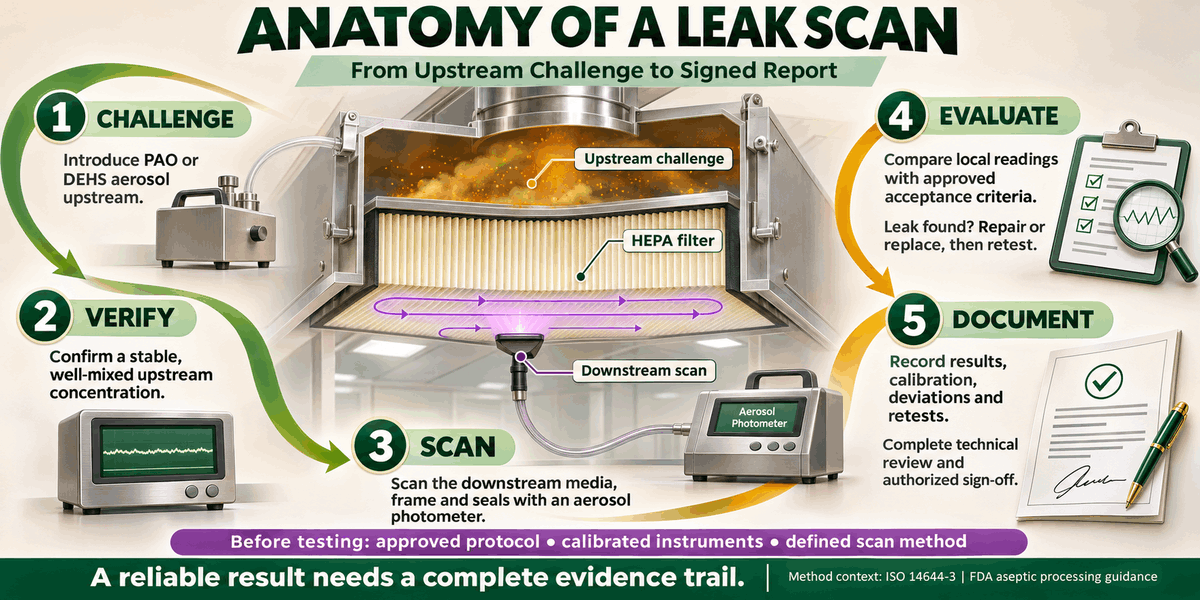
The infographic below follows a single leak scan step by step, from the upstream aerosol challenge to the signed report, so you can see where the evidence most often breaks down.
Choosing the Challenge Aerosol, From Legacy DOP to PAO and DEHS (Available PDF)
Explain why technicians still say “DOP test” even though PAO and DEHS now do the work. Show that the choice of aerosol matters less than a stable, verified upstream challenge.
Download Facts and Fiction in Cleanroom Metrology (2010) here
Photometer Scan or Particle Counter Method (Available PDF)
Compare the aerosol photometer, favored in the US, with the discrete particle counter, more common in Europe. Cover probe size, scan rate and the particle counter’s two-stage approach of scanning first and confirming second.
Reading the 0.01% Line Without Rounding Down (Available PDF)
Define the 0.01% acceptance limit and show why one local reading at that level fails the filter. Note when the filter class justifies a different threshold, such as 0.1% for H13 filters.
Repairs, Retests and the Requalification Trail (Available PDF)
Walk through what follows a failed scan, from a limited repair to a confirmatory retest. Link this to Annex 1, which requires requalification after remedial action or a change of final filters.
Matching Test Frequency to Each Cleanroom Grade
A filter that passed in spring can fail by autumn, so HEPA filter testing frequency should follow risk, not habit. Under EU GMP Annex 1, Grade A and B areas need requalification, including a filter integrity test, at least every six months. Grade C and D areas, by contrast, allow up to twelve months. FDA points the same way and gives the aseptic processing room as its example of twice-yearly leak testing. However, the calendar only sets the floor. Annex 1 treats its stated frequencies as minimum requirements, so a risk assessment can shorten an interval but never stretch it. In addition, certain events reset the clock entirely, from a final filter change to a renovation that disturbs the ceiling.
The table below shows the maximum leak test interval for each grade and the events that trigger an extra test, so you can build a schedule that holds up during inspection.
| Area or Situation | Maximum Interval or Timing | Key Point |
|---|---|---|
|
Grade A and B areas |
Every 6 months at most |
Protects open product and the background that supports it |
|
Grade C and D areas |
Every 12 months at most |
Covers less critical steps such as solution preparation and equipment cleaning |
|
Final filter change or HVAC change |
Before the area returns to use |
Requalification follows any change that affects the installation |
|
Renovation, poor air quality, or media fill or sterility failure |
During the investigation |
Extra leak testing confirms the filters are not the root cause |
Five Mistakes That Turn a Passed Test Into a Finding
A failed scan is at least honest. The real trouble starts when a test passes on paper but cannot survive a few pointed questions. In that case, the green tick becomes a liability, because an inspector judges how the team reached the result, not just the result itself. Fortunately, the weak spots tend to repeat, so a sharp reviewer can catch them before the auditor does.
- Unverified upstream challenge. The team starts scanning without confirming the aerosol concentration, so even a real leak may never register.
- Scanning too fast. A probe that rushes across the filter face can sweep past a pinhole before the detector responds.
- Skipped frames and gaskets. The report covers the media but not the seal, which is where installation damage often shows up.
- Lapsed calibration. The aerosol photometer or particle counter runs past its calibration date, and every reading it produced loses its value.
- Unreviewed contractor reports. QA files the certificate without checking the method, limits and raw data, even though the manufacturer still owns the result.
Final Words
Inspection pressure on sterile sites shows no sign of easing. FDA’s own data show that between January 2023 and mid-2026, investigators cited missing or weak procedures for preventing microbial contamination of sterile products at 161 drug inspections, making it the most-cited category in their environmental control findings. Meanwhile, EU GMP Annex 1 now expects every control, filter integrity included, to sit inside a documented contamination control strategy. As a result, a HEPA filter integrity test can no longer stand alone as a routine certificate filed and forgotten. Instead, it should serve as living evidence that your cleanroom still performs as qualified, every time an inspector asks to see it.

Qualification and Validation for GMP Systems
Our team supports the planning, execution, and maintenance of qualification and validation activities, including IQ, OQ, and PQ, to keep GMP-regulated systems compliant and under control.
FAQ
No. The factory efficiency test checks the filter media and averages the result over the whole surface, so it cannot find local leaks. An in-situ leak test under ISO 14644-3 scans the installed media, frame and gasket. EU GMP Annex 1 lists installed filter leakage testing as part of cleanroom qualification.
At least every six months. EU GMP Annex 1 sets six months as the maximum requalification interval for Grade A and B areas and twelve months for Grade C and D. These are minimum requirements, and a final filter change, an HVAC change or remedial action triggers an extra test before the area returns to use.
The filter fails. FDA treats a single probe reading at 0.01% of the upstream challenge as a significant leak, which calls for filter replacement or a limited repair. The repaired area then needs a confirmatory retest, and Annex 1 expects requalification after the remedial action, documented through a deviation and a product impact assessment.
references
- EU GMP Annex 1: Manufacture of Sterile Medicinal Products
- FDA guidance on sterile drug products produced by aseptic processing
- ISO 14644-3 cleanroom test methods
- FDA CGMP requirements for facilities and equipment
- Filter leak testing with an LSAPC
- Facts and Fiction in Cleanroom Metrology
- HEPA filter observations in FDA 483s

Marco Klinger is Head of Quality Services at Zamann Pharma Support, where he leads consulting teams through complex regulatory and quality-driven projects. He brings more than 15 years of hands-on compliance experience across regulated industries. His work includes close collaboration with companies such as Reckitt, Sanofi, Biotech, Biotest, and others. Marco has deep expertise in medical device development, aseptic manufacturing, and the design, implementation, and management of complete quality management systems within GMP-regulated environments.