
Across 2,407 human drug GMP Form 483s issued since 2022, sterility findings showed up in 37% of the ones that later escalated to a Warning Letter. Insufficient pressure differentials sit right inside that pattern. In other words, a few pascals on a gauge can decide whether an inspection closes quietly or ends in enforcement. Under the revised EU GMP Annex 1, however, inspectors no longer stop at the number on the display. Instead, they ask how the pressure cascade cleanroom was designed, how each airlock holds the gradient, and why the alarm delay sits where it does. They then pull the excursion trends and check whether every dip was investigated or simply acknowledged. That shift means good pharmaceutical engineering now must hold up against the contamination control strategy, not just the HVAC air balancing report. So, before your next audit, it pays to know exactly what inspectors check and why.
Table of Contents
How a Pressure Cascade Cleanroom Directs Contamination Away from Product
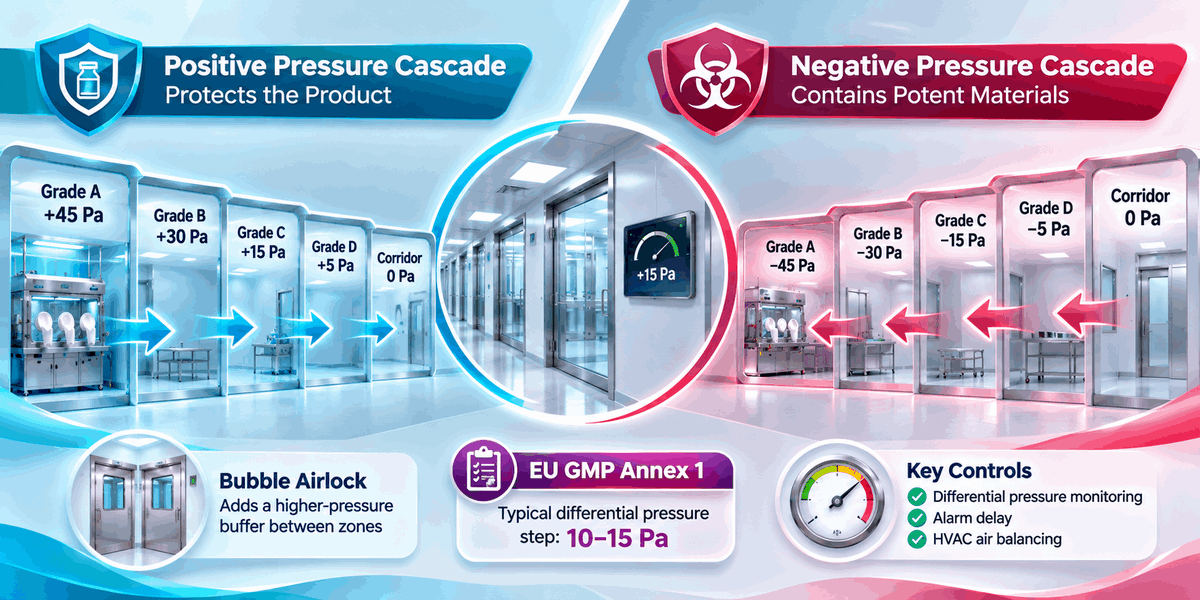
Think of cleanroom pressure cascade design as a one-way street for air. In a positive cascade, the Grade A zone holds the highest pressure. From there, each step down through Grade B, C, D and the corridor drops by about 10 to 15 pascals, the guidance range in EU GMP Annex 1. As a result, whenever a door opens, air rushes outward and carries particles away from open product.
A negative cascade, by contrast, flips the logic. Here, the room handling potent or hazardous material runs at a lower pressure than its neighbours, so any leak flows inward and the compound stays put. However, many sterile potent facilities need both at once, since the product needs protection and so do the operators. In those suites, engineers often add a bubble airlock or a pressure sink between zones to shield the product and lock in the hazard. Either way, airflow direction is a deliberate design choice, and inspectors expect you to justify it room by room.
The infographic below sets both cascades side by side, from Grade A out to the corridor, so you can see briefly which way the air moves and whether it is protecting the product or the people around it.
The Walk-Through Test Inspectors Run at Every Door
Many inspectors start this check with their feet, not with a report. First, they walk the same route your operators take and stop at every door to read the local gauge. Next, they ask for the differential pressure monitoring record for that exact minute and compare the two values side by side. If the gauge reads 12 Pa while the system logged 18 Pa, the conversation quickly turns to calibration, sensor placement and data integrity. Some inspectors also open a door on purpose, time how long the pressure takes to recover, and then check whether the alarm delay would have caught a real breach. After that, the questions shift from the hardware to the paperwork. Specifically, they want to know where each setpoint, alert limit and action limit comes from, and whether your contamination control strategy backs that choice with real risk logic. In short, a number that nobody can justify is just a number, and inspectors treat it that way.
Four Controls Behind a Defensible Cascade
A cascade that looks fine on inspection day is not the same as one you can defend. In practice, a strong cleanroom pressure cascade design rests on several connected controls rather than one good number. First, the limits between grades must reflect real risk, not a value copied from an old project. Then, each airlock must match what its zone needs to protect, whether that is sterile product, operators or both. Beyond that, the room itself must stay tight enough to recover quickly after every door opening. Finally, alarms and trending need to catch drift early and turn every excursion into a proper investigation. When all four work together, the cascade stops being a row of gauges and becomes hard evidence for your contamination control strategy.
Here is how each of these controls plays out on the shop floor and what inspectors expect to see behind it.
- Differential Pressure Limits Between Grades (Available PDF)
- Bubble, Sink and Cascade Airlocks in Practice (Available PDF)
- Door Openings, Room Airtightness and Pressure Recovery (Available PDF)
- Alarm Delays, Trending and Excursion Response (Available PDF)
Differential Pressure Limits Between Grades (Available PDF)
EU GMP Annex 1 sets a guidance value of at least 10 Pa between adjacent rooms of different grades, with special attention on the critical zone. However, each setpoint must still be justified in the contamination control strategy, not copied from an old project.
Bubble, Sink and Cascade Airlocks in Practice (Available PDF)
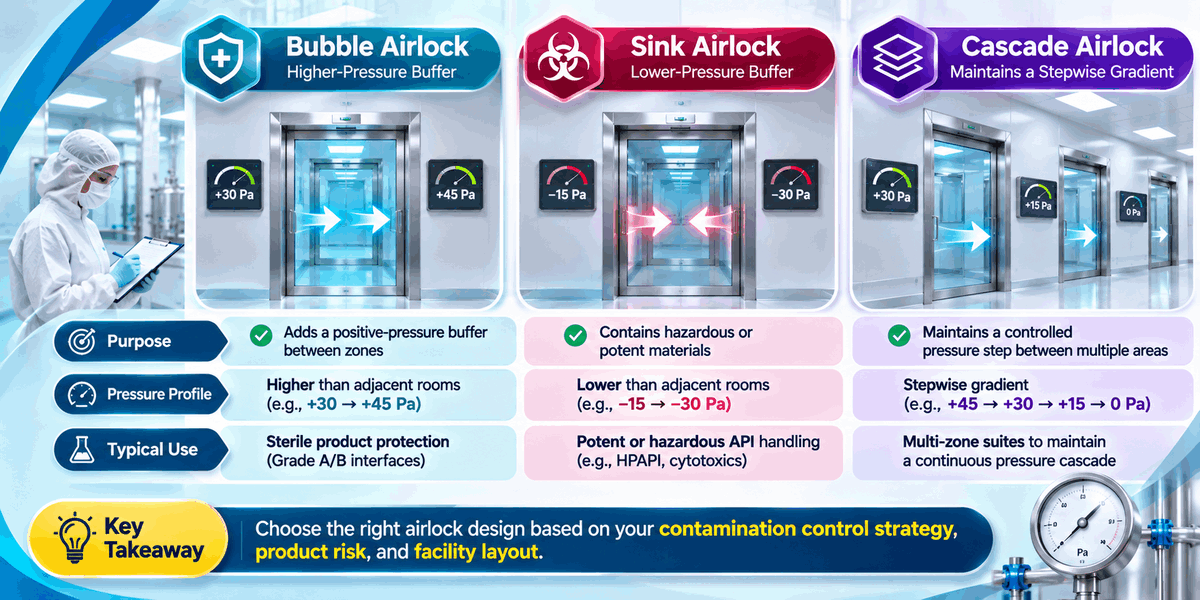
Cascade, bubble and sink airlocks each push air in a different direction, so the right choice depends on whether the zone protects the product, the operator or both. A poor choice can turn the airlock into the weakest point of the whole cascade.
Download NIH APF Pressurization Part I (2019) Here
The infographic below compares bubble, sink and cascade airlocks side by side, showing how each one directs airflow and why that choice decides whether a zone protects the product, the operator or both.
Door Openings, Room Airtightness and Pressure Recovery (Available PDF)
Every door opening briefly breaks the pressure gradient, and a leaky room takes longer to restore it. That is why door gaps, room sealing and recovery behaviour decide whether a cascade stays stable during real operation.
Alarm Delays, Trending and Excursion Response (Available PDF)
Alarm delays filter out normal door traffic, but a delay that is too long can hide a real pressure loss. Inspectors therefore expect justified delays, continuous trend data and a documented investigation for every excursion.
Proving the Cascade During HVAC Qualification
A cascade that only lives on a drawing proves nothing, so qualification must show it working in the real rooms. First, HVAC air balancing sets the airflow offsets behind each pressure step. Next, calibrated instruments verify the differential across every door against its setpoint. Then smoke studies show the airflow direction at rest and during simulated entries, and Annex 1 expects the videos to be kept. Finally, recovery tests time how fast each room returns to its cleanliness level, with a guidance value of under 20 minutes. Together, these results turn the cascade into documented evidence.
The core qualification tests include:
- HVAC air balancing: Sets the airflow offset for each pressure step.
- Differential pressure verification: Confirms every door meets its setpoint and limits.
- Smoke studies: Show airflow direction at rest and in operation, on video.
- Recovery test: Times the return to specified cleanliness.
- HEPA filter leak test: Proves the supply air stays clean.
- Containment leak test: Confirms negative zones hold potent material.
- Requalification: Every 6 months for Grades A/B, 12 months for C/D.
Excursion Patterns That Expose Design Flaws
One pressure dip is an event, but the same dip every Monday morning is a message. In practice, excursions rarely appear at random. Instead, they follow the rhythm of whatever is causing them. A sharp drop that clears in seconds usually tracks door traffic, while a slow slide over weeks often points to loading filters or drifting dampers. Similarly, when several rooms shift at once, the fault tends to sit in a shared system such as an air handler or exhaust fan. That is why inspectors care less about a single alarm and more about whether your team read the pattern behind it. So, before anyone closes a deviation as “door left open”, the trend itself should decide where the investigation starts.
The table below links common excursion patterns to their most likely causes, so you can see where an investigation should begin and which evidence to pull first.
| Excursion pattern | Most likely root cause | Where the investigation should start |
|---|---|---|
|
Sharp dips that recover within seconds to a couple of minutes |
Normal door operation, since the differential across an open-door collapses almost instantly |
Door event logs, airlock interlock timing and the justification for the alarm delay |
|
Sustained drop in one room that does not recover |
Failed door seal or closer, a propped door, or new leaks in walls, ceilings or penetrations |
Physical walkdown of doors, seals, closers and room penetrations, then a check of the room’s airflow offset |
|
Slow, steady decline over days or weeks |
HEPA or pre-filter loading, fan speed drift, damper drift or degrading duct seals |
Filter pressure-drop trend, fan and VFD data, damper positions and the last air balancing report |
|
Several rooms shift at the same moment |
Shared system event such as an AHU or exhaust fan fault, power loss, generator testing or a control failure |
BMS event log, AHU and fan status, power and maintenance records for that timestamp |
|
Wall gauge and monitoring system disagree, or data looks flat or missing |
Sensor drift, a zero-offset error, a damaged or kinked sensing tube, or a data capture gap |
Calibration records, zero-point checks, sensing tube routing and audit trail completeness |
Final Words
Inspection pressure is not easing. In FY2025, FDA carried out 1,248 drug quality inspections, up from 972 the year before, and sterile manufacturing remains one of the highest-risk areas on the list. At the same time, Annex 1 has moved the conversation from whether a gauge reads green to whether the whole system makes sense. In practice, inspectors now link design, qualification and monitoring data into one story, then test that story at the door. A pressure cascade cleanroom that stands up to this scrutiny is one where every setpoint has a reason, every alarm delay has a rationale, and every excursion leaves a clear investigation trail. Ultimately, the sites that read their own trends before inspectors do are the ones that walk out without surprises.

Qualification and Validation for GMP Systems
Our team supports the planning, execution, and maintenance of qualification and validation activities, including IQ, OQ, and PQ, to keep GMP-regulated systems compliant and under control.
FAQ
EU GMP Annex 1 sets a guidance value of at least 10 Pa between adjacent rooms of different grades, with particular attention on protecting the critical zone. FDA’s aseptic processing guidance recommends 10 to 15 Pa with doors closed. In both cases, setpoints and their criticality must be justified in the contamination control strategy, and critical differentials must be continuously monitored and recorded.
Annex 1 does not set a fixed alarm delay. Instead, any delay must be assessed and justified in the contamination control strategy, typically using door-cycle and pressure recovery data. The delay should cover normal door passage and recovery, but it must stay short enough to catch a real loss of pressure during aseptic processing.
A brief dip during a normal door cycle that recovers within the justified alarm delay is expected behaviour, not a deviation. However, an excursion that exceeds the alarm delay or action limit, occurs during aseptic operations, or keeps recurring must be documented and investigated. Under Annex 1, its impact on the batch must be assessed before certification and release.
references
- EU GMP Annex 1: Manufacture of Sterile Medicinal Products
- FDA guidance on sterile drug products produced by aseptic processing
- WHO guidelines on heating, ventilation and air-conditioning systems
- NIH APF Pressurization Part I
- ASHRAE study on minimum cleanroom pressure differentials
- Redica analysis of 2,400+ FDA 483s on sterility compliance

Marco Klinger is Head of Quality Services at Zamann Pharma Support, where he leads consulting teams through complex regulatory and quality-driven projects. He brings more than 15 years of hands-on compliance experience across regulated industries. His work includes close collaboration with companies such as Reckitt, Sanofi, Biotech, Biotest, and others. Marco has deep expertise in medical device development, aseptic manufacturing, and the design, implementation, and management of complete quality management systems within GMP-regulated environments.