
FDA inspection data tell a sharp story. Since 2022, sterility findings have made up only 8% of observations in human drug GMP Form 483s, yet they appeared in 37% of the 483s that escalated to a warning letter. In other words, a small gap in sterility assurance can quickly turn into formal enforcement. Clean steam sits at the center of that risk, because it sterilizes autoclave loads, product-contact surfaces, and SIP circuits every day. Even so, many sites still treat it as a background utility rather than a core piece of pharmaceutical engineering. Inspectors, however, do not judge a steam system by its design drawings. Instead, they judge pharmaceutical clean steam by what its condensate and test data can prove at the point of use. This article explains which tests carry that proof and where the evidence most often breaks down.
Table of Contents
Pharmaceutical Clean Steam Versus Pure Steam in GMP Terms
Few utility terms cause as much confusion in sterile manufacturing as these two. GMP guidelines often use “clean steam” without explaining it, yet the USP gave the concept a clear definition in 2006 under the name “pure steam.” In practice, therefore, the clean steam vs pure steam debate is about wording, not quality. Both EU GMP Annex 1 and ISPE now treat the two terms as equivalent. As a result, inspectors judge pharmaceutical clean steam first by its condensate, which must meet the WFI monograph, including endotoxins but excluding microbial limits. The confusion still has a price, however. ISPE once reported a contractor who ordered a “clean steam” generator for a pharmaceutical facility, only to find it unsuitable and replace it.
Where Inspectors Look First in a Steam System
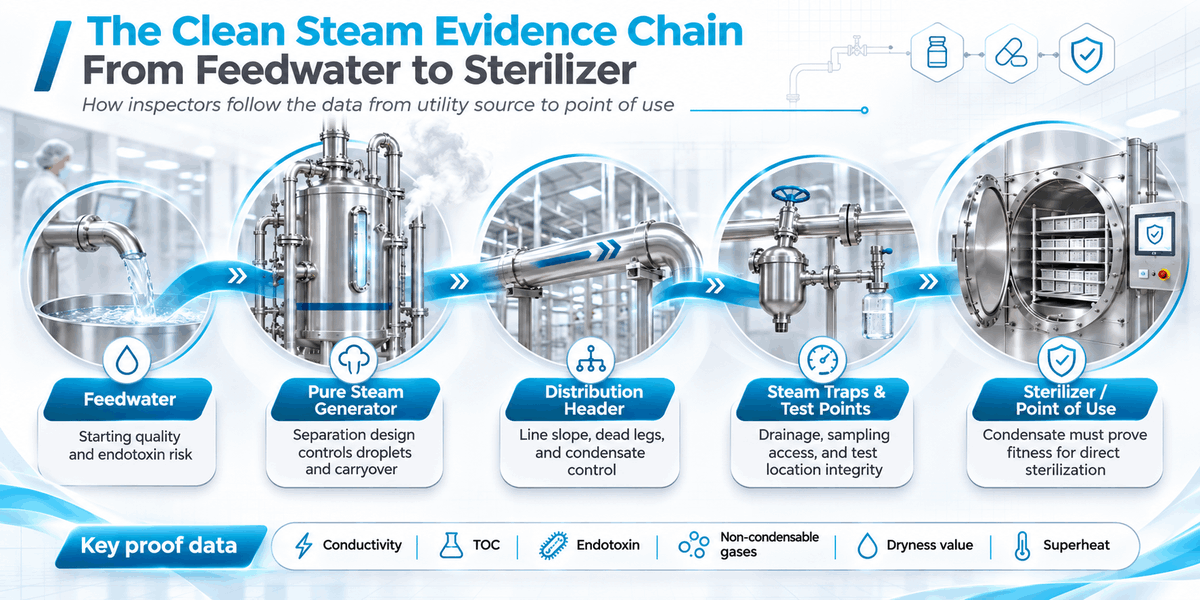
An inspector rarely starts at the autoclave. Instead, experienced inspectors follow the steam along the same path it travels through the plant. The review usually opens with feedwater, since pure steam can only be as clean as the water that feeds the generator. Next, attention shifts to the generator, where separation design decides whether droplets and endotoxins reach the distribution header. From there, the inspector walks the line and checks slopes, steam traps and dead legs that can trap condensate. Finally, the trail ends at the point of use, because clause 6.17 of EU GMP Annex 1, in force since August 2023, ties steam for direct sterilization to condensate that meets the WFI monograph. In other words, every link must carry data, not just design intent, and a single weak link can break the whole chain.
The infographic below maps this evidence chain from feedwater to sterilizer and shows which data each stage must deliver before inspectors accept the steam as fit for use.
Four Proofs Every Clean Steam Sample Must Deliver
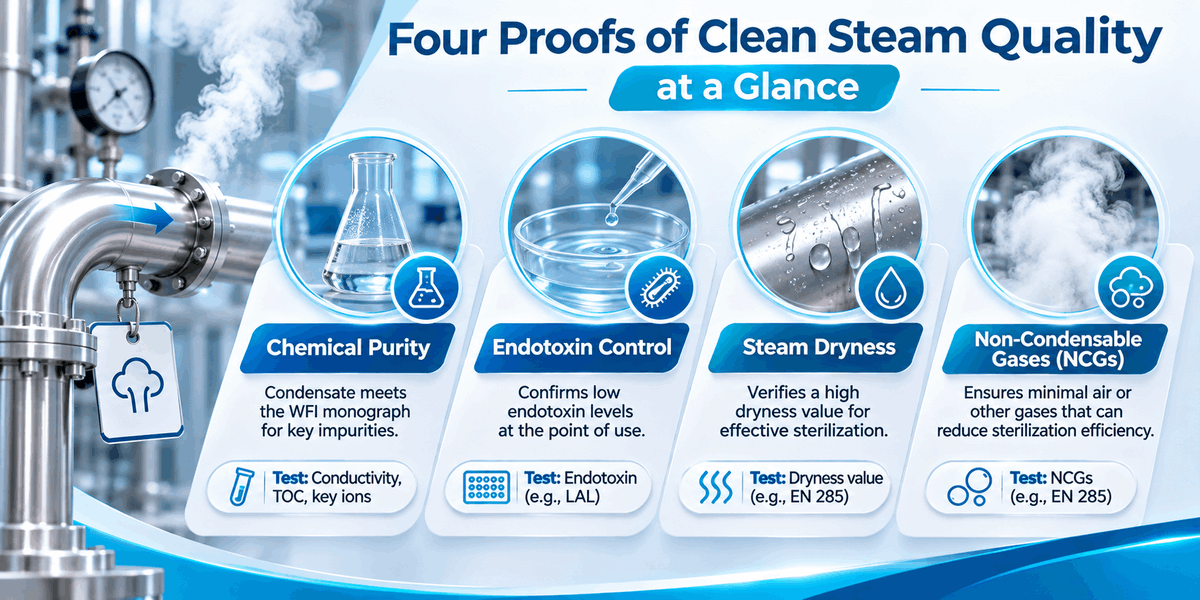
A clean steam sample can pass one test and still fail the process it supports. In fact, published research on steam sterilizers reports that 2 to 3% of steam penetration tests in routine production fail. For this reason, a single good conductivity result cannot prove steam quality on its own. Instead, inspectors expect evidence on two fronts. On the purity side, the condensate must show chemical cleanliness and controlled endotoxin levels. On the performance side, steam quality testing must show that the steam carries little air, enough moisture-free heat and no excess superheat. Only when all four proofs line up does the steam system earn real inspection confidence.
The sections below take each proof in turn, moving from the chemistry inside the condensate to the physics at the sterilizer inlet.
- Chemical Purity Against the WFI Monograph (Available PDF)
- Feedwater Quality and Endotoxin Carryover (Available PDF)
- Non-Condensable Gases and Sampling Bias (Available PDF)
- Dryness Value and Superheat at the Sterilizer Inlet (Available PDF)
The infographic below sets the four proofs side by side, so readers can see at a glance which tests confirm purity, and which confirm sterilizing performance.
Chemical Purity Against the WFI Monograph (Available PDF)
Under EU GMP Annex 1, pure steam condensate used for direct sterilization must meet the current WFI monograph.
Conductivity and TOC results therefore become the first chemical proof that the steam itself is clean.
Feedwater Quality and Endotoxin Carryover (Available PDF)
A well-designed pure steam generator typically cuts endotoxins by 3 to 4 log, but it cannot erase a poor feedwater supply. Feedwater quality sets the starting risk, while separation design decides how much reaches the point of use.
Download Design of Pure Steam Generation and Distribution Systems Here
Non-Condensable Gases and Sampling Bias (Available PDF)
Air and other non-condensable gases block heat transfer and weaken sterilization at the load surface. Yet the EN 285 test result can shift with sampling timing, condensate volume, and load size.
Dryness Value and Superheat at the Sterilizer Inlet (Available PDF)
Wet steam leaves damp loads, while superheated steam loses the condensation energy that sterilization depends on. Both checks belong at the sterilizer inlet, where pipework and pressure reduction shape the final steam quality.
Building a Sampling Plan That Survives an Audit
A sampling plan earns trust when it mirrors how the steam is actually used. For that reason, start with risk: every critical point of use, such as an autoclave or an SIP connection, needs its own sample cooler, while non-product-contact users like humidifiers can often share one sample at the end of the header. In addition, ISPE advises placing EN 285 test points within 2 to 3 meters of each autoclave, yet many sites still add them as an afterthought and later struggle to reach them. Timing matters just as much as location. Steam quality can shift during the working day as demand rises, so clean steam system validation should cover peak and quiet periods rather than one convenient time slot. Finally, condensate handling decides whether a result reflects the steam or the sampling kit, because endotoxin samples need depyrogenated containers and a leaking sample cooler can push conductivity out of limit on its own. In short, auditors read the sampling plan as a map of how well a site understands its own steam.
Failure Signals and the Root Causes Behind Them
An out-of-limit steam result is rarely a random event. Instead, it usually points to a specific weakness somewhere between the generator and the last steam trap. ISPE notes, for example, that the dryness test is the one most likely to fail when distribution design has flaws. Even a pipe bent almost invisibly during construction can trap enough condensate to cause a failure.
For this reason, a quick retest often hides the problem rather than solving it. A strong investigation, by contrast, reads each failing parameter as a clue and traces it back to its most likely source. As a result, the site fixes the cause once and avoids the repeat deviations that tend to draw inspector attention.
The table below links each common failure signal to its most likely root cause, so readers can see where an investigation should start.
| Failure signal | Likely root cause | Inspection risk |
|---|---|---|
|
High conductivity or TOC in condensate |
A leaking generator heat exchanger lets heating steam into the pure side, or a cracked sample cooler lets cooling water into the sample |
Condensate fails the WFI monograph, so the steam cannot support direct sterilization under Annex 1 |
|
Endotoxin above limit |
Feedwater endotoxin exceeds what the generator’s typical 3 to 4 log reduction can remove, or entrained droplets carry feedwater contamination into the steam |
Pyrogen risk for parenteral products and product-contact surfaces |
|
Non-condensable gases above 3.5% |
Poor feedwater degassing, a missing or failing degasser, air drawn in through pump glands or pipe leaks, or inadequate venting |
Air blocks steam penetration and can trigger Bowie-Dick and air detector failures |
|
Dryness value below the EN 285 limit |
Poorly sloped or drained pipework, dead legs, weak insulation, generator priming, or a sagging line that pools condensate |
Wet loads and uneven temperature distribution in the chamber |
|
Superheat above 25°C |
Excessive pressure drop across a reducing valve or partly closed valve, or very dry steam upstream of pressure reduction |
Failure to sterilize, plus scorched textiles and damaged rubber components |
Final Words
Inspection pressure on sterility is not easing. In FY2025, FDA investigators cited 21 CFR 211.113(b), the provision covering contamination control and sterilization validation for sterile products, 68 times, which placed it among the ten most cited drug GMP provisions. Against that backdrop, steam can no longer sit quietly in the utility room. Instead, pharmaceutical clean steam must prove its quality with the same rigor as any critical process step, through condensate that meets the WFI monograph and physical tests that hold up at the point of use. Ultimately, the sites that do well in inspections tend to be those with the clearest steam evidence, not just the best generators.

Qualification and Validation for GMP Systems
Our team supports the planning, execution, and maintenance of qualification and validation activities, including IQ, OQ, and PQ, to keep GMP-regulated systems compliant and under control.
FAQ
No, there is no quality difference from a GMP perspective. EU GMP Annex 1 and ISPE treat clean steam and pure steam as equivalent terms. What defines the steam is its condensate, which must meet the WFI monograph when the steam directly sterilizes product-contact surfaces. Only the wording differs between documents and suppliers.
Yes, when the steam directly sterilizes materials or product-contact surfaces, such as porous autoclave loads. Clause 6.17 of Annex 1 requires the condensate to meet the current WFI monograph, typically conductivity of 1.3 µS/cm at 25°C, TOC below 500 ppb and endotoxin below 0.25 EU/mL. Microbial testing of the condensate is not mandatory.
Perform all three tests during initial qualification. Then repeat them at least annually as part of requalification, and again after any change to the generator, distribution system or sterilizer. If a site sees sporadic sterilization failures or wet loads, it should increase the test frequency until it confirms the root cause.
Take samples at the generator outlet, at the end of each distribution header and at every critical point of use, such as autoclaves and SIP connections. Place EN 285 test points within 2 to 3 meters of each autoclave. Generator outlet data alone cannot prove steam quality where it contacts the product.
references

Marco Klinger is Head of Quality Services at Zamann Pharma Support, where he leads consulting teams through complex regulatory and quality-driven projects. He brings more than 15 years of hands-on compliance experience across regulated industries. His work includes close collaboration with companies such as Reckitt, Sanofi, Biotech, Biotest, and others. Marco has deep expertise in medical device development, aseptic manufacturing, and the design, implementation, and management of complete quality management systems within GMP-regulated environments.