
In fiscal year 2024, FDA issued 111 inspection-based warning letters to drug and biologics makers, and 24 of them called out poor control of water systems. That is more than one in five. Notably, all 24 went to OTC manufacturers, so this is not only a sterile-site problem. Inspectors rarely stop at a passing test result. Instead, they walk the loop, compare the drawings with the real pipework, and ask for the trend data behind every sample. As a result, a pharmaceutical water system often decides how an inspection ends, from PW used for cleaning to WFI used in injectables. Good pharmaceutical engineering builds the system right; however, only steady, documented control keeps it compliant. So, what exactly do inspectors check, and where do most sites fall short?
Inhaltsverzeichnis
Anatomy of a GMP-Ready Pharmaceutical Water System
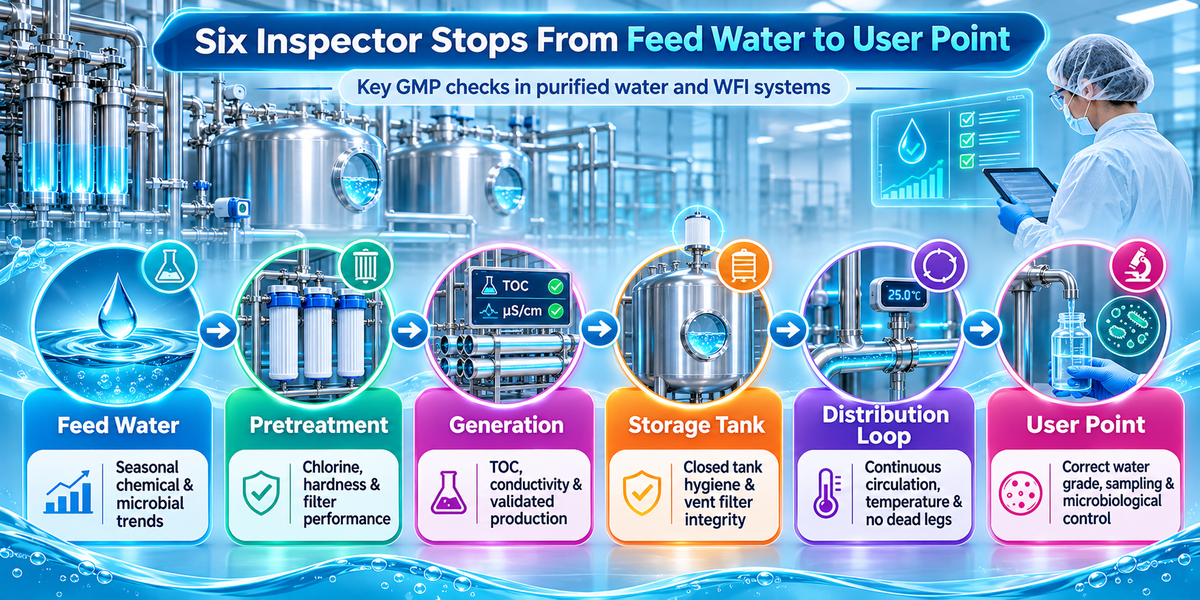
Think of a pharmaceutical water system as a relay race, not a single machine. First, pretreatment takes ordinary drinking water and strips out the chlorine, hardness and particles that would damage the membranes downstream. Next, the generation stage does the heavy lifting, usually with reverse osmosis and electrodeionization for purified water, and distillation or a qualified membrane process for water for injection.
After that, the water waits in a closed storage tank fitted with a bacteria-retentive vent filter, then moves through a distribution loop that keeps circulating day and night. Where water stands still, bacteria settle in. For this reason, inspectors read the whole chain as one system rather than a set of separate units. In practice, they focus on two grades: PW, which supports oral products and equipment cleaning, and WFI, which goes into parenterals and the final rinse of product-contact equipment. A weak link anywhere in the chain, therefore, eventually shows up at the point of use.
Water System Validation Gaps That Put Batches at Risk
Most ingredients wait in quarantine until QC releases them. Water does not. An operator opens a valve, and within seconds the water flows into a granulator, a mixing tank or a rinse cycle. Meanwhile, microbiological results need days of incubation, so the lab often confirms the quality of a sample long after that water has become part of a batch. This timing gap explains why inspectors treat water system validation as a frontline control rather than a paperwork exercise. If the system cannot prove that it delivers the same quality every day, then every batch made with that water carries an open question. Consequently, inspectors look past single passing results and ask for evidence of control across production, storage and distribution. In other words, the system itself must earn the trust that a release test would normally provide.
Purified Water System and WFI Checkpoints Inspectors Follow
A water system inspection rarely starts at a desk. Instead, most inspectors pick up the drawings and walk the system in the same order the water flows, from feed water and pretreatment to generation, storage, the distribution loop and finally the user points. Along the way, they compare each drawing with the real pipework, check the sampling ports and watch how operators take a sample. The PIC/S aide-memoire on utilities even scripts some of their questions, such as asking to see the records of every alarm that has occurred. As a result, a purified water system that looks perfect on paper can still fail at one valve nobody added to the drawing. For WFI, the route stays the same, but inspectors push harder on the temperature, conductivity and TOC data from the loop.
Along that route, four checkpoints carry the most weight: the water grade chosen for each step, the design details inspectors measure, the qualification data behind alert and action levels, and the biofilm controls in membrane-based WFI.
- Matching Pharmaceutical Grade Water to Each Manufacturing Step (Available PDF)
- Design Details Inspectors Measure in a Purified Water System (Available PDF)
- Three-Phase Qualification That Sets Alert and Action Levels (Available PDF)
- Biofilm Control in Membrane-Based Water for Injection (Available PDF)
The infographic below traces the inspector’s route through six stops, from feed water to the user point, and highlights the one check at each stop that can make or break the inspection.
Matching Pharmaceutical Grade Water to Each Manufacturing Step (Available PDF)
Inspectors check that each step uses at least its required minimum water grade. EMA tables set these minimums: for example, Purified Water for granulation and tablet coating, and WFI for the final rinse of equipment used for sterile parenteral products.
Design Details Inspectors Measure in a Purified Water System (Available PDF)
Inspectors compare drawings with the real pipework and check weld quality, passivation, pipe slope, vent filters, sanitary joints and sampling ports. Each detail shows whether water keeps moving, drains fully and avoids dead legs where microorganisms settle.
Download Aide-Memoire: Inspection of Utilities (PIC/S PI 009-4) Here
Three-Phase Qualification That Sets Alert and Action Levels (Available PDF)
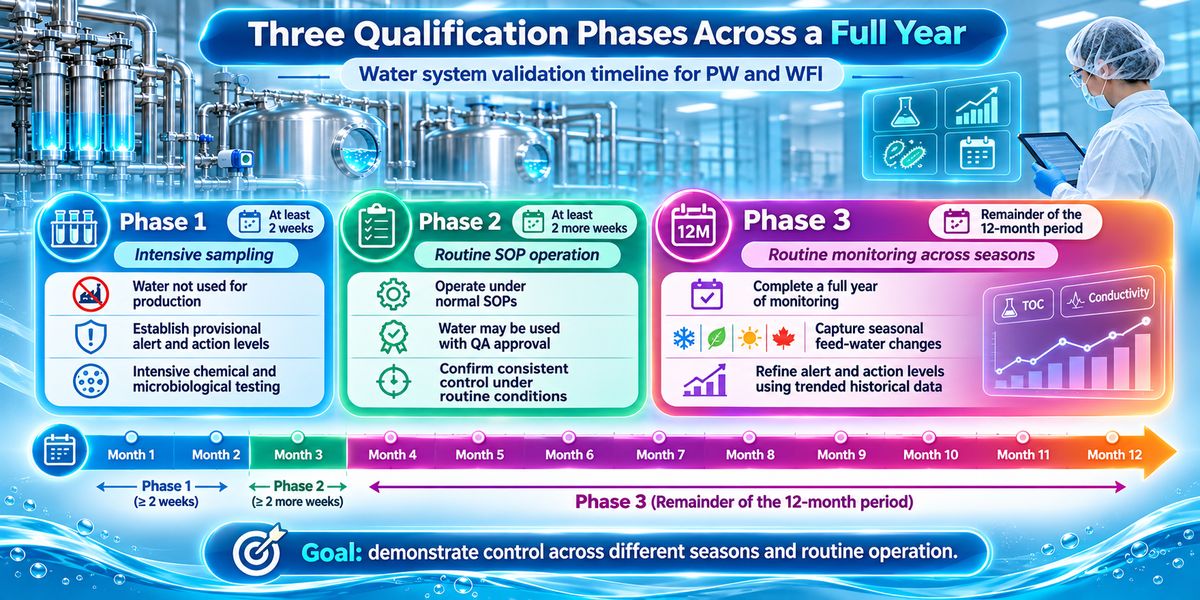
WHO expects a three-phase validation approach that covers at least one year of operation across different seasons. Phase 1 establishes provisional alert and action levels, and later levels are based on historical data trended at defined intervals.
Download WHO GMP Guide on Pharmaceutical Water Here
The infographic below maps the three qualification phases on a 12-month timeline, showing when water may enter production and why the final phase must capture seasonal changes in feed water.
Biofilm Control in Membrane-Based Water for Injection (Available PDF)
Ambient-temperature RO systems favour biofilm, and grab samples often miss it. EMA therefore expects combined thermal and chemical sanitization, online TOC and conductivity monitoring, and regular membrane maintenance.
Recurring Deficiencies Behind Water System Warning Letters
FDA warning letters about water systems rarely describe a single broken pump. Instead, they repeat the same story: the firm cannot prove its system makes water of the right quality every day, whatever the feed water does. FDA also reminds firms that quality control testing alone cannot rescue a water system that is out of control. For example, investigators have cited sites for skipping feed water tests, leaving dead legs in place and running loops that never circulate. In other cases, firms knew about biofilm or out-of-limit results and kept using the water anyway. As a result, the real gap is rarely technical alone. What is missing is evidence that design, sanitization, monitoring and investigations work together as one validated system.
The table below links six recurring deficiencies to real FDA enforcement cases, so you can see what inspectors expected and which control closes each gap.
| Recurring Deficiency | Real Enforcement Example | What FDA Expected | Control That Closes the Gap |
|---|---|---|---|
|
No proof of reliability against feed water changes |
A US manufacturer making an API for sterile drug products did not monitor the microbial and chemical quality of its feed water. |
Data showing the PW system consistently meets specifications for the actual feed water quality |
Test feed water during validation and routine monitoring, and trend results across seasons |
|
Unsuitable system design |
In FY2024, FDA cited an OTC manufacturer for multiple dead legs and a non-circulating loop, with no qualification documents. |
A design fit for intended use, supported by qualification records |
Redesign to a continuously circulating loop, remove dead legs, then requalify |
|
Incomplete qualification protocol |
In a warning letter dated September 2026, a Taiwanese site’s qualification protocol and report left out TOC, conductivity and microbial content. |
Qualification that covers every critical quality attribute |
Define TOC, conductivity and microbial limits in the URS and in every protocol |
|
Unvalidated sanitization |
One firm had no established and validated cleaning and sanitizing schedule for its purified water system |
A proven sanitization method and frequency |
Set the frequency from qualification data, and record every sanitization cycle |
|
Ignored excursions and biofilm |
One manufacturer had known about biofilm in its PW system since 2016 and kept using the water. Another failed to investigate out-of-limit microbial results during installation. |
Root cause investigations and batch impact assessments |
Open a deviation for every alert or action level breach, and assess all affected batches |
|
Reliance on end-product testing |
FDA has told firms that quality control testing cannot fix significant water system control problems. |
Ongoing control, maintenance and monitoring of the system itself |
Combine online monitoring, preventive maintenance and periodic system reviews |
Preparing PW and WFI Systems for the Next Audit
Audit readiness for a water system doesn’t happen in the week before the inspector arrives. Instead, it shows in habits that run every day. Start with the drawings, because inspectors will compare them with the real loop, valve by valve. Next, pull the last twelve months of TOC, conductivity and microbial data, and check that every adverse trend led to an investigation.
After that, review the alarm history and sanitization records, since gaps there can undermine even a strong water system validation package. For WFI, confirm that continuous TOC and conductivity monitoring runs as EU GMP Annex 1 expects, and that someone reviews the data. Meanwhile, plan a gap review against the revised USP 1231 before the new texts become official on 1 April 2027, including whether to adopt the recombinant endotoxin test. Finally, bring QA, engineering and microbiology together for an annual system review. When all of this is current, the audit becomes a walkthrough rather than a search for missing evidence.
Final Words
Enforcement pressure is not easing. In fiscal year 2025, FDA published 112 warning letters citing GMP violations under 21 CFR 211, the highest number in more than 20 years. Water systems remain a recurring part of that trend, because they touch almost every batch a site makes. Still, the pattern behind the letters is encouraging in one way: most findings point to missing evidence, not missing technology. In other words, a pharmaceutical water system passes inspection when its design, qualification, monitoring and investigations tell one consistent story. Sites that build that story every day, rather than in the week before an audit, give inspectors very little to write about.

Qualification and Validation for GMP Systems
Our team supports the planning, execution, and maintenance of qualification and validation activities, including IQ, OQ, and PQ, to keep GMP-regulated systems compliant and under control.
FAQ
Water system validation follows a three-phase approach that covers at least 12 months. Phase 1 lasts at least two weeks of intensive sampling, with no water used for production. Phase 2 adds at least two more weeks under routine SOPs, and water may be used with QA approval. Phase 3 completes the year to capture seasonal changes in feed water.
Open a deviation, investigate the root cause and assess the impact on every batch made with that water. For WFI, identify the microorganism. Then implement CAPA and review the trend data. Never raise alert or action levels to stop excursions, because higher limits can hide a failing system.
Combine thermal sanitization above 75 °C with chemical sanitization, such as peracetic acid, hydrogen peroxide or ozone, at a risk-based frequency. Monitor TOC and conductivity online, and sample the loop return daily and every user point weekly. Finally, replace membranes, gaskets and seals at defined intervals.
references
- WHO TRS 1033 Annex 3 on water for pharmaceutical use
- EMA guideline on the quality of water for pharmaceutical use
- EMA Q&A on non-distillation WFI and biofilm control
- Analysis of FDA inspection-based warning letters in FY2024
- GMP Journal report on FDA warning letters in fiscal year 2025
- ECA news on the revised USP pharmaceutical water monographs

Marco Klinger is Head of Quality Services at Zamann Pharma Support, where he leads consulting teams through complex regulatory and quality-driven projects. He brings more than 15 years of hands-on compliance experience across regulated industries. His work includes close collaboration with companies such as Reckitt, Sanofi, Biotech, Biotest, and others. Marco has deep expertise in medical device development, aseptic manufacturing, and the design, implementation, and management of complete quality management systems within GMP-regulated environments.