
In 2018, FDA issued 85 drug GMP warning letters, and 42 of them cited data integrity failures. In other words, nearly half of all letters pointed to the same weakness. Today, inspectors follow the same logic when they pick a reported result and trace it back to the raw data, the audit trail, and the person who approved it. However, many QC labs still rely on paper records, spreadsheets, and manual transcription, so that trail often breaks. For this reason, LIMS software in pharma has become a core GMP control rather than a simple IT upgrade. As part of the wider digitalization in pharma industry, validated LIMS links samples, results, and approvals in one controlled system. In this guide, we explain how a LIMS protects data integrity, what inspectors check, and how to validate it for GMP use.
Inhaltsverzeichnis
What Is LIMS Software in Pharma?
A pharmaceutical LIMS is a validated software system that manages the full life cycle of QC samples, from sample login and test assignment to results, specification checks, and batch release. In a GMP lab, it also serves as the system of records, so every result stays attributable, time-stamped, and traceable to the analyst who produced it. However, LIMS rarely works alone. A chromatography data system (CDS) controls HPLC or GC instruments and processes the raw data, while the LIMS receives the result and checks it against the specification. Similarly, an electronic laboratory notebook (ELN) captures method development work and experimental observations, so it supports R&D more than routine QC testing. In short, the CDS generates the data, the ELN documents the science, and the LIMS controls the release decision.
Why GMP LIMS Matters During Inspections
Inspectors often begin with a single reported result and trace it backwards, from the certificate of analysis to the approved result, the raw data, the analyst, and finally the sample login. At every step, they ask the same questions: who did this, when, and did anyone change it? If the answers sit in a paper notebook, a spreadsheet, and a separate instrument file, the trail quickly develops gaps. A validated GMP LIMS, by contrast, captures each step in one controlled record, so the chain stays complete and attributable. As a result, your team can show inspectors the evidence that 21 CFR Part 11 and EU GMP Annex 11 expect, instead of rebuilding it under pressure.
The table below shows how key requirements of 21 CFR Part 11 and EU GMP Annex 11 translate into LIMS controls, and what inspectors look for on site.
| Control area | Regulatory basis | How the LIMS meets it | What inspectors check |
|---|---|---|---|
|
Audit trail |
21 CFR 11.10(e); Annex 11, clause 9 |
Records who created, changed, or deleted GMP data, with date, time, and reason for change |
The audit trail is active, cannot be edited, and is reviewed regularly |
|
Access control |
21 CFR 11.10(d) and 11.10(g); Annex 11, clause 12 |
Assigns unique user accounts and role-based permissions |
No shared logins exist, and every access change is recorded |
|
Electronic signatures |
21 CFR 11.50 and 11.70; Annex 11, clause 14 |
Links each signature permanently to its record, with name, date, time, and meaning |
Signatures cannot be copied or removed, and their meaning (review or approval) is clear |
|
Data transfer and manual entry |
Annex 11, clauses 5 and 6 |
Uses validated interfaces and adds a second check for critical manual entries |
Interfaces are validated, and critical manually entered data is verified |
How a Pharmaceutical LIMS Protects Data Integrity in the QC Lab
Data integrity rarely fails because of one major event. Instead, it erodes through small gaps, such as a shared password, an unreviewed change, or a result typed in by hand. A pharmaceutical LIMS closes these gaps by building ALCOA+ principles into daily lab work, so each record stays attributable, accurate, and complete from the moment an analyst creates it. In practice, inspectors focus on a few key controls that reveal whether a system truly protects GMP data or simply stores it.
The four controls below show where that difference becomes visible, from audit trails and electronic signatures to user access, OOS workflows, and instrument interfaces.
- Audit Trails and Electronic Signatures (Available PDF)
- User Access and Role-Based Controls (Available PDF)
- OOS Results and Investigation Workflows (Available PDF)
- Instrument and CDS Interfaces (Available PDF)
The infographic below maps the path a QC result takes from sample login to the certificate of analysis, showing the checkpoints where inspectors confirm that every record stays complete, attributable, and unchanged.

Audit Trails and Electronic Signatures (Available PDF)
A LIMS audit trail records who created, changed, or deleted GMP data, when it happened, and why. Electronic signatures then link each review or approval permanently to a named person, so every decision stays attributable.
User Access and Role-Based Controls (Available PDF)
Unique logins and role-based permissions ensure that only trained, authorized users can enter, change, or approve LIMS data. Separating administrator rights from routine users also prevents anyone from altering the records they are responsible for.
OOS Results and Investigation Workflows (Available PDF)
A LIMS flags out-of-specification results as soon as an analyst enters them and holds the batch until the investigation is complete. It then guides the lab through a documented Phase I and Phase II investigation, so no result is set aside without scientific justification.
Instrument and CDS Interfaces (Available PDF)
Validated interfaces move results directly from instruments and chromatography data systems into the LIMS, removing the risk of manual transcription errors. Inspectors expect these transfers to include built-in checks that confirm the data arrives complete and unchanged.
Download EudraLex Volume 4, Annex 11: Computerized Systems Here
How to Validate a LIMS Under GAMP 5
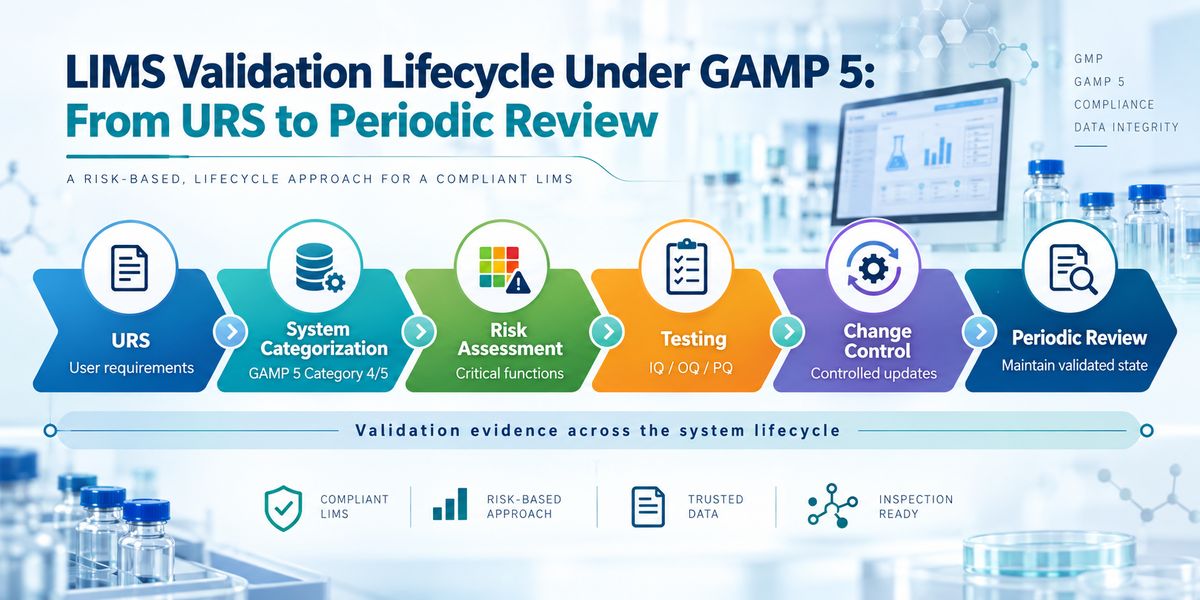
LIMS validation starts with a user requirements specification (URS) that defines the lab’s needs and its GMP-critical functions. Next, the team classifies the system under GAMP 5, where most LIMS platforms are Category 4 configured products and custom code falls into Category 5. A risk assessment then focuses testing on critical functions, and a traceability matrix links every test back to the URS. However, computer system validation continues after go-live through change control and periodic review, which are exactly where inspectors often find gaps.
The infographic below shows each stage of the GAMP 5 validation lifecycle for a LIMS, from URS to periodic review, so your team can see where documented evidence must exist both before and after go-live.
What a Successful LIMS Implementation Looks Like
A successful LIMS implementation depends less on the software itself and more on how the organization prepares it. Labware LIMS offers a good example, since many pharmaceutical companies run it across several QC sites at once. First, teams must govern master data carefully, because specifications, test methods, and product codes drive every result the system calculates. Next, a global template harmonizes core workflows across sites, while still allowing justified local differences. Equally important, role-based training ensures that analysts and reviewers use the system as it was validated, not as they used the old paper process. Finally, controlled release cycles introduce new features in planned and tested batches, so the system can grow without leaving its validated state.
Final Words
Inspection pressure is rising, not easing. In fiscal year 2025, FDA’s drug center reported a 50% increase in the warning letters it issued, a clear sign that enforcement is gathering pace. At the same time, data integrity, access control, and audit trail gaps remain recurring themes in laboratory findings. For this reason, LIMS software in pharma should be treated as a living GMP control rather than a one-time IT project. When teams validate the system under GAMP 5, govern master data, review audit trails, and keep every change under control, each QC result becomes evidence they can defend. As a practical next step, run a gap assessment of your current lab systems before an inspector does it for you.

Digital Solutions for GMP Operations
We support pharmaceutical teams in implementing, maintaining, and optimizing GMP software, data management systems, and computerized workflows that strengthen compliance, data integrity, and operational efficiency.
FAQ
No. A vendor can supply Part 11 technical controls, such as audit trails and electronic signatures, but compliance depends on how the regulated company configures, validates, and operates the system. Each GMP workflow must be validated for its intended use and supported by SOPs, user training, and routine audit trail review.
Audit trails should be reviewed as often as the data they relate to. If GMP regulations define a review point, such as before batch release, the audit trail review follows the same frequency. Where no frequency is defined, set one through a documented risk assessment based on data criticality.
Most LIMS platforms are GAMP 5 Category 4 configured products, because labs adapt standard software through configuration rather than new code. Custom-coded functions fall into Category 5 and need more extensive validation, so many LIMS validation strategies cover both categories.
references

Reza Esmaeili is a technology and product leader in Germany, combining CTO and CPO experience to bridge engineering execution with customer-driven product strategy. He has led cloud and automation initiatives that improved operational efficiency and reduced costs. He has managed cross-functional teams of engineers and product managers and brought new software products from concept to market. He focuses on building data-driven product organizations by introducing analytics to track performance and guide decisions. He champions Agile ways of working to shorten feedback loops, improve quality, and accelerate go-to-market execution in close partnership with sales and marketing.