
In 2025, the FDA issued more than 120 warning letters to drug manufacturing facilities, primarily for significant CGMP violations. As digitalization in pharma industry operations accelerate, maintaining reliable records and compliant systems becomes increasingly important. The right pharma software solutions can strengthen quality control, data integrity, and inspection readiness. However, not every eQMS, LIMS, or MES meets pharmaceutical regulatory requirements. Therefore, manufacturers must assess GMP compliance, validation needs, and supplier reliability before choosing their next digital system.
Table of Contents
What Is Meant by Pharma Software Solutions?
Pharma software solutions are digital systems that help pharmaceutical companies manage, monitor, and document regulated GxP processes. For example, pharmaceutical manufacturing software supports production workflows, batch records, and process monitoring. Meanwhile, pharmaceutical quality management system (QMS) platforms manage deviations, CAPA, change control, and training activities. Laboratory information management systems (LIMS) also support sample tracking, testing, and laboratory data management. Together, these systems improve traceability, data integrity, and operational control. However, companies must validate and maintain them according to their intended use to support GMP compliance.
Why Does Software Compliance Matter During GMP Inspections?
During GMP inspections, regulators assess whether electronic records are accurate, complete, and traceable. Therefore, software compliance is essential for maintaining data integrity and providing reliable inspection evidence. FDA 21 CFR Part 11 establishes controls for applicable electronic records and signatures, while EU GMP Annex 11 addresses computerized systems used in GMP operations. These requirements and guidelines cover critical controls such as audit trails, user access, and electronic data security. However, using compliant software alone does not guarantee GMP compliance. Manufacturers must also validate systems, control changes, and maintain reliable records throughout the software lifecycle. As a result, strong digital controls help reduce compliance risks and support inspection readiness.
4 Critical Checks Before Selecting Pharmaceutical Software
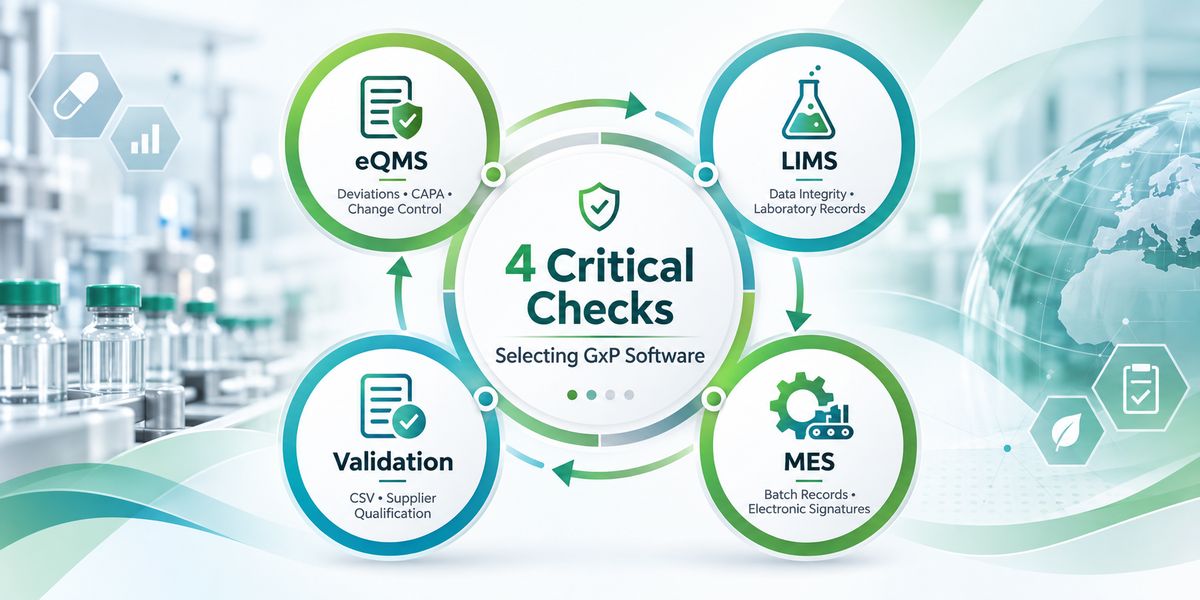
Selecting the right pharmaceutical software solutions requires four critical checks: eQMS for deviations, CAPA, and change control; LIMS for data integrity and traceability; MES for manufacturing control and electronic batch records; and computerized system validation for GxP compliance. Additionally, companies must assess supplier reliability and applicable FDA 21 CFR Part 11 and EU GMP Annex 11 requirements to reduce compliance risks and improve inspection readiness.
Before selecting pharmaceutical software, manufacturers should focus on four critical areas to ensure GxP compliance, data integrity, and inspection readiness:
- Evaluate eQMS Workflows and CAPA Traceability (Available PDF)
- Verify LIMS Data Integrity and Laboratory Records (Available PDF)
- Assess MES Batch Records and Electronic Signatures (Available PDF)
- Plan Computerized System Validation and Supplier Qualification (Available PDF)
The infographic below highlights four essential checks for selecting GxP software that supports regulatory compliance, data integrity, and reliable pharmaceutical operations.
Evaluate eQMS Workflows and CAPA Traceability (Available PDF)
An effective eQMS should manage deviations, CAPA, and change control through traceable workflows. Therefore, manufacturers must verify approval histories, CAPA effectiveness, and audit-ready records.
Download ICH Guideline Q10 on Pharmaceutical Quality System Here
Verify LIMS Data Integrity and Laboratory Records (Available PDF)
Pharma LIMS software should ensure accurate, complete, and traceable laboratory records. Additionally, manufacturers must verify audit trails, access controls, and data integrity throughout testing.
Assess MES Batch Records and Electronic Signatures (Available PDF)
MES software should support accurate electronic batch records and controlled manufacturing processes. Moreover, manufacturers must verify electronic signatures, audit trails, and batch-release controls.
Plan Computerized System Validation and Supplier Qualification (Available PDF)
Computerized system validation ensures pharmaceutical software meets its intended use and GxP requirements. Therefore, manufacturers must assess supplier reliability, risk-based testing, and validation documentation.
How Should Manufacturers Compare Pharma Software Vendors?
Choosing the right pharma software vendor requires more than comparing features, pricing, and technical capabilities. First, manufacturers must define the software’s intended use and assess its impact on GxP processes. Next, they should evaluate functional requirements, system integration, and data integrity controls. Moreover, supplier competence and documented validation evidence are essential for maintaining regulatory compliance. Therefore, a structured vendor assessment helps manufacturers reduce compliance risks and select software that supports long-term GMP operations.
The following table outlines six essential criteria for comparing pharmaceutical software vendors and the evidence manufacturers should request before making a decision.
| Evaluation Criteria | What Manufacturers Should Check | Evidence to Request | Table Header |
|---|---|---|---|
|
Intended Use & Functional Fit |
Does the software support required GxP, eQMS, LIMS, or MES workflows? |
URS, functional specifications, and requirements mapping |
|
|
GxP Risk & Data Integrity |
Could system failures affect patient safety, product quality, or data integrity? |
Risk assessments, audit trails, and control measures |
|
|
System Integration & Supplier Competence |
Can the software integrate securely, and does the vendor provide reliable support? |
Integration test results, supplier qualification, and service agreements |
|
|
Computerized System Validation |
Can the manufacturer demonstrate that the system performs as intended? |
Validation plans, test protocols, and validation reports |
How Can Manufacturers Maintain a Validated State After Go-Live?
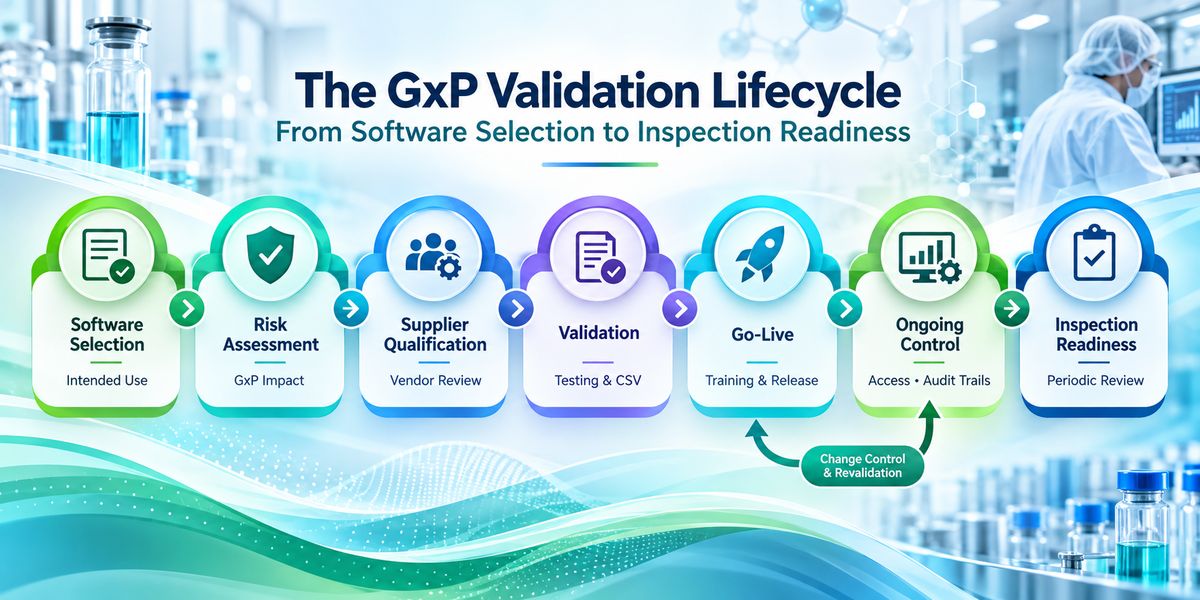
Maintaining a validated state requires continuous control of GxP software solutions after implementation. First, manufacturers must assess software changes and perform risk-based revalidation when necessary. Additionally, regular access reviews and audit trail monitoring help protect data integrity. Teams should also investigate incidents, identify root causes, and document corrective actions. Finally, periodic evaluations must review system performance, security, and validation status. These ongoing controls support GMP compliance and long-term inspection readiness.
The following infographic illustrates the GxP validation lifecycle, showing how software selection, risk assessment, validation, and ongoing monitoring support GMP compliance and inspection readiness.
Final Words
India’s growing focus on risk-based inspections has led to more than 860 regulatory actions since December 2022, according to figures reported in March 2026. For pharmaceutical manufacturers, this highlights the importance of maintaining reliable records, validated processes, and effective CAPAs. Therefore, pharma consultancy in kolkata should focus on addressing compliance gaps and verifying corrective actions. Ultimately, inspection readiness depends on quality controls that remain effective beyond the inspection itself.

Digital Solutions for GMP Operations
We support pharmaceutical teams in implementing, maintaining, and optimizing GMP software, data management systems, and computerized workflows that strengthen compliance, data integrity, and operational efficiency.
FAQ
Yes. Pharmaceutical manufacturers remain responsible for validating GxP software for its intended use. Vendor documentation can support validation, but it does not replace site-specific risk assessments and testing.
Manufacturers should assess applicable electronic record controls, including user access, audit trails, electronic signatures, and record protection. They must also maintain documented evidence that the system meets relevant regulatory requirements.
No. Manufacturers must assess each software change through documented change control and risk assessment. Changes affecting critical GxP functions, data integrity, or validated requirements may require additional testing or revalidation.
references

Reza Esmaeili is a technology and product leader in Germany, combining CTO and CPO experience to bridge engineering execution with customer-driven product strategy. He has led cloud and automation initiatives that improved operational efficiency and reduced costs. He has managed cross-functional teams of engineers and product managers and brought new software products from concept to market. He focuses on building data-driven product organizations by introducing analytics to track performance and guide decisions. He champions Agile ways of working to shorten feedback loops, improve quality, and accelerate go-to-market execution in close partnership with sales and marketing.