
By March 2026, India’s CDSCO and state regulators had conducted risk-based inspections at more than 960 pharmaceutical premises since December 2022. For manufacturers, this highlights a critical challenge: proving GMP compliance through reliable documentation and controlled processes. Therefore, pharma consultancy in kolkata can help identify gaps in quality systems, regulatory compliance, and process validation. Moreover, professional pharma consultancy services help manufacturers address these gaps, strengthen inspection readiness, and maintain compliance with revised Schedule M requirements.
Table of Contents
What Is Pharma Consultancy in Kolkata?
Pharma consultancy in Kolkata helps pharmaceutical manufacturers meet Good Manufacturing Practice (GMP) requirements and maintain regulatory compliance. It provides technical support for quality management systems, regulatory documentation, audits, and validation activities. Moreover, pharmaceutical consultants help manufacturers identify compliance gaps, improve processes, and prepare for inspections by the Central Drugs Standard Control Organisation (CDSCO). They also support process validation, equipment qualification, and corrective and preventive actions (CAPA). As a result, manufacturers can strengthen quality controls, maintain reliable documentation, and demonstrate compliance with applicable regulatory standards.
Why Does GMP Compliance Require Specialist Support?
India’s revised Schedule M places greater emphasis on documented quality systems, risk management, and consistent manufacturing controls. Therefore, pharmaceutical manufacturers must demonstrate GMP compliance through reliable records, validated processes, and effective corrective actions. However, outdated procedures, incomplete validation reports, and weak deviation investigations can create serious inspection risks. Specialist GMP consultancy helps manufacturers identify these gaps, conduct risk-based assessments, and implement corrective actions. As a result, manufacturers can strengthen their quality systems, improve CDSCO inspection readiness, and maintain compliance with regulatory requirements.
4 Areas Where Pharma Consultants Strengthen Inspection Readiness
Effective inspection preparation starts long before an inspector arrives. Pharmaceutical consultants assess whether manufacturing practices, documentation, and quality controls meet applicable GMP requirements. They also help manufacturers identify compliance gaps and prioritise corrective actions based on risk. As a result, quality teams can strengthen their processes and support compliance with clear, traceable evidence.
Four key areas play a central role in this process: GMP audits and gap assessments, regulatory affairs and documentation, validation and qualification, and quality management systems and CAPA.
- GMP Audits and Gap Assessments (Available PDF)
- Regulatory Affairs and Documentation (Available PDF)
- Validation and Qualification (Available PDF)
- Quality Management Systems and CAPA (Available PDF)
The infographic below shows how four key consulting areas work together to strengthen GMP compliance and provide reliable evidence for regulatory inspections.
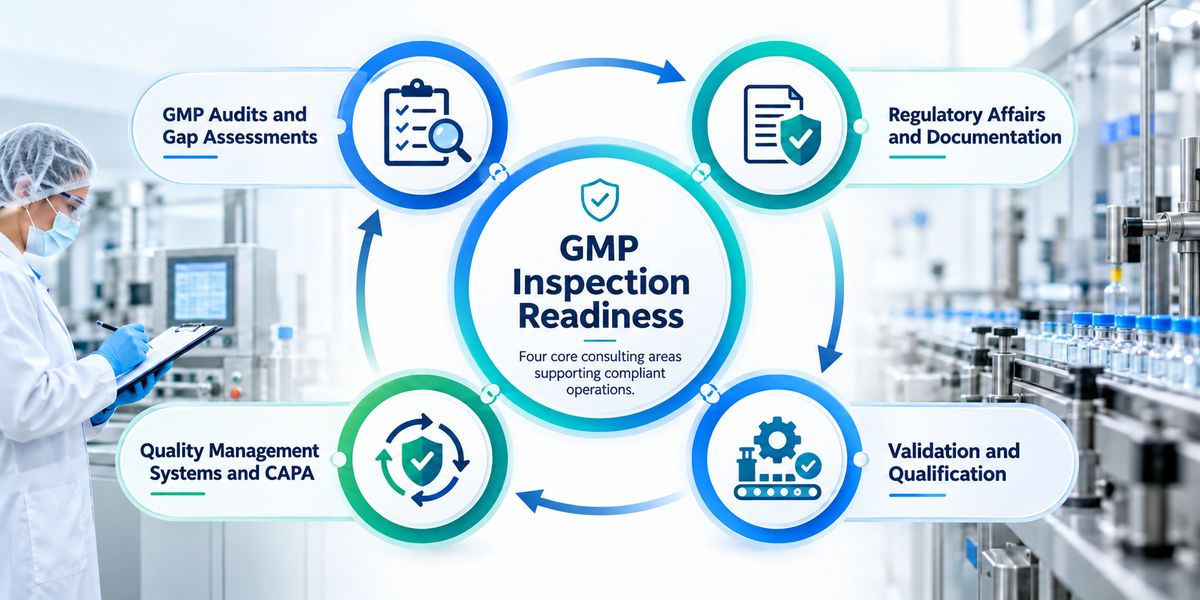
GMP Audits and Gap Assessments (Available PDF)
GMP audits help manufacturers identify compliance gaps in production, documentation, and quality controls. Moreover, risk-based assessments help prioritise corrective actions and improve inspection readiness.
Regulatory Affairs and Documentation (Available PDF)
Regulatory affairs support helps manufacturers maintain accurate documentation and meet regulatory requirements. In addition, strong data integrity practices ensure traceable records and reliable inspection evidence.
Validation and Qualification (Available PDF)
Validation ensures manufacturing processes consistently meet defined quality requirements, while qualification confirms equipment performs as intended. Therefore, documented testing and approved reports help demonstrate GMP compliance.
Download Good Manufacturing Practices: Guidelines on Validation Here
Quality Management Systems and CAPA (Available PDF)
Quality management systems help manufacturers control deviations, manage risks, and implement corrective actions. Moreover, CAPA effectiveness checks verify that actions address root causes and reduce the risk of recurring problems.
Download ICH Guideline Q10 on Pharmaceutical Quality System Here
How Should Kolkata Manufacturers Evaluate a Pharma Consultant?
Choosing a pharma consultant requires more than reviewing a list of services. Kolkata manufacturers should assess practical GMP experience, knowledge of revised Schedule M, and expertise in audits, validation, and quality systems. In addition, they should request examples of completed projects, including gap assessments, validation reports, and CAPA follow-up records. However, technical expertise alone is not enough. Consultants must also define clear deliverables, responsibilities, and timelines. Therefore, manufacturers should prioritise consultants who can address compliance risks, improve quality processes, and provide reliable evidence for regulatory inspections.
What Evidence Should a Consultancy Engagement Deliver?
A pharmaceutical consultancy engagement should deliver clear evidence, not just recommendations. Manufacturers should connect every deliverable to a specific GMP compliance risk. For example, audit findings should lead to documented corrective actions and follow-up assessments. Similarly, validation activities should produce approved protocols, test results, and reports. Effective consulting also strengthens documentation, quality management systems, and CAPA effectiveness. As a result, manufacturers can demonstrate that their processes remain controlled and ready for regulatory inspections.
The table below shows how consultancy deliverables address common GMP risks and provide evidence for inspection readiness.
| Consulting Service | GMP Risk Addressed | Expected Deliverable | Inspection Benefit |
|---|---|---|---|
|
GMP Gap Assessment |
Undetected compliance gaps |
Audit reports, risk-ranked findings, corrective action plans |
Documents compliance weaknesses and follow-up actions |
|
Regulatory Documentation |
Incomplete or outdated records |
Approved SOPs, controlled documents, revision histories |
Demonstrates document control and regulatory traceability |
|
Process Validation |
Unverified manufacturing performance |
Approved protocols, test results, validation reports |
Demonstrates that processes meet defined acceptance criteria |
|
Quality Management and CAPA |
Recurring deviations and ineffective corrective actions |
Root cause investigations, CAPA records, effectiveness checks |
Shows whether corrective actions address identified problems |
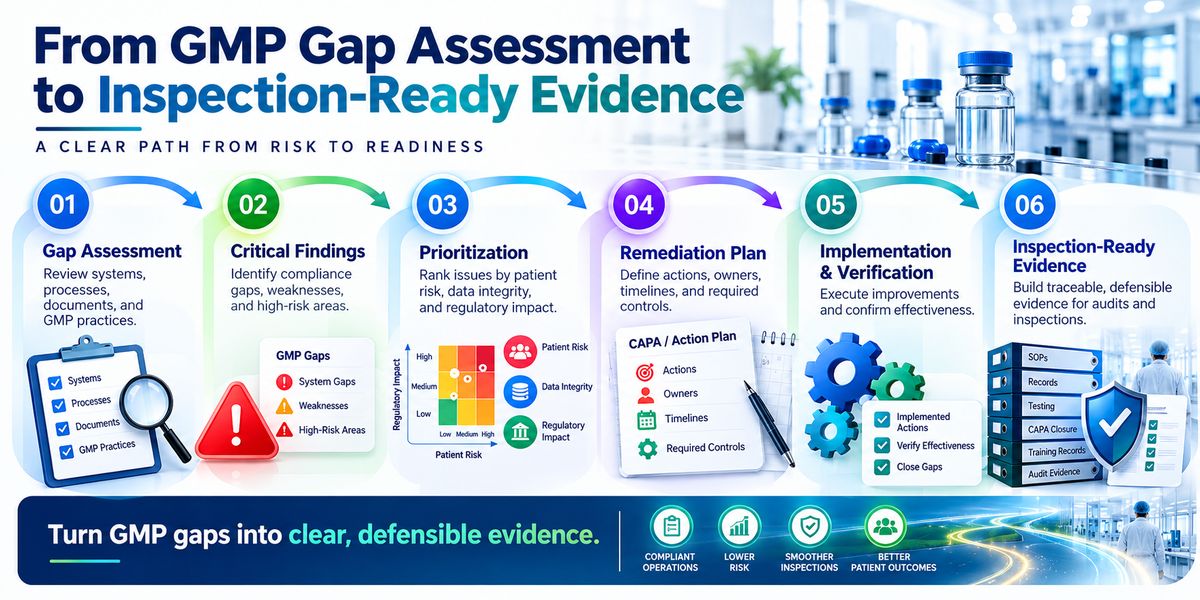
The infographic below shows how a structured GMP gap assessment leads to risk-based corrective actions, effectiveness checks, and documented evidence for regulatory inspections.
Final Words
India’s growing focus on risk-based inspections has led to more than 860 regulatory actions since December 2022, according to figures reported in March 2026. For pharmaceutical manufacturers, this highlights the importance of maintaining reliable records, validated processes, and effective CAPAs. Therefore, pharma consultancy in kolkata should focus on addressing compliance gaps and verifying corrective actions. Ultimately, inspection readiness depends on quality controls that remain effective beyond the inspection itself.

Quality Management System
We work with pharmaceutical teams to design, implement, and run effective Quality Management Systems, covering change control, CAPA, deviations, and audits to support consistent GMP compliance.
FAQ
Manufacturers should maintain current SOPs, batch records, validation reports, deviation investigations, CAPA records, and training documentation. Inspectors assess these records to verify GMP compliance, data integrity, and effective quality controls.
Manufacturers need approved validation protocols, predefined acceptance criteria, documented test results, deviation assessments, and final validation reports. Ongoing process monitoring provides additional evidence that manufacturing processes remain controlled.
Manufacturers must document root cause investigations, corrective actions, and effectiveness checks against defined criteria. Trend analysis and follow-up monitoring help demonstrate whether actions prevent recurring deviations and maintain process control.
references

Marco Klinger is Head of Quality Services at Zamann Pharma Support, where he leads consulting teams through complex regulatory and quality-driven projects. He brings more than 15 years of hands-on compliance experience across regulated industries. His work includes close collaboration with companies such as Reckitt, Sanofi, Biotech, Biotest, and others. Marco has deep expertise in medical device development, aseptic manufacturing, and the design, implementation, and management of complete quality management systems within GMP-regulated environments.