
Since December 2022, regulators have inspected more than 960 drug manufacturing premises across India. As a result, GMP and revised Schedule M readiness now require stronger systems, evidence, and validation. For manufacturers seeking pharma consultants in ahmedabad, expert support can help identify compliance gaps before inspections. Therefore, the right pharma consultancy services can strengthen CDSCO compliance, qualification, validation, and pharmaceutical plant projects.
Inhaltsverzeichnis
What Do Pharma Consultants in Ahmedabad Actually Handle?
Pharma consultants in Ahmedabad often support much more than general advisory work. They can help companies strengthen GMP systems, prepare regulatory documentation, manage plant setup projects, and plan qualification and validation activities. In addition, pharmaceutical consultancy services may support SOP development, gap assessments, audits, CAPA actions, and inspection readiness. Therefore, the right consultant works across both strategy and implementation, helping pharmaceutical teams turn regulatory requirements into practical, controlled, and audit-ready systems.
Why Schedule M and CDSCO Readiness Matter
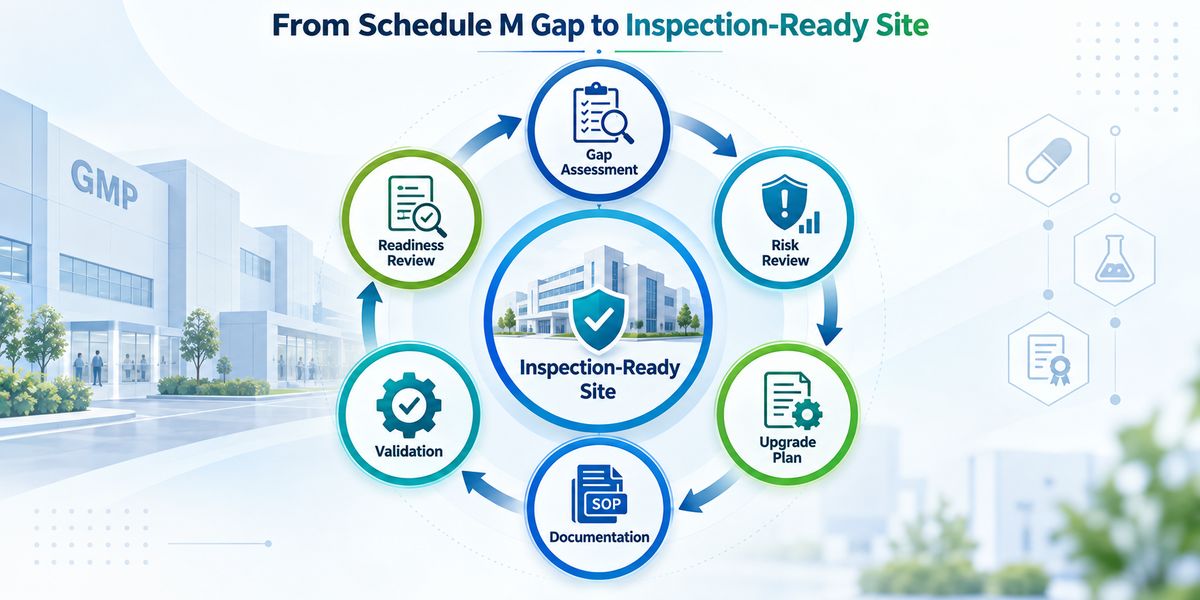
Revised Schedule M has raised the compliance expectations for pharmaceutical manufacturers across India. Therefore, consulting projects should address GMP systems, documentation, risk management, qualification, validation, and data integrity from the start. CDSCO inspection readiness also requires companies to prove that these controls work consistently in practice. As a result, effective support should move beyond gap identification and help teams implement corrective actions, maintain evidence, and build an inspection-ready quality system.
This infographic shows how manufacturers can move from Schedule M gap assessment to a controlled, validated, and inspection-ready pharmaceutical site.
4 Technical Projects Where Consultants Add the Most Value
Pharmaceutical consultants create the most value when projects require both technical expertise and practical execution. They can help manufacturers close compliance gaps, strengthen facility design, build defensible validation evidence, and prepare teams for regulatory inspections. Therefore, the right support can reduce implementation risks while improving GMP control, documentation quality, and inspection readiness.
The following four project areas show where specialist consulting support can make the greatest practical difference:
- Close Revised Schedule M and GMP Gaps (Available PDF)
- Design a GMP-Ready Pharmaceutical Plant (Available PDF)
- Build Qualification and Validation Evidence (Available PDF)
- Prepare the Site for Risk-Based Regulatory Inspection (Available PDF)
Close Revised Schedule M and GMP Gaps (Available PDF)
This CDSCO notification explains how manufacturers should identify and address revised Schedule M and GMP gaps.
Download the Revised Schedule M GMP Compliance Application here
Design a GMP-Ready Pharmaceutical Plant (Available PDF)
The WHO guideline explains how HVAC design supports contamination control, product quality, and GMP-compliant pharmaceutical facilities.
Build Qualification and Validation Evidence (Available PDF)
The WHO guideline explains how manufacturers can document and maintain reliable qualification and validation evidence for critical facilities, systems, equipment, and processes.
Download the WHO HVAC Guide here
Prepare the Site for Risk-Based Regulatory Inspection (Available PDF)
The WHO guideline explains how companies and regulators can manage quality risks across inspections, CAPAs, and manufacturing sites.
How to Match the Consultant to the Project
Not every pharmaceutical consultant fits every technical project. Start by defining the main compliance or operational risk, then match it with the consultant’s specialist knowledge and relevant project experience. In addition, review evidence from similar assignments and agree on measurable deliverables before work begins. This approach helps manufacturers avoid generic advice and focus resources where technical risk is highest.
The table below shows which expertise, experience, and deliverables to look for across common pharmaceutical projects.
| Project / Main Risk | Best-Fit Consultant Expertise | Evidence to Check | Expected Deliverable |
|---|---|---|---|
|
Schedule M / GMP gaps |
GMP, quality systems, Schedule M, QRM |
Similar gap assessments and remediation projects |
Gap assessment and remediation plan |
|
Plant setup or facility upgrade |
GMP facility design, HVAC, utilities, engineering |
Experience with similar facilities and dosage forms |
Design review and implementation plan |
|
Qualification and validation |
Equipment, utilities, process and cleaning validation |
Similar qualification and validation projects |
Validation strategy, protocols and reports |
|
Inspection readiness |
GMP auditing, CAPA, documentation and regulatory support |
Relevant audit and inspection-readiness experience |
Readiness assessment, CAPA plan and evidence package |
What Should Manufacturers Verify Before Awarding the Project?
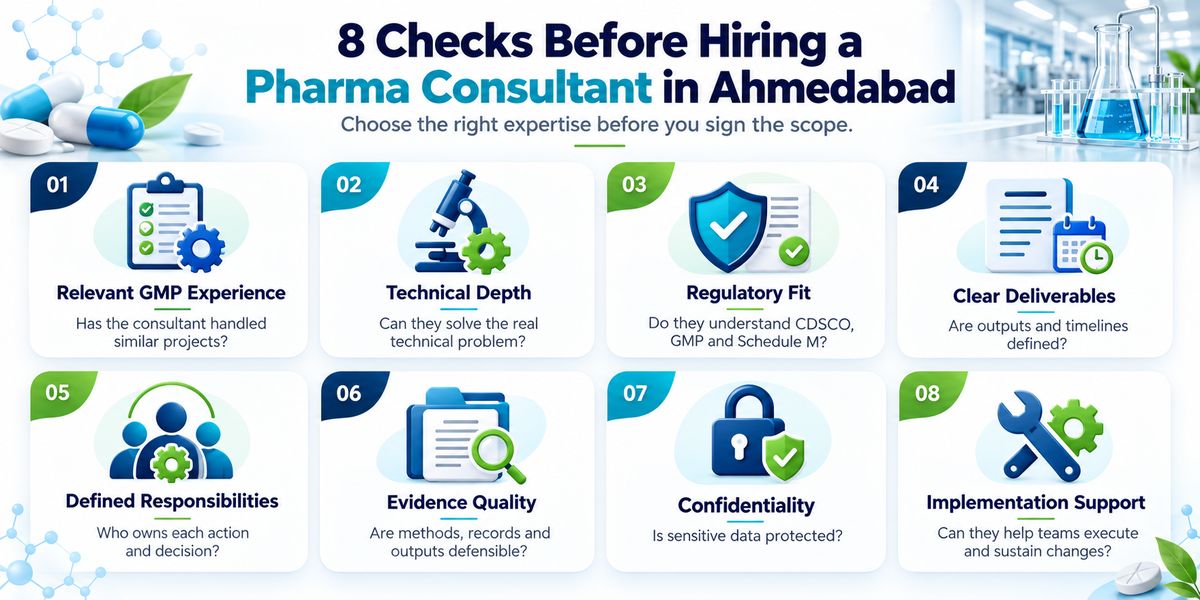
Before awarding a pharmaceutical consulting project, manufacturers should verify more than credentials alone. They should assess relevant project experience, technical depth, regulatory knowledge, deliverables, responsibilities, evidence quality, confidentiality, and implementation support. In addition, the scope should clearly define who owns each action and how results will be documented. This reduces project risk and helps ensure the consultant can support practical GMP compliance, not just provide recommendations.
The infographic below highlights eight checks manufacturers should complete before hiring a pharma consultant in Ahmedabad, helping teams assess technical fit, accountability, and implementation readiness.
Final Words
India’s inspection environment is becoming more enforcement-focused, with more than 860 regulatory actions taken following risk-based inspection findings since December 2022. Therefore, manufacturers should treat GMP readiness as an ongoing operational priority, not a one-time inspection exercise. The right pharma consultants in ahmedabad can help turn regulatory expectations into practical controls, stronger evidence, and sustainable compliance.

Quality Management System
We work with pharmaceutical teams to design, implement, and run effective Quality Management Systems, covering change control, CAPA, deviations, and audits to support consistent GMP compliance.
FAQ
A GMP consultant can identify Schedule M gaps, assess quality systems, review documentation, and build a practical remediation plan. They can also support implementation, validation, CAPA, and inspection readiness.
Check relevant validation experience, technical expertise, previous project evidence, and knowledge of GMP requirements. The scope should also define protocols, responsibilities, reports, and acceptance criteria before work starts.
Consultants can perform GMP gap assessments, review CAPAs and documentation, check data integrity controls, and conduct inspection-readiness audits. They also help teams close critical gaps and organize evidence before the inspection.
references

Marco Klinger is Head of Quality Services at Zamann Pharma Support, where he leads consulting teams through complex regulatory and quality-driven projects. He brings more than 15 years of hands-on compliance experience across regulated industries. His work includes close collaboration with companies such as Reckitt, Sanofi, Biotech, Biotest, and others. Marco has deep expertise in medical device development, aseptic manufacturing, and the design, implementation, and management of complete quality management systems within GMP-regulated environments.