
EU regulators found that manufacturer incident reports increased by more than 20% from 2017 to 2024, showing how rapidly post-market safety evidence is growing. In 2026, post market surveillance of medical devices is therefore more than a reporting duty under the EU MDR. It connects PMS plans, PSURs, vigilance, PMCF, trend reporting, and risk management into one continuous control system. Likewise, Pharmacovigilance shows why safety monitoring must continue after market entry. For pharmaceutical and medical device professionals, strong PMS turns real-world data into timely action and defensible regulatory evidence.
Inhaltsverzeichnis
What Is Post Market Surveillance of Medical Devices?
Post market surveillance of medical devices is the manufacturer’s continuous process for monitoring a device after it enters the market. It involves proactively collecting and analysing real-world data on safety, quality, performance, complaints, incidents, and emerging risks. Manufacturers must then use these findings to identify trends and assess whether existing controls remain effective. Therefore, PMS does not end after approval or certification. Instead, it continues throughout the device lifetime and supports timely corrective actions, risk management updates, and ongoing compliance with regulatory requirements.
Why EU MDR Post Market Surveillance Matters?
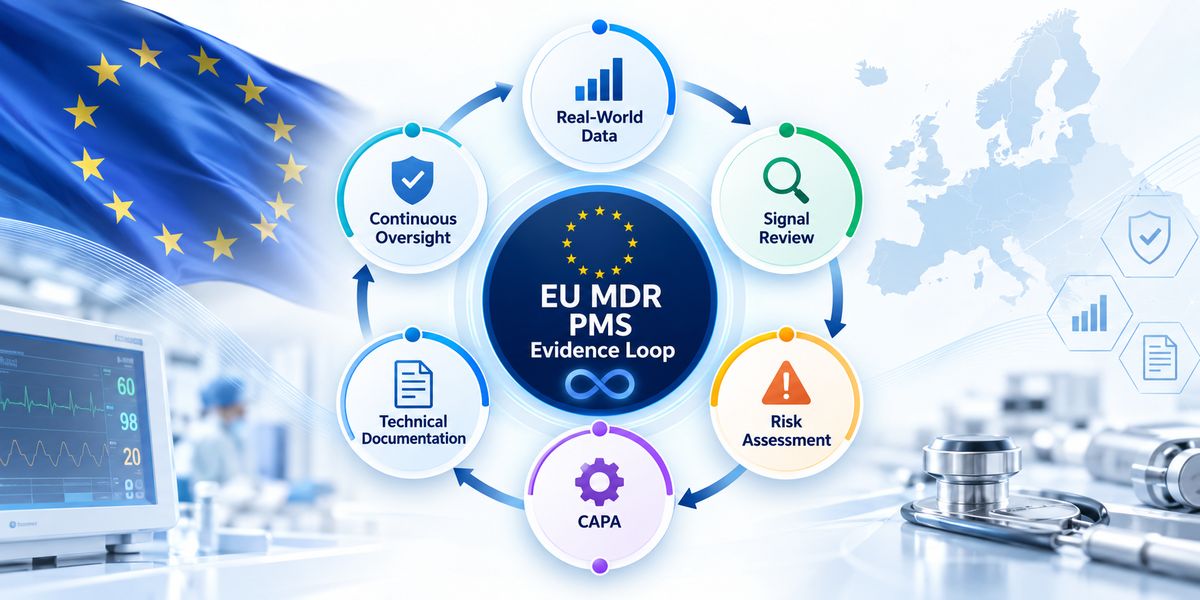
EU MDR post market surveillance connects real-world device performance with the manufacturer’s wider quality and regulatory system. PMS findings can update clinical evaluation, risk management, CAPA, and technical documentation when new safety or performance concerns appear. Moreover, manufacturers use this evidence to confirm that the device continues to meet applicable safety and performance requirements. Therefore, effective PMS is not simply a reporting activity. It provides the ongoing evidence needed to detect emerging risks, take timely action, and demonstrate continued device conformity throughout its lifecycle.
4 Controls That Make a PMS System Defensible
A defensible PMS system does more than collect post-market data. It must show how manufacturers identify signals, assess risks, take action, and maintain traceable evidence. Therefore, strong controls help connect medical device post market surveillance with risk management, CAPA, clinical evaluation, and regulatory documentation. Moreover, these controls allow teams to explain not only what they found, but also how they responded and why their decisions remain justified.
The following four controls help turn PMS activities into a structured, traceable, and inspection-ready system.
- Build a Risk-Based Post Market Surveillance Plan (Available PDF)
- Plan Post Market Clinical Follow Up (Available PDF)
- Prepare and Update the Periodic Safety Update Report (Available PDF)
- Control Vigilance, Trend Reporting, and Field Safety Actions (Available PDF)
This infographic shows how EU MDR post market surveillance connects real-world evidence with risk assessment, corrective actions, documentation, and continuous regulatory oversight.
Build a Risk-Based Post Market Surveillance Plan (Available PDF)
A risk-based PMS plan defines what post-market data manufacturers will collect, review, and evaluate. It also links surveillance activities to device risk, responsibilities, review frequency, and required follow-up actions.
Plan Post Market Clinical Follow Up (Available PDF)
A PMCF plan defines how manufacturers will collect clinical data after a device enters the market. It sets clear objectives, methods, timelines, and activities to support ongoing clinical evaluation.
Prepare and Update the Periodic Safety Update Report (Available PDF)
The PSUR summarizes key PMS findings, safety trends, and changes in the device’s benefit-risk profile. Manufacturers must update it at defined intervals and connect its conclusions with risk management and corrective actions.
Control Vigilance, Trend Reporting, and Field Safety Actions (Available PDF)
A strong vigilance process helps manufacturers assess incidents, identify adverse trends, and meet reporting deadlines. It also supports decisions on serious incident reporting, field safety corrective actions, and communication with competent authorities.
How PMS Data Feed Risk Management and Technical Documentation
Post-market data should actively shape a manufacturer’s quality and regulatory controls. When PMS identifies new signals, trends, or safety concerns, teams should reassess risks and update the clinical evaluation, CAPA, labelling, instructions for use, and PMS activities where necessary. Moreover, these changes must flow into the relevant technical documentation through a controlled and traceable process. Therefore, strong EU MDR post market surveillance turns real-world evidence into documented regulatory action and helps keep device conformity current throughout the product lifecycle.
This infographic shows how post-market signals move through assessment, risk management, CAPA, and documentation updates to support timely regulatory action.

PMS Reports and PSUR Requirements by Device Class
EU MDR reporting requirements increase with device risk. Class I manufacturers prepare a PMS Report and update it when necessary, while Classes IIa, IIb, and III require a Periodic Safety Update Report. Moreover, Class IIa PSURs require updates at least every two years, whereas Class IIb and III reports require updates at least annually. Therefore, higher-risk devices face more frequent review and greater regulatory oversight to keep safety, performance, and benefit-risk evidence current.
The table shows the PMS requirements by MDR device class.
| MDR Device Class | Required PMS Report | Update Frequency | Regulatory Handling |
|---|---|---|---|
|
Class I
|
PMS Report
|
When necessary
|
Available to competent authorities on request
|
|
Class IIa
|
PSUR
|
At least every 2 years
|
Available to the notified body and authorities as applicable
|
|
Class IIb
|
PSUR
|
At least annually
|
Greater notified-body oversight
|
|
Class III
|
PSUR
|
At least annually
|
Submitted for notified-body review under Article 86
|
Final Words
Regulatory audits are increasingly testing whether post-market evidence connects across the entire quality system. By October 2023, the MDSAP program had conducted 22,252 medical device audits across 74 countries, reflecting the scale of modern regulatory oversight. Therefore, effective post market surveillance of medical devices must provide a clear, traceable link between safety signals, risk management, CAPA, clinical evidence, and technical documentation.

Medical Devices & IVDs EU Registration
We guide companies through medical device and IVD EU registration by supporting MDR and IVDR requirements, technical documentation, and structured processes for compliant market access.
FAQ
Class IIa PSURs must be updated at least every two years. Class IIb and Class III PSURs must be updated at least annually.
References

Alireza Zarei is the founder and CEO of Zamann Pharma Support GmbH in Germany. He pairs 20 years in GMP—beginning in a lab in 2005—with front-line global project delivery for companies such as Boehringer Ingelheim, Roche, BioNTech, Takeda, Fresenius Medical Care, Biotest, ratiopharm and others. He focuses on innovative validation and qualification procedures, master data management strategies, end-to-end LIMS implementation and care, with pragmatic advice on general Quality Management topics and management level OpEx consulting. Together with his team he also created Pharmuni.com as the leading GMP learning platform in the industry.