
In 2025, EudraVigilance processed 1,765,581 ICSRs, showing the scale of modern drug safety monitoring. Therefore, a pharmacovigilance specialist must do far more than record adverse events. The role requires accurate case processing, consistent MedDRA coding, timely reporting, and careful signal escalation. As a result, strong pharmacovigilance practice supports patient safety, GVP compliance, and inspection readiness.
Table of Contents
What Is a Pharmacovigilance Specialist?
A pharmacovigilance specialist monitors and manages safety information throughout a medicine’s lifecycle. The role often includes case processing, adverse event reporting, data review, and regulatory documentation. However, it is narrower than some related positions. A drug safety specialist may perform similar operational tasks, while a safety scientist often focuses more on medical evaluation and signal assessment. In contrast, a PV manager oversees teams and systems, and a QPPV carries defined legal responsibilities for the pharmacovigilance system.
Why Pharmacovigilance Specialists Matter for GVP Compliance?
A drug safety specialist turns daily safety activities into documented evidence of regulatory control. They process safety reports, maintain accurate records, follow reporting timelines, and support signal management. Therefore, the quality of their work directly affects data integrity and traceability. In addition, well-controlled records help teams retrieve evidence quickly during audits or inspections. Strong GVP compliance depends on both written procedures and consistent execution.
The table highlights four core activities that most directly support GVP compliance and inspection readiness.
| Specialist Activity | Controlled Evidence | Why It Matters for GVP and Inspections |
|---|---|---|
|
ICSR processing |
Complete case records, source information, follow-up data |
Supports accurate, complete, and traceable safety reporting |
|
Adverse event reporting |
Submission records, reporting dates, acknowledgements |
Demonstrates control of regulatory reporting timelines |
|
Signal management support |
Signal review records, validation evidence, assessment decisions |
Shows how potential safety concerns are identified and evaluated |
|
Record and quality management |
Procedures, audit trails, training records, deviation and CAPA evidence |
Helps inspectors verify that PV activities remain controlled and documented:trannslate to germany |
4 Core Workstreams Behind the Role
A drug safety specialist works across several connected safety processes rather than handling isolated tasks. Each activity affects the quality, traceability, and regulatory value of safety data. Therefore, specialists must understand how information moves from an individual case to broader safety evaluation. In addition, consistent execution helps teams maintain GVP compliance and prepare reliable evidence for regulatory review.
The four workstreams below show where specialist activities have the greatest impact on patient safety and regulatory control.
- ICSR Processing and Adverse Event Reporting (Available PDF)
- MedDRA Coding and Case Quality (Available PDF)
- Signal Detection, Validation, and Escalation (Available PDF)
- Inspection-Ready Documentation and GVP Controls (Available PDF)
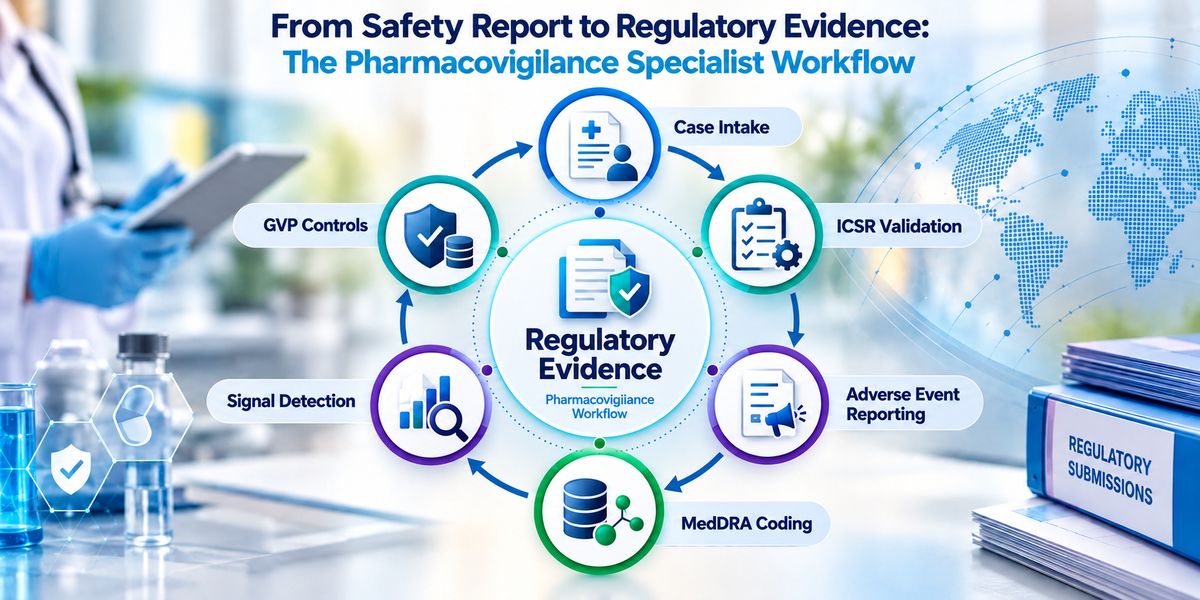
The infographic shows how ICSR processing, MedDRA coding, signal detection, and GVP controls turn safety reports into traceable regulatory evidence.
ICSR Processing and Adverse Event Reporting (Available PDF)
This guidance explains how to manage valid ICSRs, follow-up information, reporting timelines, case narratives, and duplicate cases. It helps teams maintain complete, consistent, and traceable adverse event reporting.
MedDRA Coding and Case Quality (Available PDF)
This document explains how MedDRA supports standardized coding of medical information in pharmacovigilance. It also highlights coding consistency, terminology selection, and quality checks that improve reliable safety analysis.
Signal Detection, Validation, and Escalation (Available PDF)
This guidance describes how potential safety signals move from detection and validation to prioritisation, assessment, and regulatory action. It helps pharmacovigilance teams document decisions and escalate important safety concerns consistently.
Inspection-Ready Documentation and GVP Controls (Available PDF)
This guidance explains how pharmacovigilance inspections assess systems, responsibilities, records, and compliance controls. It shows why complete documentation, traceable processes, and effective corrective actions are essential for inspection readiness.
Skills Employers Look for in Pharmacovigilance Jobs
Employers expect pharmacovigilance professionals to combine technical knowledge with strong professional judgment. Core skills include ICSR processing, MedDRA coding, safety database use, GVP knowledge, and accurate regulatory documentation. However, technical expertise alone is not enough. Specialists also need analytical thinking, attention to detail, clear communication, and effective cross-functional collaboration. Therefore, strong candidates can manage safety data accurately while explaining risks and decisions clearly to different stakeholders.
How to Start a Pharmacovigilance Career
A pharmacovigilance career usually starts with a relevant scientific or healthcare background and a clear understanding of drug safety principles. Candidates should then build practical skills in case processing, adverse event reporting, MedDRA, and GVP requirements. However, employers also look for evidence that applicants can apply this knowledge in real workflows. Therefore, strong entry-level candidates combine technical training with careful documentation, analytical thinking, and targeted applications for suitable pharmacovigilance jobs.
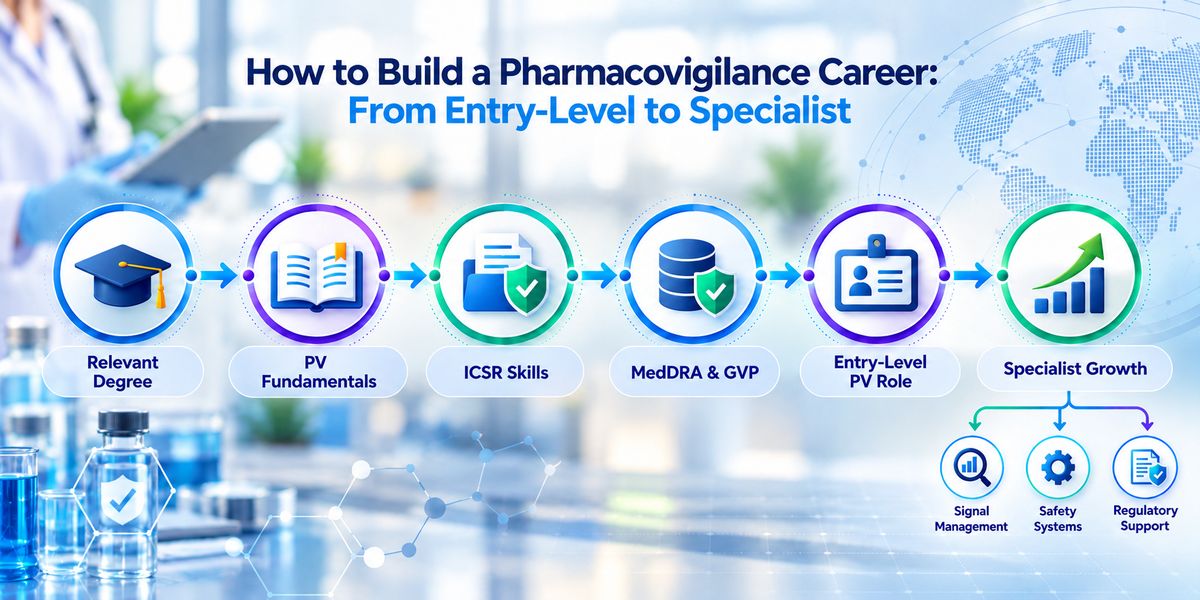
The infographic shows the practical steps from relevant education and PV fundamentals to ICSR skills, GVP knowledge, entry-level roles, and specialist growth, helping readers understand how a pharmacovigilance career develops.
Final Words
In 2024, EMA-requested pharmacovigilance inspections identified 22 findings in adverse reaction management and reporting. This trend shows that inspectors continue to examine how well companies control routine safety activities, not simply whether procedures exist. Therefore, a pharmacovigilance specialist must turn accurate case handling, timely follow-up, and reliable documentation into evidence that can withstand regulatory scrutiny.

Quality Management System
We work with pharmaceutical teams to design, implement, and run effective Quality Management Systems, covering change control, CAPA, deviations, and audits to support consistent GMP compliance.
FAQ
Yes. Life-science and healthcare graduates can enter pharmacovigilance, but employers often expect practical knowledge of ICSR processing, adverse event reporting, MedDRA coding, safety databases, and GVP requirements.
Employers commonly look for case-processing skills, MedDRA knowledge, regulatory reporting awareness, safety-database experience, and understanding of GVP. Strong documentation, analytical judgment, attention to detail, and communication are also important.
A specialist supports inspection readiness by maintaining complete safety records, meeting reporting timelines, applying controlled case-processing procedures, and documenting signal-management activities. These controls help demonstrate traceability and compliance during regulatory inspections.
References

Marco Klinger is Head of Quality Services at Zamann Pharma Support, where he leads consulting teams through complex regulatory and quality-driven projects. He brings more than 15 years of hands-on compliance experience across regulated industries. His work includes close collaboration with companies such as Reckitt, Sanofi, Biotech, Biotest, and others. Marco has deep expertise in medical device development, aseptic manufacturing, and the design, implementation, and management of complete quality management systems within GMP-regulated environments.