
In fiscal year 2023, FDA investigators cited deficient environmental monitoring systems in aseptic areas 38 times, which placed this finding among the ten most frequent drug observations on Form 483s. Behind many of these citations lies a recurring problem. Most sites run two systems that watch the same rooms, yet only one of them can serve as the GMP record. The building management system (BMS) controls HVAC keeps pressures and temperatures in range and supports pharmaceutical engineering teams in daily operation. The environmental monitoring system (EMS), by contrast, independently records critical parameters, raises GMP alarms and provides the validated evidence that inspectors review. Therefore, the real question in BMS vs EMS in pharma is not which system performs better, but which one proves control and how far each must be validated. For this reason, a clearly documented boundary between the two systems has become a core expectation under EU GMP Annex 1 and 21 CFR Part 11.
Table of Contents
BMS vs EMS in Pharma Explained in GMP Terms
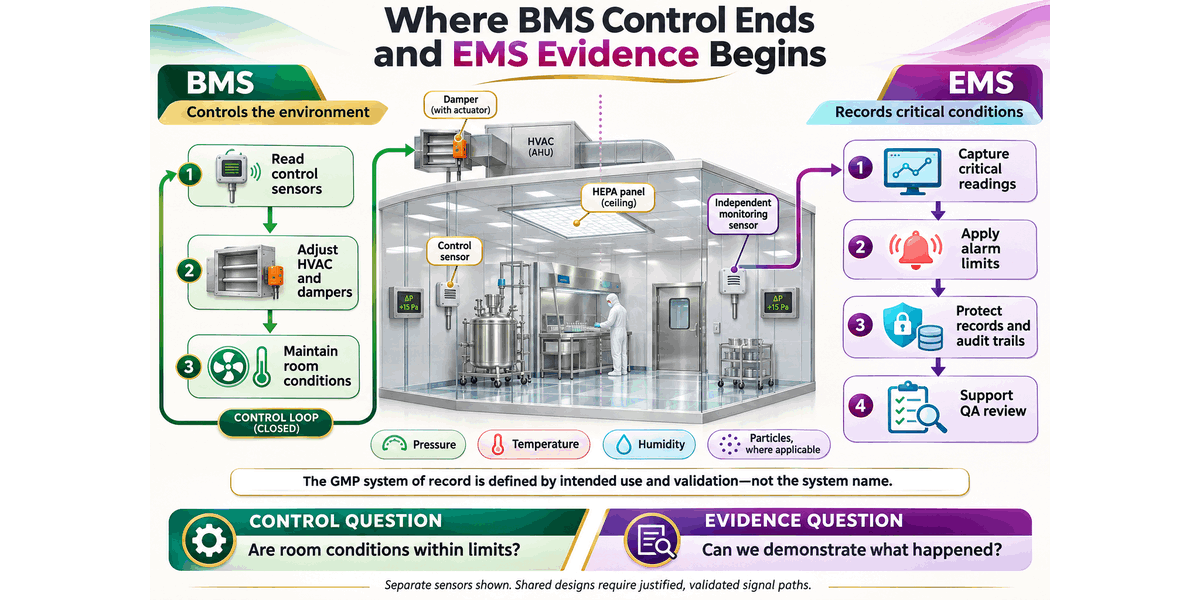
A building management system (BMS) controls HVAC, room pressures, temperature and humidity, while an environmental monitoring system (EMS) independently records GMP-critical conditions and raises alarms when results leave their limits. As a result, most sites treat the EMS as the system of record validated under GAMP 5, whereas the BMS follows good engineering practice with targeted qualification of its GMP-relevant functions.
The table below compares both systems across four key GMP criteria, so you can see exactly where control ends and documented evidence begins.
| GMP Criterion | Building Management System (BMS) | Environmental Monitoring System (EMS) |
|---|---|---|
|
Core purpose |
Controls and monitors HVAC, and often lighting, power, fire and security systems |
Monitors and records GMP-critical environmental conditions without controlling equipment |
|
Role in the GMP record |
Acts as the control system |
Acts as the designated system of record |
|
Validation approach |
Follows good engineering practice, with initial qualification and risk-based periodic re-qualification of GMP-relevant functions |
Undergoes computerized system validation following GAMP 5 |
|
Data integrity controls |
Usually lacks native 21 CFR Part 11 compliance, and an added data historian needs its own validation |
Provides audit trails, access control and electronic signatures in line with 21 CFR Part 11 and EU GMP Annex 11 |
How Inspectors Decide Which System Holds the GMP Record
Inspectors rarely start with the software. Instead, they start with a decision, such as a released batch or a closed excursion, and then trace it back to the data behind it. Under FDA expectations, electronic data becomes a CGMP record as soon as a site generates it to meet a CGMP requirement, so the origin of every environmental value matters. Next, the inspector asks which system produced that value, whether the site formally designated it as the system of record, and whether validation, access control and audit trail review protect its data integrity. If the answer leads to an unvalidated BMS trend, a finding usually follows. For this reason, well-prepared sites name the EMS as the GMP record in their system inventory and validation documents, and they keep BMS data in a clearly supporting role.
The infographic below follows a single environmental reading from sensor to batch record and shows the exact point where BMS control ends and EMS evidence begins.
4 Decisions That Separate Control from Evidence
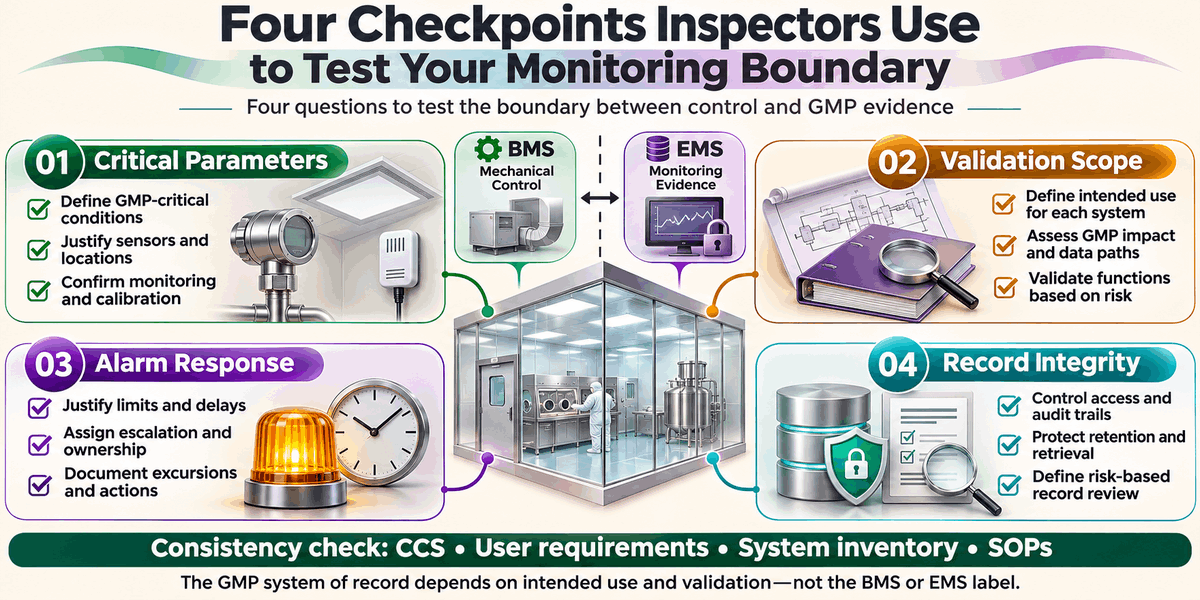
A clear boundary between the BMS and the EMS never appears by accident. Instead, it grows out of a few documented decisions that quality, engineering and validation teams make together. Each decision answers one practical question: which parameters the EMS must watch, how deeply each system needs validation, how alarms reach the right people, and how the record stays trustworthy. Moreover, inspectors expect to find the same answers in the contamination control strategy, the user requirements and the SOPs. When these documents disagree, the boundary looks improvised, and that weakness quickly turns into a discussion point during the inspection.
The four decisions below define that boundary, starting with the parameters that need continuous monitoring and ending with the audit trails that protect the GMP record.
- Critical Parameters Under Continuous Monitoring (Available PDF)
- Validation Depth for BMS and EMS (Available PDF)
- Alarm Limits and Excursion Response (Available PDF)
- Audit Trails and Part 11 Readiness (Available PDF)
The infographic below turns these four decisions into the checkpoints inspectors typically walk through, so you can test your own monitoring boundary before an audit does it for you.
Critical Parameters Under Continuous Monitoring (Available PDF)
The EMS should watch only GMP-critical conditions such as differential pressure, particles, temperature and humidity. Annex 1 requires critical pressure differences to be continuously monitored and recorded.
Validation Depth for BMS and EMS (Available PDF)
The EMS needs full computerized system validation under GAMP 5. The BMS needs only targeted qualification and risk-based re-qualification.
Alarm Limits and Excursion Response (Available PDF)
Alarm limits, delays and escalation must be defined before an excursion occurs. Every alarm should be documented and every deviation investigated.
Audit Trails and Part 11 Readiness (Available PDF)
A trustworthy GMP record depends on audit trails, access control and electronic signatures. Reviewers must check audit trails together with the records they approve.
Inspection Findings That Expose a Blurred Boundary
Most findings in this area do not stem from missing technology. Instead, they stem from a boundary that nobody wrote down. A typical case begins when QA releases a batch based on BMS trend data, and the inspector then learns that the BMS was never validated for that purpose. In response, the CAPA usually designates the EMS as the system of record and updates the GMP impact assessment. Similarly, shared differential pressure sensors without calibration traceability trigger findings, so sites must bring every GMP-relevant sensor into a controlled calibration program.
Alarm delays set without a rationale also draw attention, because EU GMP Annex 1 expects each delay to be justified in the contamination control strategy. Finally, when nobody reviews the audit trail of the cleanroom monitoring system, the CAPA typically introduces a risk-based review procedure with clear ownership.
Choosing a Continuous Monitoring System Architecture
No single continuous monitoring system architecture suits every site, yet each option shifts the validation burden in a different direction. A fully separate set-up gives the EMS its own sensors, network and database, so the scope of EMS validation stays focused, and GMP data remains independent of HVAC changes. A shared-sensor design, by contrast, splits one signal between both systems, which saves hardware but demands controlled calibration and a validated signal path to protect data integrity.
An integrated platform goes one step further and combines control and monitoring in a single system; consequently, the site must prove that non-GMP functions cannot affect GMP data. In every case, however, the deciding factor is not the technology itself but a documented, risk-based justification that inspectors can follow from the user requirements to the contamination control strategy.
Final Words
Enforcement pressure is not easing. In 2025, FDA issued 303 warning letters to drug and biologics firms, roughly 59% more than in the previous year, and documentation and data integrity gaps featured in many of them. Against this background, BMS vs EMS in pharma is no longer a technical debate for engineers alone; instead, it has become a question of evidence that quality assurance must defend. Sites that formally name the EMS as the system of record, justify their alarm settings and review audit trails routinely will face inspectors with clear answers. Therefore, the most valuable next step is simple: review your GMP impact assessment and system inventory and confirm that both tell the same story.

Qualification and Validation for GMP Systems
Our team supports the planning, execution, and maintenance of qualification and validation activities, including IQ, OQ, and PQ, to keep GMP-regulated systems compliant and under control.
FAQ
Yes, but only for its GMP-relevant functions. A BMS that controls critical parameters such as differential pressure needs initial qualification and risk-based periodic re-qualification. Full computerized system validation under GAMP 5 is reserved for the EMS, which serves as the GMP system of record.
Only if the BMS is validated for that intended use and meets 21 CFR Part 11 and EU GMP Annex 11 requirements, including audit trails, access control and electronic signatures. Most sites avoid this risk by designating a validated EMS as the system of record and using BMS trends as supporting information only.
Yes, if the sensor is calibrated, the signal split is documented, and the EMS signal path is validated to protect data integrity. However, independent sensors simplify validation and inspections, especially for critical pressure differences that EU GMP Annex 1 requires to be continuously monitored and recorded.
references

Marco Klinger is Head of Quality Services at Zamann Pharma Support, where he leads consulting teams through complex regulatory and quality-driven projects. He brings more than 15 years of hands-on compliance experience across regulated industries. His work includes close collaboration with companies such as Reckitt, Sanofi, Biotech, Biotest, and others. Marco has deep expertise in medical device development, aseptic manufacturing, and the design, implementation, and management of complete quality management systems within GMP-regulated environments.