
Leaks can drain as much as 20 to 30 percent of a compressor’s output in a poorly maintained plant, according to US Department of Energy data. That number usually starts an energy discussion. In a GMP facility, however, it raises a sharper question: if a site cannot account for its air, how can it prove what that air carries? Inspectors, in fact, ask exactly that. They follow the line from the intake to the last valve on the filling machine, and they expect data at every step. As a result, compressed air in pharma industry settings is no longer treated as a background utility. So, in this guide, we trace that path the way an auditor does and show where smart pharmaceutical engineering stops contamination before it reaches the product.
Table of Contents
Compressed Air in Pharma Industry Beyond the Utility Room
Walk through any tablet line or filling suite, and you will find compressed air doing quiet but critical work. In fact, a US Department of Energy market assessment found that about 70 percent of manufacturing facilities run some form of compressed air system. In GMP terms, however, not every drop of that air carries the same risk. Pharmaceutical compressed air becomes a direct-impact utility the moment it touches the product, the primary packaging or a product-contact surface, for example when it dries tablet coatings, blows out vials or protects an aseptically filled batch. By contrast, air that only drives valves, cylinders or gauges counts as indirect impact, as long as it never reaches the product. EU GMP Annex 1 draws the same line. That single classification decision, therefore, shapes every specification, test and qualification step that follows.
How Inspectors Read a Compressed Air System
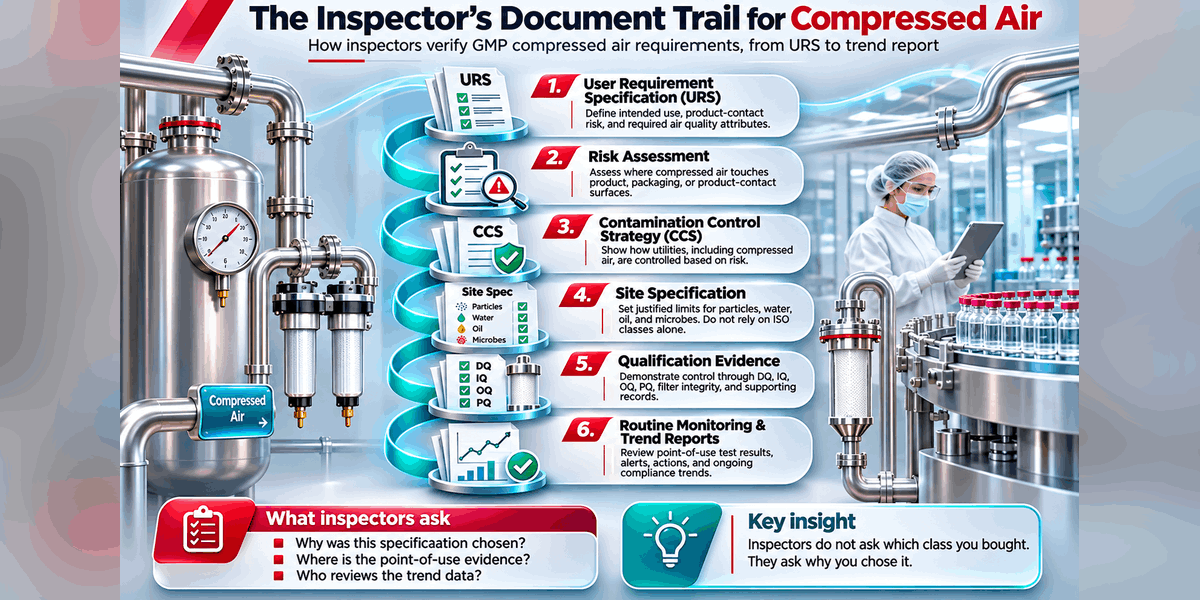
Inspectors rarely start at the compressor. Instead, they open the contamination control strategy and look for the section on compressed air. EU GMP Annex 1 lists 16 elements a CCS should cover, and utilities appear fourth on that list, so a missing air section stands out fast. Next, the inspector checks whether the site has turned that risk into GMP compressed air requirements of its own. A specification copied straight from ISO 8573-1 purity classes rarely passes this test, because ISO classifies air quality but does not decide what your product needs. Annex 1 makes the same point: utility controls should match the risk, and the site should document that risk in its CCS. In short, inspectors do not ask which class you bought. They ask why you chose it.
The infographic below follows the documents an inspector traces, from the URS and risk assessment through the CCS and qualification to routine trend reports and shows how each step proves your air is fit for use.
4 Checkpoints Along the Air Path
The US Department of Energy notes that a typical compressed air system can run at just 10 to 15 percent overall efficiency. In other words, most of the energy fed into the compressor never reaches the point of use. Air quality follows the same pattern. Air can leave the compressor clean and still pick up oil, water or microbes on its way through dryers, piping and hoses. For that reason, a compliant system needs more than a good machine in the utility room. Instead, it needs a control at every stage the air passes through, and proof that each control still works.The four checkpoints below follow that path in order: the specification that defines the air, the drying and filtration that protect it, and the qualification evidence that proves it holds.
- Product Contact Sets the Specification (Available PDF)
- Dryers and the Pressure Dew Point Target (Available PDF)
- The Point of Use Sterile Filter as the Last Barrier (Available PDF)
- Qualification Evidence That Survives an Audit (Available PDF)
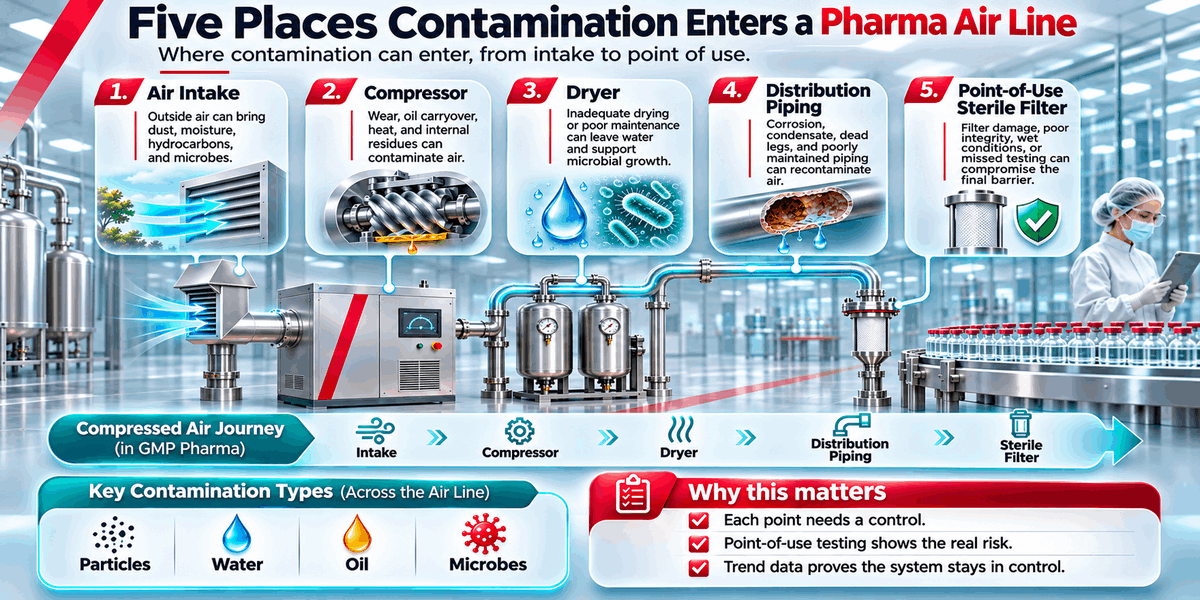
The infographic below maps the five points where contamination can enter the air line, from the intake to the point of use, so you can see exactly where each control must sit.
Product Contact Sets the Specification (Available PDF)
Product-contact use, not the compressor brochure, decides how clean the air must be.
This section shows how to turn ISO 8573-1 purity classes into a justified site limit for particles, water and oil.
Dryers and the Pressure Dew Point Target (Available PDF)
Saturated air cools in the piping and condenses, which leads to corrosion and microbial growth.
Set the pressure dew point by end use, then choose the dryer that can hold it.
The Point of Use Sterile Filter as the Last Barrier (Available PDF)
The sterile filter at the point of use is the last control before the air meets the product.
It only works if it stays dry and integral and is tested at defined intervals.
Qualification Evidence That Survives an Audit (Available PDF)
Inspectors judge qualification by its evidence, from URS and DQ through IQ, OQ and PQ.
Seasonal variation, requalification and change control keep that evidence valid over time.
Download EudraLex Volume 4, Annex 15: Qualification and Validation Here
Compressed Air Quality Testing at the Last Point of Use
Many sites miss one detail. ISO 8573-7 tells you how to test compressed air for viable microorganisms, yet it sets no limit and no testing frequency. That gap shapes how compressed air quality testing works on site, because the numbers become yours to justify. First, the team chooses sampling points through risk assessment, starting with the drops where air meets the product rather than the outlet next to the compressor. Next, it tests particles, pressure dew point, oil and microbes against limits written into the URS. Annex 1 also expects periodic microbial monitoring of the gas at the point of use, so a clean result in the utility room proves very little. Finally, alert and action limits turn single results into trends, and trends are what inspectors read. In practice, one well-explained excursion does less damage than a year of data nobody reviewed.
The table below shows what each test measures, which method defines it, and what evidence inspectors expect to see at the point of use.
| Parameter | What is measured | Test method | Commonly specified limit (example) | Evidence inspectors expect |
|---|---|---|---|---|
|
Solid particles |
Particle count per m³ by size range |
ISO 8573-4 |
Class 1: ≤20,000 (0.1–0.5 µm), ≤400 (0.5–1 µm), ≤10 (1–5 µm) per m³ |
Trend data for each point of use, with alert and action limits |
|
Water |
Pressure dew point |
ISO 8573-3 |
Class 2: pressure dew point of −40 °C or lower |
Dew point records and dryer alarm history |
|
Oil |
Total oil, covering aerosol, liquid and vapour |
ISO 8573-2 (aerosol) and ISO 8573-5 (vapour) |
Class 1: ≤0.01 mg/m³ total oil |
Results covering both aerosol and vapour, even with oil-free compressors |
|
Microorganisms |
Viable colony-forming units per m³ |
ISO 8573-7 (no limit or frequency set) |
Matched to the cleanroom grade where the air is released, e.g. Grade A no growth, Grade B 10 CFU/m³ |
Periodic point-of-use results and excursion investigations |
|
Point-of-use sterile filter |
Filter integrity |
Integrity test as specified by the filter manufacturer |
Sterilising-grade filter, 0.22 µm maximum, integrity tested at installation and periodically |
Integrity test records and filter change history |
Common Inspection Gaps in Pharma Compressed Air Systems
Inspectors find the same compressed air gaps repeatedly, and most of them start with paperwork rather than hardware. The classic one is a specification that simply says “oil-free,” with no limit in mg/m³. Here the numbers matter. The European Pharmacopoeia caps oil in medicinal air at 0.1 mg/m³, while ISO 8573-1 Class 1 sits ten times lower at 0.01 mg/m³. Yet the standard oil detector tube cannot read below 0.1 mg/m³, so a site that claims Class 1 but tests with tubes cannot prove its own specification. Beyond oil, auditors often find sampling done only next to the compressor, sterile filters that were never integrity tested, and a contamination control strategy that never mentions compressed air. Each gap looks small on its own. Together, however, they tell an inspector that nobody owns the air once it leaves the utility room.
Final Words
Enforcement is not slowing down. In fiscal year 2025, the FDA published 112 warning letters citing drug GMP rules, the highest number in more than 20 years, and control of microbiological contamination remained among the most frequently cited failures. Compressed air rarely makes the headline of those letters. Still, it sits quietly behind many of them, because air that touches the product is part of the contamination story whether a site documents it or not. As a result, the strongest sites treat compressed air in pharma industry operations as evidence to manage, not a utility to forget. In the end, a clear specification, tested points of use and a trend report someone reads will protect you better than any compressor badge.

Qualification and Validation for GMP Systems
Our team supports the planning, execution, and maintenance of qualification and validation activities, including IQ, OQ, and PQ, to keep GMP-regulated systems compliant and under control.
FAQ
EU GMP does not mandate a single ISO 8573-1 class. Annex 1 requires the site to specify particle, water, oil and microbial limits based on how the air is used. Many sites choose Class 1.2.1 for direct product contact, but that choice must be justified through risk assessment and documented in the URS and contamination control strategy.
Neither ISO 8573-7 nor the European Pharmacopoeia sets microbial limits or a testing frequency for compressed air. Sites therefore align limits with the cleanroom grade where the air is released, for example no growth for Grade A, 10 CFU/m³ for Grade B and 100 CFU/m³ for Grade C. Annex 1 also expects periodic microbial monitoring at the point of use.
No. An oil-free compressor only keeps lubricant out of the compression chamber, while hydrocarbons can still enter through the intake air. Sites should define a numeric total oil limit in mg/m³ and test both oil aerosol and vapour. Standard detector tubes read only down to 0.1 mg/m³, so they cannot prove a Class 1 limit of 0.01 mg/m³.
references
- EU GMP Annex 1: Manufacture of Sterile Medicinal Products
- EU GMP Annex 15: Qualification and Validation
- FDA Guidance on Sterile Drug Products Produced by Aseptic Processing
- US DOE Improving Compressed Air System Performance Sourcebook
- ECA Requirements for Compressed Air in the Pharmaceutical Industry
- GMP Journal FDA Warning Letter Report for Fiscal Year 2025

Marco Klinger is Head of Quality Services at Zamann Pharma Support, where he leads consulting teams through complex regulatory and quality-driven projects. He brings more than 15 years of hands-on compliance experience across regulated industries. His work includes close collaboration with companies such as Reckitt, Sanofi, Biotech, Biotest, and others. Marco has deep expertise in medical device development, aseptic manufacturing, and the design, implementation, and management of complete quality management systems within GMP-regulated environments.