
A water system can pass its conductivity checks and still be unsuitable for injectable manufacturing. Here’s why: USP requires Water for Injection to contain less than 0.25 EU/mL of bacterial endotoxins, while Purified Water has no equivalent general endotoxin requirement. Consequently, WFI vs purified water is more than a quality comparison; it directly affects patient safety and GMP compliance. For pharmaceutical engineering teams, the real challenge is maintaining the right water quality from generation to the point of use.
Inhaltsverzeichnis
WFI vs Purified Water Through the Lens of USP and Ph. Eur
Two pharmaceutical water systems can pass the same chemical purity checks yet serve very different purposes. Under USP <1231> and Ph. Eur. monographs 0008 and 0169, Purified Water supports mainly nonparenteral applications, while Water for Injection (WFI) represents the highest standard pharmacopoeial water grade for injectable manufacturing. However, WFI must also meet a bacterial endotoxin limit of less than 0.25 IU/mL. This distinction makes water-grade selection a critical GMP decision, not simply a matter of choosing cleaner water.
Inspectors Trace Every Water Grade Back to Patient Risk
EU GMP Annex 1 cites circulation above 70°C as one way to limit microbial growth in WFI systems. Yet even a well-controlled water loop cannot justify using the wrong pharmaceutical water grade. Inspectors assess water quality against the product’s route of administration and each manufacturing step. For parenteral medicines, WFI is required in formulations and, generally, for final rinsing of product-contact equipment. Consequently, substituting Purified Water where WFI is required can trigger serious GMP findings and raise concerns about endotoxin contamination and patient safety.
4 Specification Gaps Between Water for Injection and USP Purified Water
Two water grades can meet the same chemical purity tests yet carry very different microbial risks. USP <1231> identifies microbial action levels of 10 CFU/100 mL for WFI and 100 CFU/mL for Purified Water. More importantly, WFI must meet a bacterial endotoxin limit of 0.25 EU/mL, while USP Purified Water has no equivalent general requirement. Therefore, conductivity results alone cannot prove that water is suitable for injectable manufacturing.
Four technical differences reveal where water quality specifications, microbial monitoring, and generation methods affect GMP compliance.
- Bacterial Endotoxins as the Deciding Specification (Available PDF)
- Microbial Action Limits and the Sample Volume Shift (Available PDF)
- Conductivity and Total Organic Carbon in Continuous Monitoring (Available PDF)
- Distillation Versus Membrane Routes to Water for Injection (Available PDF)
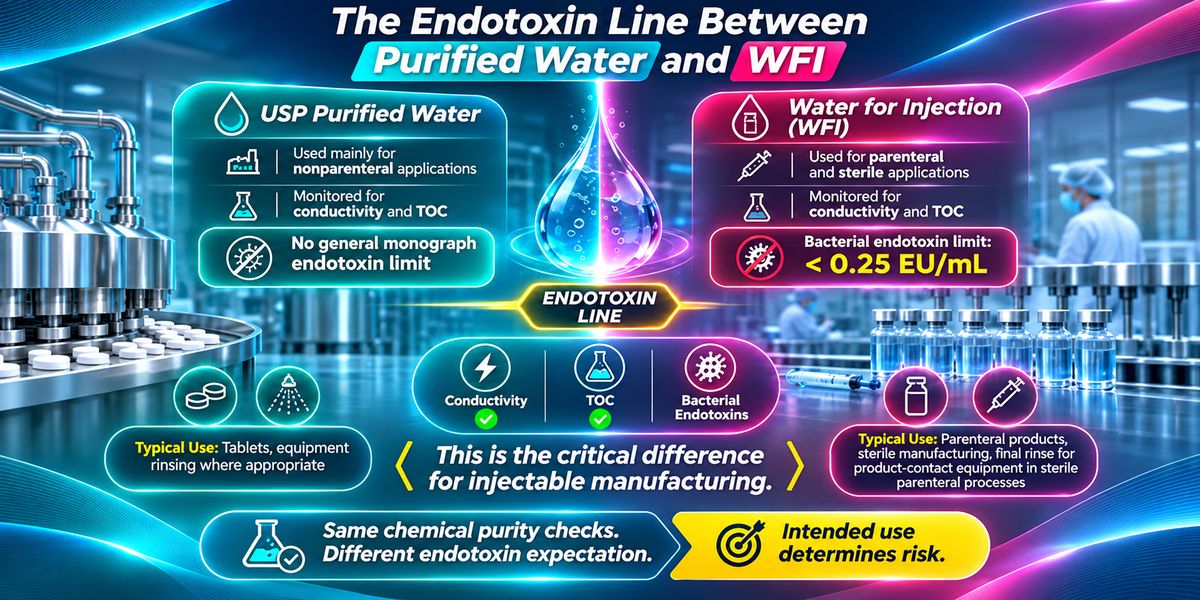
This infographic compares the 0.25 EU/mL WFI endotoxin limit with USP Purified Water requirements, highlighting a critical distinction for injectable drug manufacturing.
Bacterial Endotoxins as the Deciding Specification (Available PDF)
WFI must contain no more than 0.25 EU/mL of bacterial endotoxins. However, USP Purified Water has no general monograph endotoxin limit, making intended use critical.
Download 2024 EDQM Virtual Training Programme — Module 4: Microbiology Here
Microbial Action Limits and the Sample Volume Shift (Available PDF)
USP <1231> identifies action levels of 10 CFU/100 mL for WFI and 100 CFU/mL for Purified Water. These are microbial monitoring action levels, not universal monograph acceptance limits.
Download USP <1231> Pharmaceutical Water Standards (PDF) here
Conductivity and Total Organic Carbon in Continuous Monitoring (Available PDF)
Both grades require conductivity and TOC testing. Continuous monitoring can reveal chemical quality changes, but it cannot replace microbial or endotoxin testing.
Download Annex 1 — Manufacture of Sterile Medicinal Products Here
Distillation Versus Membrane Routes to Water for Injection (Available PDF)
WFI can be produced through distillation or suitably controlled, validated membrane-based processes. However, both routes must consistently deliver pharmacopoeial WFI quality
Download WHO TRS 1025, Annex 3 — Non-Distillation WFI Production Here
Pharmaceutical Water Grades Matched to Each Process Step
A cleaning cycle can start with potable water and finish with Water for Injection (WFI). The difference comes down to patient risk, not simply water purity. According to EMA guidance, pharmaceutical water grades must match the manufacturing stage, product type, and route of administration. Therefore, selecting the wrong grade can compromise contamination control, even when the water system passes its routine quality tests.
The table below maps common pharmaceutical manufacturing and cleaning steps to their minimum acceptable water grades under European regulatory guidance.
| Manufacturing or Cleaning Step | Application | Minimum Water Grade |
|---|---|---|
|
API synthesis |
APIs without sterility or apyrogenicity requirements |
Potable Water |
|
Wet granulation and tablet coating |
Solid dosage manufacturing |
Purified Water |
|
Parenteral formulation |
Injectable medicines |
WFI |
|
Final equipment rinse / CIP |
Non-sterile medicines |
Purified Water or higher manufacturing grade |
|
Final equipment rinse / CIP |
Sterile parenteral medicines |
WFI |
Loop Design and Monitoring Evidence Inspectors Ask For
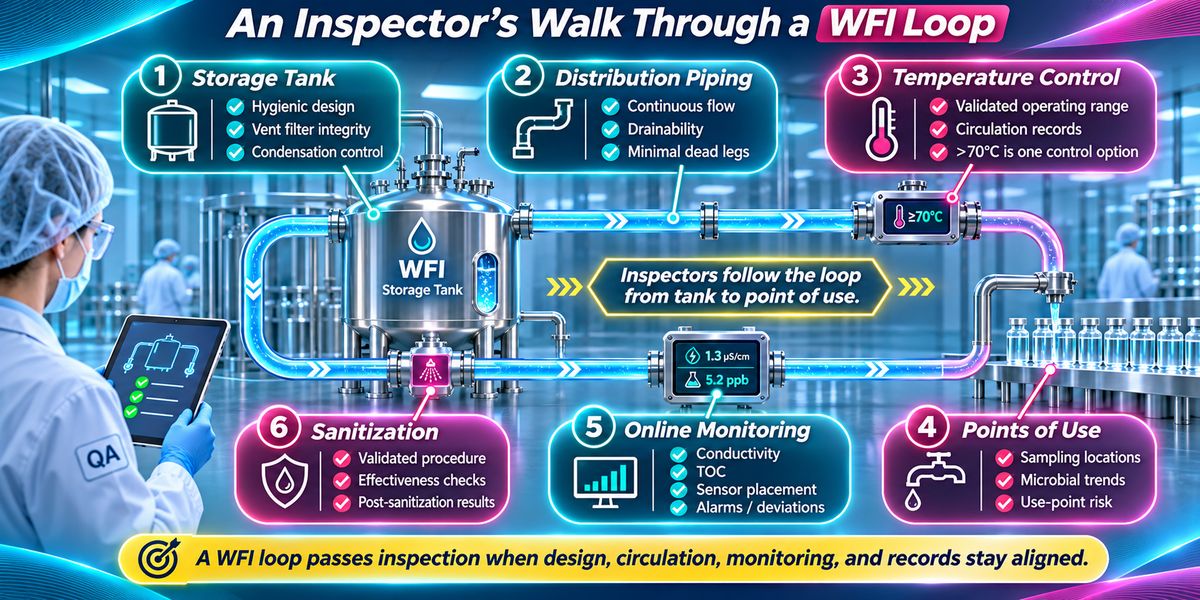
A WFI system may pass routine laboratory tests while contamination risks remain hidden in the distribution loop. During an inspection, GMP inspectors look beyond test results. They follow the water from the storage tank to each point of use, checking whether the system stays under control. They also examine temperature trends, sanitization records, and signs of microbial growth. EU GMP Annex 1 identifies circulation above 70°C as one way to limit microbial growth, although this is not mandatory for every WFI system.
What inspectors look for during a WFI loop inspection:
- Storage Tanks: Hygienic design, vent filters, and condensation control.
- Distribution Piping: Proper flow, effective drainage, and minimal dead legs.
- Temperature Control: Validated operating temperatures and circulation records.
- Points of Use: Sampling locations, microbial trends, and contamination risks.
- Online Monitoring: Conductivity, TOC results, sensor placement, and deviations.
- Sanitization: Validated procedures, effectiveness checks, and supporting records.
This infographic highlights six critical WFI loop inspection points, showing how storage, circulation, monitoring, and sanitization support GMP compliance and contamination control.
Final Words
In FY2025, FDA recorded 53 Form 483 citations concerning microbial contamination controls for sterile drug products. Although these findings were not specific to water systems, they highlight the continued scrutiny of contamination control. Ultimately, WFI vs purified water is about more than meeting specifications. Manufacturers must demonstrate that water quality, distribution controls, and monitoring records consistently protect patients.

Qualification and Validation for GMP Systems
Our team supports the planning, execution, and maintenance of qualification and validation activities, including IQ, OQ, and PQ, to keep GMP-regulated systems compliant and under control.
FAQ
No. EMA guidance requires Water for Injection (WFI) for the final rinse of product-contact equipment used in sterile parenteral manufacturing. Using Purified Water instead can create contamination risks and GMP compliance concerns.
USP WFI has a bacterial endotoxin limit of 0.25 EU/mL, while USP Purified Water has no general monograph endotoxin limit. However, specific applications may require additional endotoxin controls.
QA should review microbial trends, sampling locations, circulation conditions, and sanitization effectiveness. Additionally, the investigation should assess potential batch impacts and document corrective actions under GMP requirements.
No. The European Pharmacopoeia permits distillation and suitable membrane-based processes, including reverse osmosis combined with appropriate treatment. However, manufacturers must validate the process and demonstrate consistent microbial and endotoxin control.
references
- EMA Guideline on the Quality of Water for Pharmaceutical Use
- European Commission – EU GMP Annex 1 (PDF)
- WHO TRS 1033, Annex 3 – Water for Pharmaceutical Use (PDF)
- EDQM – Bacterial Endotoxin Testing in WFI and Purified Water
- FDA Guide to Inspections of High Purity Water Systems
- FDA – Pyrogen and Endotoxins Testing Guidance (2026)
- WHO TRS 1025, Annex 3 – WFI Production Methods (PDF)

Marco Klinger is Head of Quality Services at Zamann Pharma Support, where he leads consulting teams through complex regulatory and quality-driven projects. He brings more than 15 years of hands-on compliance experience across regulated industries. His work includes close collaboration with companies such as Reckitt, Sanofi, Biotech, Biotest, and others. Marco has deep expertise in medical device development, aseptic manufacturing, and the design, implementation, and management of complete quality management systems within GMP-regulated environments.