
Five hundred and ten. That is how many Form 483s FDA investigators issued drug facilities in fiscal year 2023, and equipment cleaning and maintenance ranked among the ten most-cited observations. Behind many of those findings sits a decision made long before the inspection, often at the design stage. For example, a valve placed where no one can clean it, or a utility loop modified without formal review, can resurface years later as a citation. As a result, pharmaceutical engineering now works as a frontline GMP function rather than a back-office technical task. However, many sites still manage design, qualification and maintenance as separate projects. This guide connects them into one lifecycle, from the first user requirement to the final requalification. Along the way, it shows what inspectors check at each stage and where GMP engineering and validation services make a measurable difference.
Inhaltsverzeichnis
Pharmaceutical Engineering Inside a GMP Framework
Ask a university, and pharmaceutical engineering means drug discovery or a promising career path. Ask a GMP inspector, however, and the answer becomes far more practical. In a regulated plant, the discipline covers everything that physically makes, holds, or moves a medicine, including the facility, the process equipment, the critical utilities, and the automation that controls them. Each of these elements must do more than simply work. It must also prove, in writing, that it works for its intended use. For this reason, engineers in this field draft user requirements, review designs with QA, and support qualification long before the first batch. In practice, a pump is never just a pump. Instead, it becomes a qualified asset with a maintenance history, a calibration record, and a change log. Consequently, an engineering signature now carries real regulatory weight. Put simply, GMP turns engineering from a technical service into documented evidence of control.
How Inspectors Read Engineering Decisions
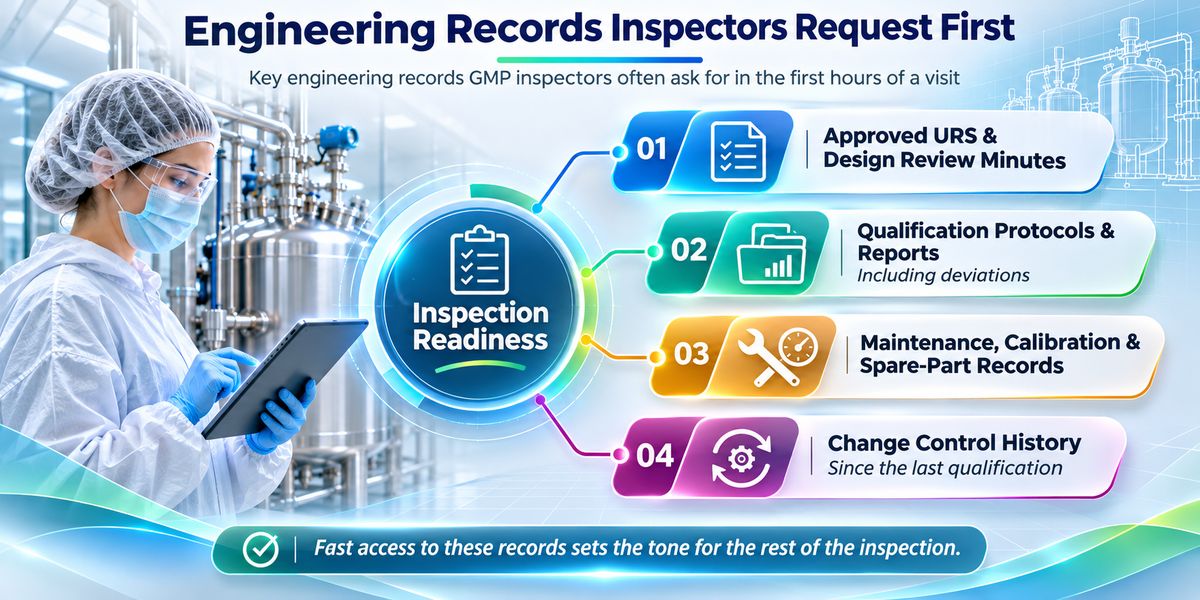
Inspectors rarely begin with the drawing. They begin with a symptom, such as a deviation that keeps coming back, a cleaning result that failed twice, or an alarm nobody escalated. Then they work backwards. Did the user requirements specification ever describe the need that failed? And did anyone at design review challenge it, or did the signature simply follow the agenda? From there, the qualification package comes out, and the questions get sharper. Did the IQ, OQ, and PQ test take the real risk, or only what was easy to test? Maintenance and calibration history then closes the loop, because it shows whether the system still behaves as qualified. Once that chain breaks, the finding no longer belongs to production alone. That is why the same records land on the table early:
- The approved URS and design review minutes
- Qualification protocols and reports, including their deviations
- Maintenance, calibration, and spare-part records
- Change control history since the last qualification
Sites that pull these up in minutes usually feel the difference by lunchtime.
The infographic below shows the engineering records inspectors usually ask for in the first hours of a visit, and why producing them quickly sets the tone for the rest of the inspection.
Engineering Touchpoints From Facility Design to Qualification
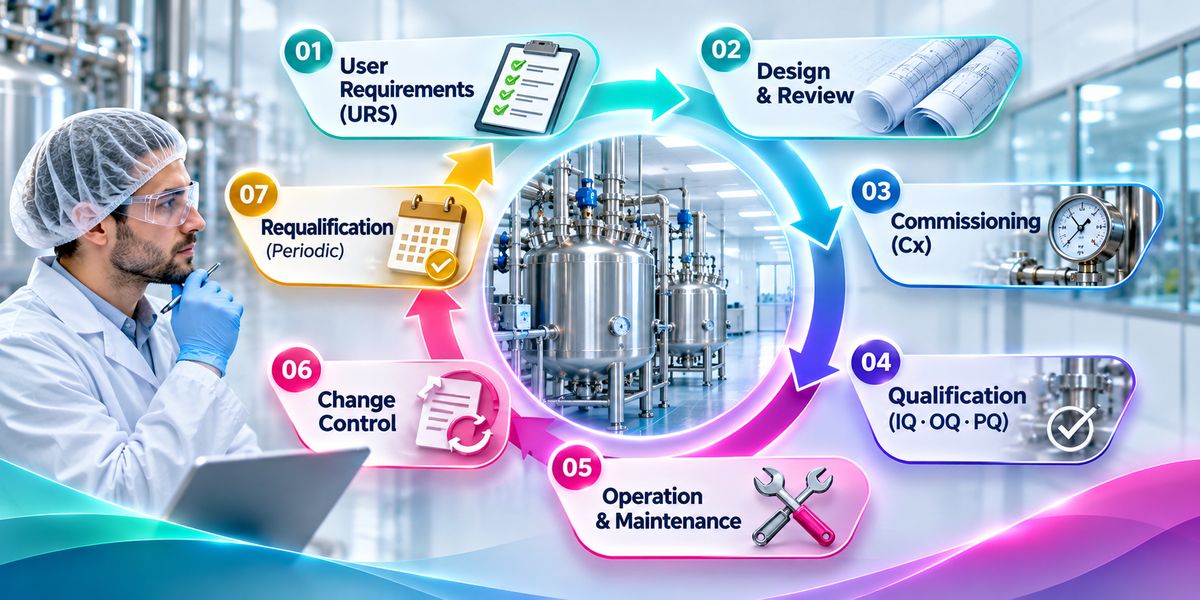
Most GMP problems surface far from where they started. A cramped corridor drawn at concept stage becomes a mix-up risk in routine production. Likewise, one vague line in the URS can turn into a qualification test that nobody can confidently pass or fail. Each stage, therefore, inherits both the strengths and the shortcuts of the stage before it. ICH Q9 quality risk management gives engineers and QA a shared way to spot those weak points early, while changes are still cheap. In other words, good engineering is less about perfect drawings and more about decisions that stay defensible years later.
The four stages below follow that inheritance in order, from the first requirement on paper to the moment a modified system must prove itself again.
- GMP Facility Design and User Requirements (Available PDF)
- Commissioning and Qualification in Practice (Available PDF)
- Critical Utilities and Equipment Qualification (Available PDF)
- Change Control and Requalification (Available PDF)
The infographic below maps each engineering stage, from the first URS to periodic requalification, so you can see exactly where an early weak decision turns into a later inspection finding.
GMP Facility Design and User Requirements (Available PDF)
Good facility design starts long before construction, with a URS that turns GMP risks, material flows and cleanroom grades into clear, testable requirements. When that document is vague, every later stage inherits the gap, from design qualification to routine monitoring.
Download EudraLex Volume 4, Annex 1: Manufacture of Sterile Medicinal Products Here
Commissioning and Qualification in Practice (Available PDF)
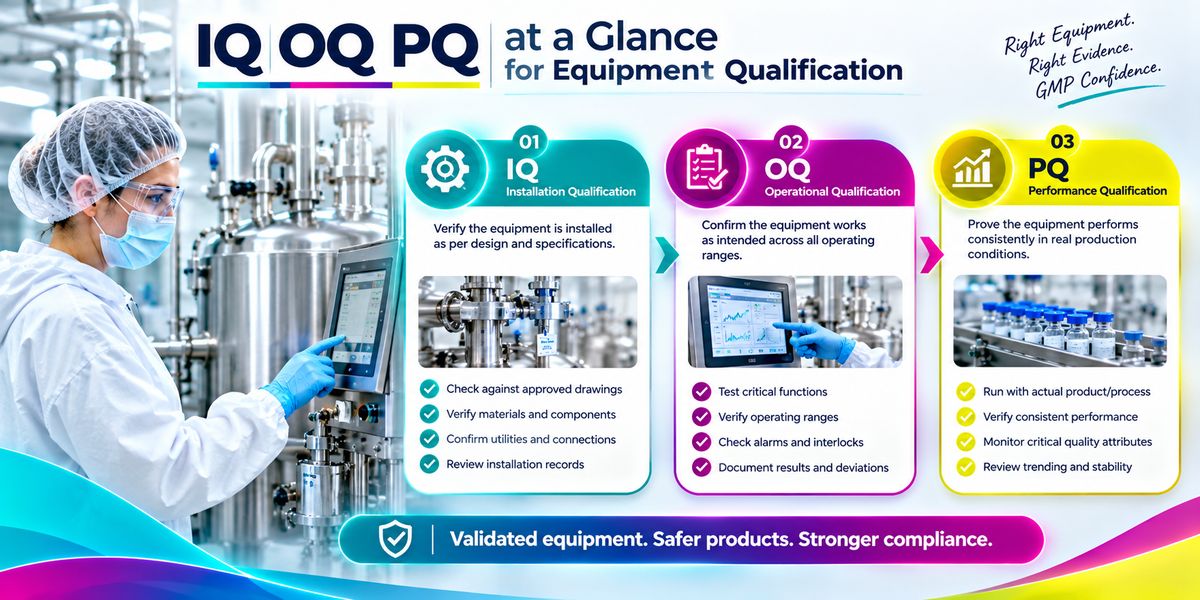
Commissioning and qualification prove that equipment is installed and works as the URS intended, moving from FAT and SAT through IQ, OQ and PQ. A risk-based approach in line with ASTM E2500 and EU GMP Annex 15 lets teams reuse sound commissioning data instead of testing everything twice.
Download EudraLex Volume 4, Annex 15: Qualification and Validation Here
The infographic below compares IQ, OQ and PQ side by side, showing what each stage proves and why skipping or merging stages without justification creates inspection risk.
Critical Utilities and Equipment Qualification (Available PDF)
Water, clean steam, compressed gases and HVAC rarely appear on a batch record, yet they touch almost every product a site makes. That is why inspectors expect these utilities to be qualified, monitored and trended as carefully as the process equipment they feed.
Change Control and Requalification (Available PDF)
No qualified system stays unchanged for long, because parts wear out, software updates and processes evolve. Effective change control uses ICH Q9 quality risk management to decide when a change needs requalification and keeps the validated state intact for the system’s entire life.
Download ICH Guideline Q10 on Pharmaceutical Quality System Here
Common Engineering Gaps Found During Inspections
Inspection findings seldom describe a problem as an engineering failure. Instead, they record its consequences, such as equipment that cannot be cleaned effectively, a water system that moves out of trend or a modification made without a documented impact assessment. When inspectors trace these observations back to their origin, a limited number of root causes usually emerges. In some cases, the URS did not define a requirement that later proved critical. In others, qualifications focused on parameters that were easy to test rather than those that carried the greatest risk. More frequently, however, the system was qualified correctly but gradually moved away from its validated state, because maintenance, calibration and change control were never linked back to the qualification baseline. Consequently, similar gaps appear across solid dosage, biotech and sterile operations alike. Each of them can be prevented through defined engineering controls, which require considerably less effort than remediation after an inspection.
The following table maps each recurring engineering gap to the observation it typically triggers, the requirement involved and the preventive control that addresses it.
| Engineering gap | What inspectors typically cite | Governing requirement | Preventive engineering control |
|---|---|---|---|
|
Vague or outdated URS |
Equipment not of appropriate design or size for its intended use |
21 CFR 211.63; EU GMP Annex 15 (URS as the reference point throughout the validation lifecycle) |
Keep the URS current, verify it during design qualification and trace every requirement to a test |
|
Weak facility layout and flows |
Inadequate separation of operations, creating mix-up or contamination risk |
21 CFR 211.42; EU GMP Annex 1 (separation measures and airflow visualisation studies) |
Design separated flows early and confirm airflow patterns both at rest and in operation |
|
Equipment hard to clean, maintain or calibrate |
Equipment not cleaned or maintained at appropriate intervals, or not calibrated under a written programme |
21 CFR 211.67(a) and 211.68(a); EU GMP Annex 15 (calibration as part of IQ) |
Design for cleanability, finalise maintenance procedures after OQ and link calibration to qualification records |
|
Utilities and cleanrooms not requalified |
Systems not shown to remain in a state of control over time or across seasons |
EU GMP Annex 15 (requalification,, at a justified frequency); EU GMP Annex 1 (seasonal variation; maximum 6 months for grade A and B, 12 months for grade C and D) |
Qualify utilities across seasonal variation, trend monitoring data and set justified requalification intervals |
|
Uncontrolled engineering changes |
Change not assessed for impact on validation, calibration or maintenance |
EU GMP Annex 15 (change control); ICH Q10 (change management system) |
Use risk-based impact assessment before approval and review effectiveness after implementation |
Digital Engineering Records and Data Integrity
Most engineering records no longer live in binders. Calibration results sit in a CMMS, change requests move through an eQMS, and many sites now execute IQ and OQ protocols on tablets. However, a digital record only carries regulatory weight if it stays attributable, complete, and protected by a reliable audit trail. Inspectors therefore look beyond the screen. They ask who entered a calibration value, whether anyone edited it afterwards, and how the system itself was validated. This focus continues to grow, as the revision of EU GMP Annex 11 and the proposed Annex 22 on artificial intelligence raise expectations for computerized systems. In practice, an unvalidated CMMS can weaken an otherwise sound equipment qualification package. For this reason, engineering teams should treat their digital tools as GMP systems, with defined user access, ALCOA+ controls, and periodic audit trail review.
Building an Inspection-Ready Engineering Function
An inspection-ready engineering function does not depend on a last-minute effort before an audit. Instead, it relies on clear ownership. Engineering designs, installs and maintains the systems, while QA approves the criteria that define a qualified state. When these roles blur, records lose their authority and decisions lose their rationale. A practical structure usually rests on four elements:
- A good engineering practice procedure that controls specifications, drawings and vendor documents
- QA review at fixed points, such as URS approval, qualification reports and major changes
- A single register that shows the qualification status of every GMP-relevant system
- Regular GMP training for engineers, not only for production staff
Even with this structure, internal teams sometimes lack capacity or specialist knowledge. In such cases, external pharmaceutical engineering services or pharmaceutical validation support can fill the gap, for example during a new facility project, a water system upgrade or inspection remediation. However, the site must still review and approve every protocol and report, because regulators hold the manufacturer accountable for the result.
Final Words
Enforcement is no longer easing. In fiscal year 2025, FDA issued 303 warning letters to drug and biologics manufacturers, a 59% rise from the previous year. At the same time, European regulators are revising Annex 15 and Annex 11, which points in the same direction on both sides of the Atlantic. Inspectors now expect evidence that systems remain in a state of control, not just proof that they passed qualification once. For this reason, pharmaceutical engineering can no longer stop at handover. Instead, it must stay connected to QA through every change, requalification and maintenance cycle. Sites that build this link early usually face fewer surprises, and they also spend less time rebuilding records under inspection pressure.

Qualification and Validation for GMP Systems
Our team supports the planning, execution, and maintenance of qualification and validation activities, including IQ, OQ, and PQ, to keep GMP-regulated systems compliant and under control.
FAQ
Yes, in part. EU GMP Annex 15 allows tests performed during FAT, SAT or other stages to support IQ and OQ without repetition, provided the approach is justified and transport or installation does not affect functionality. Under an ASTM E2500 risk-based approach, subject matter experts verify critical aspects, and QA approves the documented rationale.
EU GMP Annex 1 sets a maximum requalification interval of 6 months for grade A and B cleanrooms and 12 months for grade C and D. For other equipment and utilities, Annex 15 requires a justified, risk-based frequency. Requalification is also required after significant changes, such as replacing final filters or modifying HVAC settings.
Yes, when it stores GMP-relevant data such as calibration results, maintenance history or equipment status. EU GMP Annex 11 and FDA 21 CFR Part 11 apply to these records, so the system needs risk-based validation, controlled user access, audit trails and periodic review to keep data attributable and complete.
references

Marco Klinger is Head of Quality Services at Zamann Pharma Support, where he leads consulting teams through complex regulatory and quality-driven projects. He brings more than 15 years of hands-on compliance experience across regulated industries. His work includes close collaboration with companies such as Reckitt, Sanofi, Biotech, Biotest, and others. Marco has deep expertise in medical device development, aseptic manufacturing, and the design, implementation, and management of complete quality management systems within GMP-regulated environments.