
In FY 2024-25, exports from Indore’s Special Economic Zone dropped by more than 9% after pharma shipments fell, partly because one major drug maker faced USFDA approval hurdles. That single setback shows how closely the Pithampur pharma cluster depends on inspection outcomes. At the same time, revised Schedule M now holds domestic units to WHO-aligned GMP standards. As a result, many plants must satisfy two sets of inspectors with one quality system. For that reason, pharma consultancy in Indore has become a compliance priority rather than an optional extra. Specifically, targeted pharma consultancy services help manufacturers close GMP gaps, strengthen validation and data integrity, and build the evidence inspectors expect.
Table of Contents
Pharma Consultancy in Indore Beyond Turnkey Plant Design
Most plants in Pithampur look impressive on day one. The cleanrooms are finished, the HVAC is running, and the engineers have signed off on the equipment. But inspectors don’t spend long admiring the building. Instead, they ask for a batch record, check who changed the result in the lab system, and want to know how the team closed last year’s deviation. Pharma consultancy in Indore mostly works in that gap between a finished plant and one that can explain itself. In practice, that means risk assessments, equipment qualification, CAPA follow-up, and getting staff ready for the questions they’ll hear. A turnkey contractor usually steps back once it hands over the site, while a GMP consultancy in Indore picks up where that work ends.
Where USFDA Scrutiny Meets Revised Schedule M
Many plants in the Pithampur pharma cluster run two kinds of business under one roof. Some lines make generics for the US market, so they sit on the USFDA’s inspection radar. Meanwhile, the same site often supplies Indian buyers, which brings state drug inspectors in to check revised Schedule M. The two visits rarely happen in the same month, but both teams end up in the same QC lab, reading the same SOPs. So when a team closes a deviation without finding the real root cause, the problem rarely stays small. It can show up as an FDA 483 observation on one visit and a Schedule M finding on the next. That’s why pharmaceutical regulatory consulting works best here when it builds one quality system that can stand up to both inspections.
The map below shows which inspectors review each part of a typical Pithampur site, and where a single weak quality system can trigger findings on both fronts.
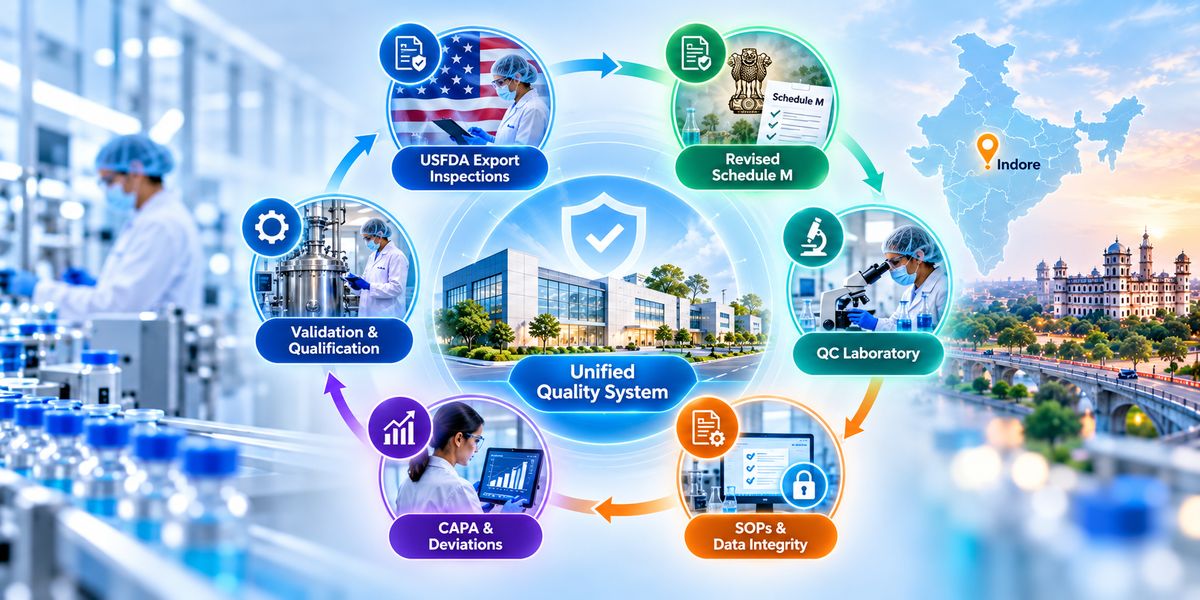
Compliance Areas That Decide USFDA Inspection Outcomes
Inspectors don’t try to check everything in a week, and they don’t need to. Instead, they pick a thread, maybe a failed assay or a late CAPA, and follow it until it either holds or breaks. At most sites, that thread tends to run through the same few places. Some of them sit in the quality system on paper, while others live on the lab bench and the production floor. If a site gets these areas right, the rest of the inspection usually goes far more smoothly.
Four of those places come up repeatedly, and each one deserves a closer look.
- Revised Schedule M Gap Assessment (Available PDF)
- Data Integrity Controls in QC Laboratories (Available PDF)
- Lifecycle Process Validation Evidence (Available PDF)
- Preventing FDA 483 Observations (Available PDF)
Revised Schedule M Gap Assessment (Available PDF)
A GMP gap assessment compares what a plant does today with what revised Schedule M now asks for, from the quality system and risk management to qualification and computerized systems. The useful result is a short, ranked action list with owners and deadlines that the site can start working on the next day.
Data Integrity Controls in QC Laboratories (Available PDF)
Many data integrity findings start in the QC lab, where shared logins, unreviewed audit trails, and reprocessed chromatograms leave records that nobody can fully reconstruct. Inspectors expect every result to be attributable, complete, and traceable from the instrument to the final report.
Lifecycle Process Validation Evidence (Available PDF)
FDA treats process validation as a three-stage lifecycle: process design, process qualification, and continued process verification. Pharmaceutical validation services often add the most value in the third stage, where trends tend to slow down once the PPQ batches pass.
Preventing FDA 483 Observations (Available PDF)
FDA investigators organize drug inspections around six systems, with the quality system always in scope, and they group Form 483 observations under those same systems. USFDA audit consulting uses that structure to run mock inspections and to test whether each CAPA fixed its root cause.
Download FDA Drug Inspection Program Here
The infographic below follows a single finding from the Form 483 to a verified CAPA, which is exactly what investigators review when they come back for a follow-up inspection.
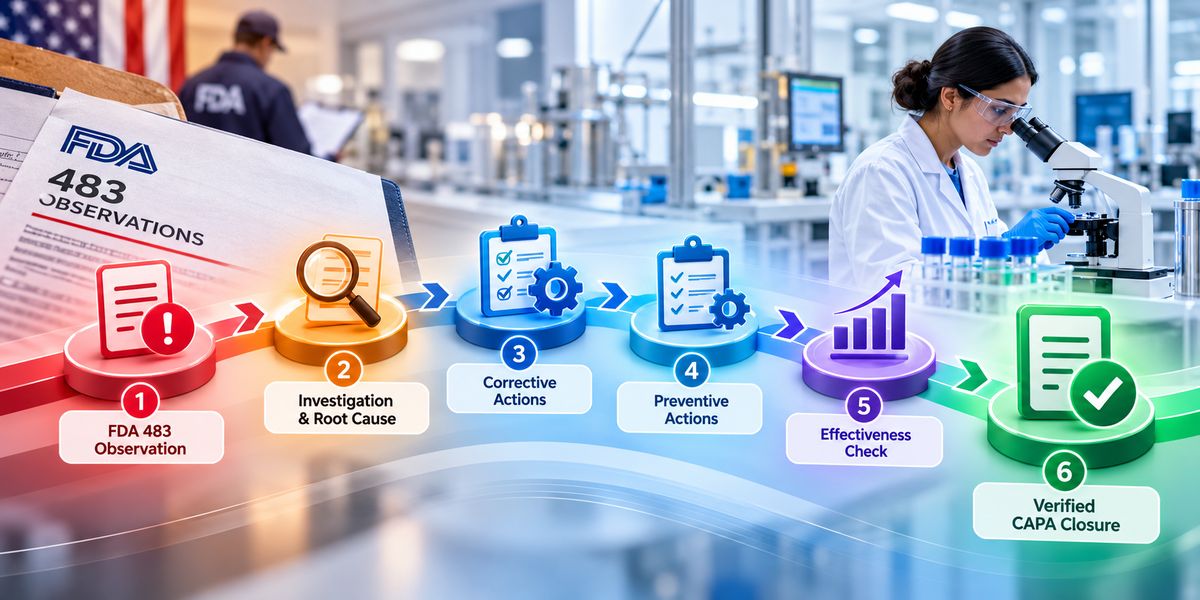
Engineering Firms Versus GMP Consultancies
Search for pharma consultants in Indore, and most of the results come from engineering and turnkey firms. That makes sense, because the region keeps building new lines and cleanroom space. Still, a contractor who designs your HVAC and a consultant who prepares you for a USFDA visit are doing very different jobs. One works mainly on the building and its utilities. The other works on the quality system that every FDA drug inspection must cover. So, before you sign anything, it helps to be clear about which problem you’re trying to solve.
The table below compares the two models’ side by side, so you can see what each one delivers and which part of an inspection it supports.
| Aspect | Engineering and turnkey firms | GMP compliance consultancies |
|---|---|---|
|
Core work |
Design, supply, installation, and commissioning of plant layout, HVAC, utilities, and cleanrooms |
Gap assessments, SOPs, validation protocols, CAPA plans, and mock audits |
|
When sites usually hire them |
New plant, expansion, or major facility upgrade |
Before an inspection, after a Form 483, or during a revised Schedule M upgrade |
|
FDA inspection system they support most |
Facilities and equipment system, covering buildings, utilities, and equipment qualification |
Quality system, which every FDA drug manufacturing inspection must include |
|
Revised Schedule M link |
Premises, equipment, and utility requirements |
PQS, quality risk management, product quality review, change control, and annual self-inspection |
Red Flags in a Consulting Proposal
Most consulting proposals look good on paper. The trouble usually shows up a few months later, when the consultant has left and an inspector starts asking questions the site team can’t answer. A few warning signs tend to appear early, though, if you read the proposal closely. For that reason, it’s worth checking the scope line by line before you agree to anything:
- SOPs that read like they were written for a different plant, because they probably were.
- A gap report that lists findings but never says who owns each CAPA or when it’s due.
- A fixed price for “full Schedule M compliance” before anyone has done a proper GMP gap assessment.
- No time set aside to train your own QA team, so the knowledge walks out the door with the consultant.
- A promise of a “guaranteed clean inspection,” which no honest consultant can make.
Final Words
Indian regulators have changed how they choose which plants to visit. Since late 2022, they’ve carried out more than 960 risk-based inspections, and about 860 of those ended in enforcement action, from stop-production orders to license cancellations. The sites weren’t picked at random. Instead, regulators looked at compliance history, quality failures, recalls, and complaints, and CDSCO is now piloting AI tools that rank facilities by risk. In other words, a plant’s own records now help decide whether an inspector shows up. For Pithampur sites that also answer to the USFDA, that’s the clearest reason to bring in pharma consultancy in Indore early, while there’s still time to get those records in order.

Quality Management System
We work with pharmaceutical teams to design, implement, and run effective Quality Management Systems, covering change control, CAPA, deviations, and audits to support consistent GMP compliance.
FAQ
You have 15 business days from the day the Form 483 is issued. FDA reviews on time replies before it decides on a warning letter, so send yours within that window even if some fixes are still in progress, along with a CAPA plan and dates.
It compares your site with the GMP requirements added under G.S.R. 922(E), mainly PQS, risk management, product quality review, qualification, change control, computerized systems, supplier audits, and annual self-inspection. The useful outcome is a ranked upgrade plan with owners and deadlines.
The usual ones are shared logins, audit trails nobody reviews, reprocessed chromatograms without the original results, and uncontrolled blank forms. Each one breaks ALCOA, which means an inspector can no longer trust who did what, and when.
Set measurable success criteria when you open the CAPA, then check them with objective data after implementation, such as deviation trends, repeat-failure rates, or internal audit results. Document the review and close the CAPA only when the issue has not recurred over a defined monitoring period.
references

Marco Klinger is Head of Quality Services at Zamann Pharma Support, where he leads consulting teams through complex regulatory and quality-driven projects. He brings more than 15 years of hands-on compliance experience across regulated industries. His work includes close collaboration with companies such as Reckitt, Sanofi, Biotech, Biotest, and others. Marco has deep expertise in medical device development, aseptic manufacturing, and the design, implementation, and management of complete quality management systems within GMP-regulated environments.