
Under the old IVD Directive, only about 8% of in vitro diagnostics needed a notified body before reaching the EU market. Today, however, the IVDR brings roughly 80% of them under notified body control, and auditors now look past the label to the quality system behind it. As a result, IVD registration has become a test of evidence, not paperwork. Notified bodies check how you classify each device, how you prove its performance and how your technical documentation links every claim to data. Meanwhile, EUDAMED registration became mandatory in May 2026. Therefore, this guide follows each step from risk class to CE marking, so your file holds up under review.
Table of Contents
How IVD Registration Differs from Medical Device Approval
Unlike most medical devices, an IVD never touches the patient. Instead, it examines a specimen such as blood, urine or tissue, so its main risk lies in a wrong result that drives a wrong clinical decision. For this reason, the IVDR replaces clinical evaluation with performance evaluation, built on scientific validity, analytical performance and clinical performance. The intended user also shapes the risk. A test that trained lab staff runs carries less risk than the same test in lay hands, so most self-tests land in class C. Companion diagnostics go further still, because they decide which patients receive a specific medicine. As a result, the notified body must consult a medicines agency before it certifies them.
Why IVDR Compliance Starts with the Quality System?
A technical file rarely fails on its own; it fails because of the system behind it. For this reason, notified bodies assess IVD regulatory requirements through the ISO 13485 quality system. First, they trace product claims to design control. Next, they test whether change control blocks unapproved changes. Finally, they check that post-market data feed back into risk management and performance evaluation. When any link breaks, a nonconformity follows, and the certificate waits. That wait is costly, since half of IVDR notified bodies now need 13 to 18 months to issue a new QMS certificate. IVDR compliance therefore begins long before submission.
The Route to IVD CE Marking, Step by Step
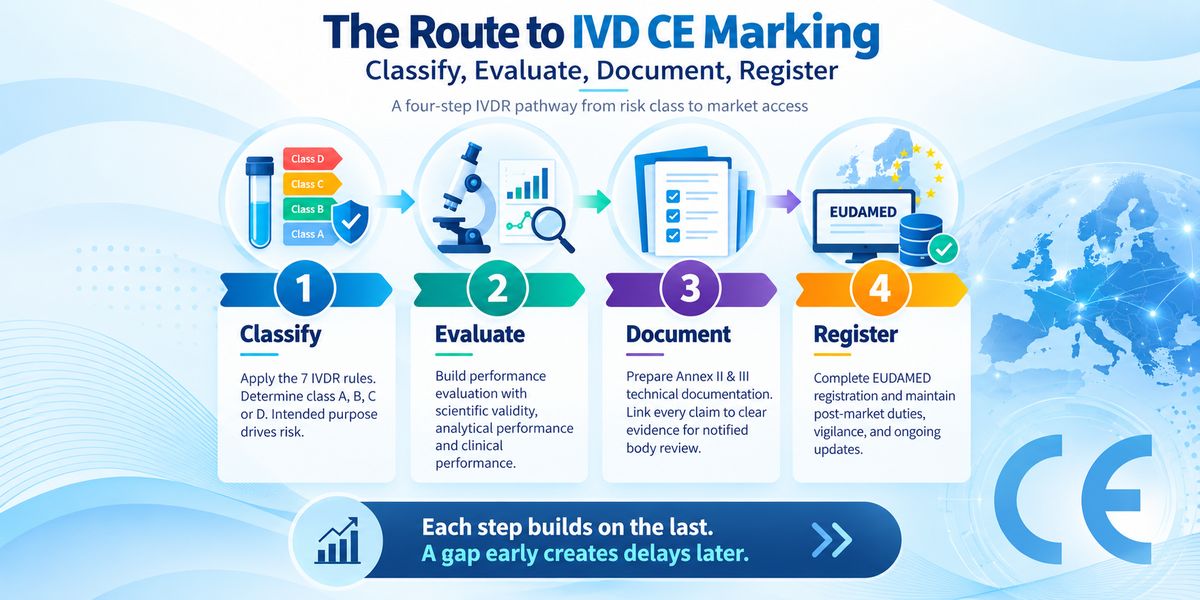
IVD CE marking works less like a checklist and more like a chain. Each step hands its output to the next, so an early mistake travels all the way to the notified body. For example, a device placed in the wrong class follows the wrong conformity assessment route, and the evidence behind it no longer fits the claim. Likewise, a performance evaluation that misses the intended purpose leaves gaps in the technical documentation. Getting the order right, therefore, saves months of rework.
The four steps below follow that chain, from risk classification to performance evidence, technical documentation and EUDAMED registration.
- IVD Classification Under the Seven IVDR Rules (Available PDF)
- Performance Evaluation and Clinical Evidence (Available PDF)
- Technical Documentation for Notified Body Review (Available PDF)
- EUDAMED Registration and Post-Market Duties (Available PDF)
The infographic below maps the four steps from risk class to EUDAMED registration, showing how each output feeds the next and why a gap at any stage resurfaces later.
IVD Classification Under the Seven IVDR Rules (Available PDF)
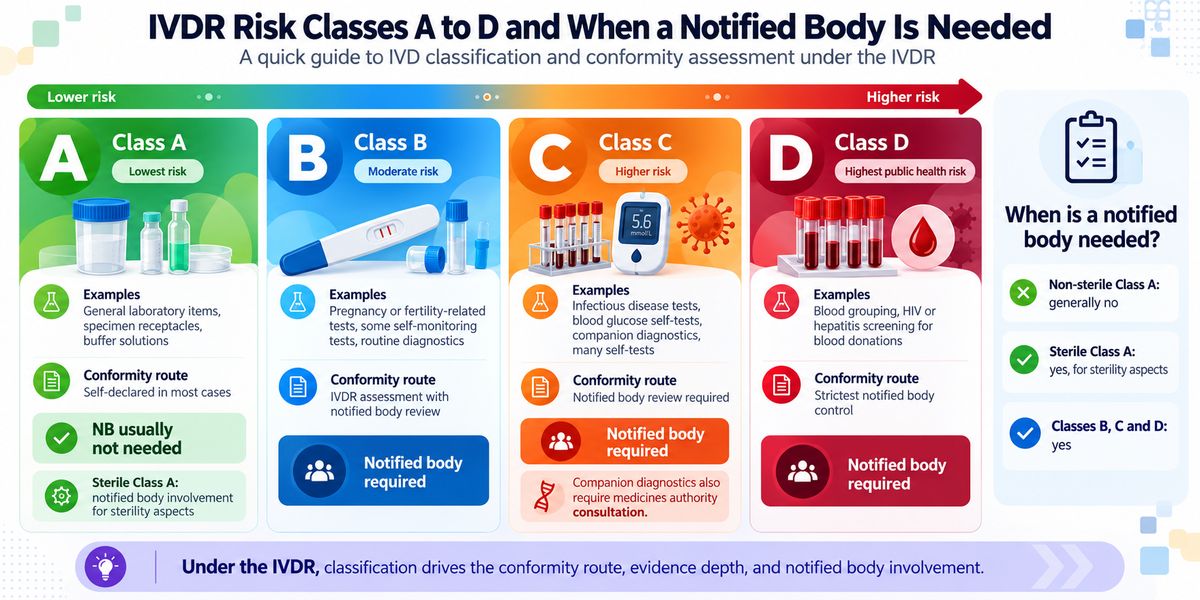
Under the IVDR, the intended purpose decides the risk class, and seven rules in Annex VIII sort every IVD into class A, B, C or D. That class then sets the conformity assessment route, the depth of notified body review and, for companion diagnostics, a mandatory medicines agency consultation.
Download MDCG 2020-16 rev.5 on IVD Classification Rules (2026) Here
The infographic below shows the four IVDR risk classes and where notified body review becomes mandatory.
Performance Evaluation and Clinical Evidence (Available PDF)
The IVDR asks manufacturers to prove three things: that the analyte links to a clinical condition, that the test measures it correctly, and that its results hold up in the target population. This performance evaluation never closes, because post-market data must keep feeding the report for the life of the device.
Technical Documentation for Notified Body Review (Available PDF)
Annex II and III technical documentations must show, in one clear and searchable file, how the device meets every applicable general safety and performance requirement. Notified bodies name incomplete submissions and poorly structured files as the most common causes of review delays.
EUDAMED Registration and Post-Market Duties (Available PDF)
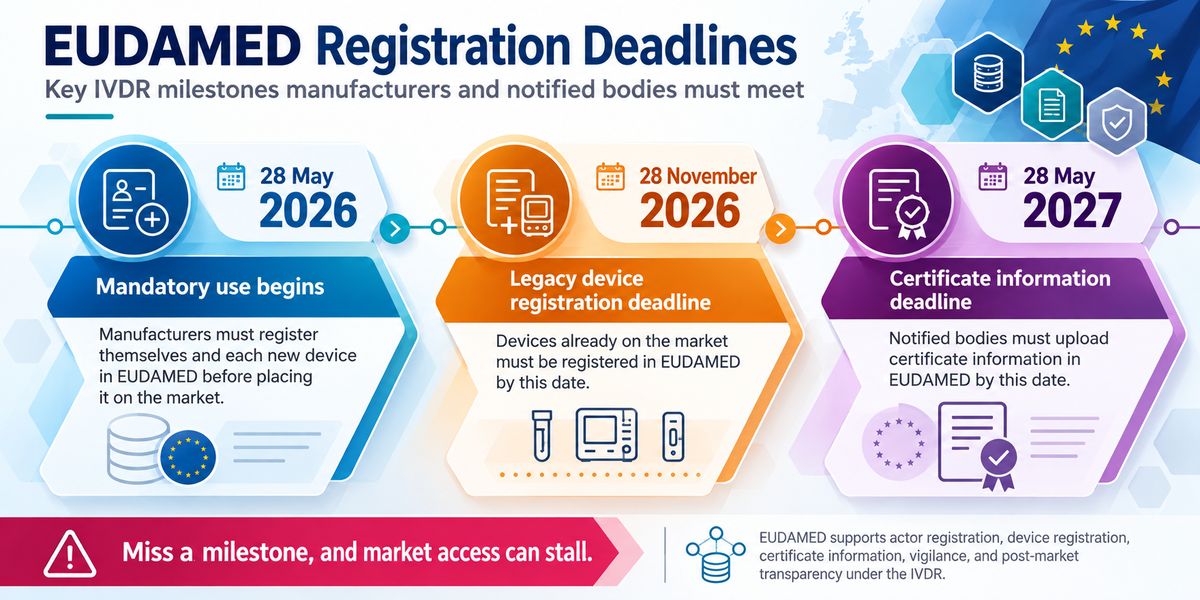
Since 28 May 2026, manufacturers must register themselves and each new device in EUDAMED before market placement; devices already on sale must follow by 28 November 2026. Vigilance, PSURs and PMPF then keep the certificate valid.
Download the EUDAMED Roll-Out Q&A Here
The infographic below sets out the three EUDAMED milestones manufacturers and notified bodies must meet, so you can see which obligation applies to your devices and when it falls due.
IVDR Transition Periods and the Deadlines Ahead
Regulation (EU) 2024/1860 gave legacy IVDs more time, but it did not give unconditional time. Instead, a device keeps its place on the market only while the manufacturer meets every condition. First, the quality system had to comply with the IVDR by 26 May 2025. Next, the manufacturer must apply to a notified body and sign a written agreement within fixed windows. In addition, the device must stay free of significant changes to its design or intended purpose. Meanwhile, the Commission’s December 2025 targeted revision is still under negotiation in Parliament and Council, so the current deadlines still apply.
The table below shows, for each group of legacy IVDs, the last dates to apply to a notified body, sign the agreement and keep placing the device on the EU market.
| Legacy IVD group | Apply to a notified body by | Sign written agreement by | Placing on the market allowed until |
|---|---|---|---|
|
IVDD notified body certificate |
26 May 2025 |
26 September 2025 |
31 December 2027 |
|
Self-declared under IVDD, now class D |
26 May 2025 |
26 September 2025 |
31 December 2027 |
|
Self-declared under IVDD, now class C |
26 May 2026 |
26 September 2026 |
31 December 2028 |
|
Self-declared under IVDD, now class B or sterile class A |
26 May 2027 |
26 September 2027 |
31 December 2029 |
|
Non-sterile class A |
No transition period |
No transition period |
Full IVDR compliance since 26 May 2022 |
IVD Registration Beyond the EU
An IVDR file rarely stays in Europe, because its performance data and ISO 13485 quality system support other markets. In the US, however, a CE certificate has no legal weight, so the FDA still requires a 510(k), De Novo or PMA, although IVDR performance data often form its backbone. Great Britain is simpler: on 21 October 2026, the UK confirmed long-term acceptance of CE-marked IVDs, with MHRA registration still required. Meanwhile, one MDSAP audit covers quality system checks for the US, Canada, Brazil, Japan and Australia. In short, a strong IVDR file is the fastest start to global market access.
Final Words
Notified bodies are no longer short of applications; they are short of complete ones. In the Commission’s latest notified body survey, only 5 of the 19 bodies designated under the IVDR said that more than half of the files they receive arrive complete. As a result, reviews often stall on missing data long before an auditor assesses the science. For manufacturers, the lesson is clear. Successful IVD registration now depends less on speed and more on a file that is classified correctly, backed by current performance evidence and traceable from every claim to its data. Meanwhile, teams that already manage medical device registration under the MDR can carry much of that discipline over to their IVDs. In the end, the files that raise the fewest questions tend to reach the market first.

Medical Devices & IVDs EU Registration
We guide companies through medical device and IVD EU registration by supporting MDR and IVDR requirements, technical documentation, and structured processes for compliant market access.
FAQ
Usually 13 to 18 months. In the Commission’s 2026 survey, 67% of IVDR notified bodies reported this range for a combined QMS and product certificate.
Yes. Companion diagnostics are class C, and the notified body must consult a national medicines authority or the EMA before it issues the certificate.
Only non-significant changes. A significant change to design or intended purpose ends the transition period and requires full IVDR certification.
references

Alireza Zarei is the founder and CEO of Zamann Pharma Support GmbH in Germany. He pairs 20 years in GMP—beginning in a lab in 2005—with front-line global project delivery for companies such as Boehringer Ingelheim, Roche, BioNTech, Takeda, Fresenius Medical Care, Biotest, ratiopharm and others. He focuses on innovative validation and qualification procedures, master data management strategies, end-to-end LIMS implementation and care, with pragmatic advice on general Quality Management topics and management level OpEx consulting. Together with his team he also created Pharmuni.com as the leading GMP learning platform in the industry.