
In 2025 alone, ANVISA received more than 9,000 notification and registration submissions for medical devices, and over 1,600 of them covered high-risk Class III and IV products. However, review trends often show that many files stall for months when classification, BGMP evidence, or the technical dossier falls short. For this reason, medical device registration in Brazil demands more than paperwork; instead, it requires inspection-ready proof at every step. In this guide, we explain how ANVISA classifies devices, which route fits yours, and what evidence regulators expect, so your team can plan a faster and more predictable path to market.
Table of Contents
Choosing the Right Route for Medical Device Registration in Brazil
Choosing the right route starts with accurate Brazil medical device classification. ANVISA assigns devices to four risk classes under RDC 751/2022. Classes I and II follow the notification pathway, while Classes III and IV require registration. Therefore, manufacturers should confirm the risk class early, prepare the correct technical documentation, and address applicable GMP evidence before submission.
This table provides a quick overview of how ANVISA risk classes determine the notification or registration route and the GMP evidence required for each class.
| ANVISA Risk Class | Risk Level | Regulatory Route | GMP Evidence |
|---|---|---|---|
|
Class I |
Low |
Notification |
ANVISA CBPF is not required for notification. |
|
Class II |
Medium |
Notification |
ANVISA CBPF is not required for notification. |
|
Class III |
High |
Registration |
Manufacturing site requires a valid ANVISA CBPF. The CBPF application protocol may support filing, but approval depends on the certificate being published. |
|
Class IV |
Maximum |
Registration |
Manufacturing site requires a valid ANVISA CBPF. The CBPF application protocol may support filing, but approval depends on the certificate being published. |
This infographic shows how each ANVISA risk class determines the regulatory pathway and required GMP evidence in Brazil.

What ANVISA Checks Before It Approves a Device?
Before ANVISA approves a Class III or IV device, it confirms that the manufacturer holds valid ANVISA GMP certification (the BGMP certificate, or CBPF). To grant it, the agency either inspects the site or accepts recent MDSAP audit reports. In both cases, it checks the quality system against RDC 665/2022, focusing on design controls, risk management, process validation and CAPA. As a result, gaps in this evidence can delay approval even when the technical dossier is complete.
Building an Approval-Ready ANVISA Submission
A successful ANVISA submission depends on them more than collecting documents. Manufacturers must define the intended use clearly, confirm the correct regulatory pathway, appoint a suitable Brazil registration holder, and prepare compliant technical documentation. In addition, Class III and IV devices require early BGMP planning to avoid delays. Therefore, an approval-ready strategy should align classification, local representation, GMP readiness, and Portuguese dossier preparation from the start.
The following four steps address the areas that most often determine whether an ANVISA submission moves smoothly through review:
- Fixing the Intended Use Before You Classify (Available PDF)
- Choosing the Right Brazil Registration Holder (Available PDF)
- Planning BGMP Early for Class III and IV Devices (Available PDF)
- Preparing a Portuguese Dossier That Passes First Review (Available PDF)
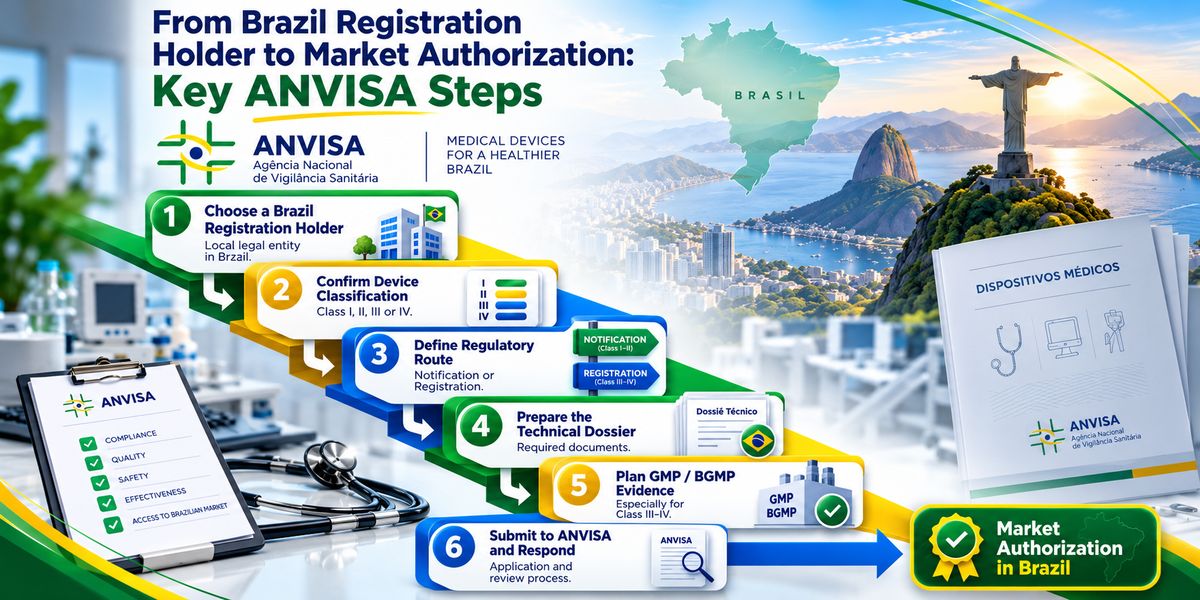
The infographic below maps each step from appointing a local holder to securing market authorization, and it shows why GMP evidence and technical dossier work should run in parallel to avoid review delays.
Fixing the Intended Use Before You Classify (Available PDF)
ANVISA applies medical device classification rules according to the device’s intended purpose. Therefore, define the intended use clearly before selecting the applicable risk class and regulatory pathway.
Download COLLEGIATE BOARD RESOLUTION – RDC No. 751 OF 15 SEPTEMBER 2022 Here
Choosing the Right Brazil Registration Holder (Available PDF)
The registration holder becomes the locally identified entity responsible for the device in Brazil. Therefore, manufacturers should select a holder that can reliably maintain ANVISA compliance and regulatory continuity.
Download Manual para-Registro de Materiais de Uso em Saúde na ANVISA Here
Planning BGMP Early for Class III and IV Devices (Available PDF)
ANVISA applies its medical device GMP certification framework to manufacturers of Class III and IV devices. Early CBPF planning can therefore prevent certification from becoming a bottleneck during market authorization.
Preparing a Portuguese Dossier That Passes First Review
A well-structured technical dossier should present the required administrative, technical, safety, performance, clinical, labeling, and manufacturing information clearly. ANVISA accepts relevant dossier documents in Portuguese, English, or Spanish, while documents in other languages require Portuguese translation.
Download Documentos de Instrução – Equipamentos para Saúde (RDC 751/22) Here
Is the IN 290 Reliance Route Worth It?
The ANVISA IN 290 reliance routes can streamline review for eligible Class III and IV medical devices already approved by a recognized Equivalent Foreign Regulatory Authority (EFRA). However, it only works when the foreign approval covers a device that is essentially identical to the Brazilian submission, including the manufacturer and intended use. Therefore, even a small intended-use mismatch can push the application back to the ordinary review pathway. Manufacturers should confirm product sameness and EFRA eligibility before choosing reliance, since ANVISA still keeps final decision-making authority and does not guarantee faster approval.
Where Brazil Submissions Stall, and How to Prevent It
ANVISA submissions often slow down when classification, technical documentation, GMP evidence, or conformity requirements do not align. Even small inconsistencies can trigger questions and extend review timelines. Therefore, manufacturers should identify regulatory gaps before filing and confirm that every document supports the same intended use, risk class, and compliance strategy. A structured pre-submission review can reduce avoidable delays and help move the Brazil medical device registration process forward more efficiently.
Final Words
ANVISA’s oversight increasingly extends beyond approval to active, risk-based market surveillance. In a targeted 2025 operation, 35 of 38 inspected aesthetic clinics showed sanitary irregularities, highlighting the importance of maintaining compliance after market entry. Therefore, successful medical device registration in Brazil should be treated as the start of continuous regulatory readiness, not the end of it.

Medical Devices & IVDs EU Registration
We guide companies through medical device and IVD EU registration by supporting MDR and IVDR requirements, technical documentation, and structured processes for compliant market access.
FAQ
No. Class I and II devices generally follow the notification pathway under RDC 751/2022. Classes III and IV require full ANVISA registration because they present higher risk.
Not necessarily before filing. ANVISA may accept the CBPF application protocol with the registration submission, but it will not approve the Class III or IV device until the required GMP certificate is issued.
Yes. A foreign manufacturer needs an ANVISA-regularized Brazilian entity to hold the authorization and manage the device locally. This holder becomes the legally identified company responsible for the authorized product in Brazil.
references

Alireza Zarei is the founder and CEO of Zamann Pharma Support GmbH in Germany. He pairs 20 years in GMP—beginning in a lab in 2005—with front-line global project delivery for companies such as Boehringer Ingelheim, Roche, BioNTech, Takeda, Fresenius Medical Care, Biotest, ratiopharm and others. He focuses on innovative validation and qualification procedures, master data management strategies, end-to-end LIMS implementation and care, with pragmatic advice on general Quality Management topics and management level OpEx consulting. Together with his team he also created Pharmuni.com as the leading GMP learning platform in the industry.