
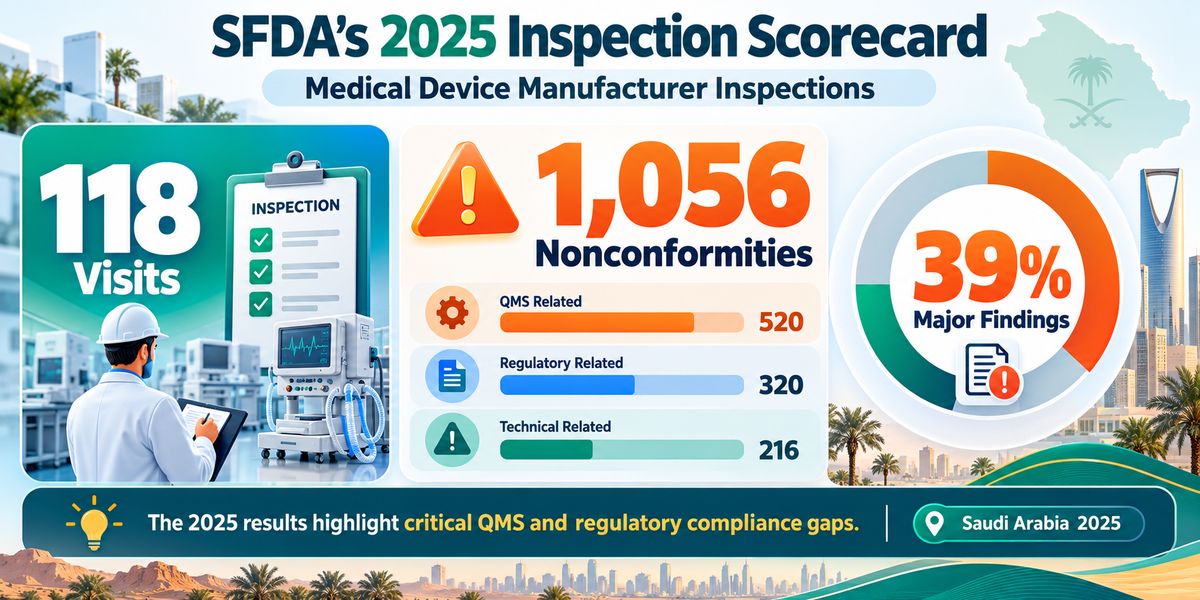
In 2025, the Saudi Food and Drug Authority (SFDA) identified 1,056 nonconformities during medical device manufacturer inspections. This finding highlights why regulatory compliance matters beyond initial approval. For companies pursuing medical device registration in Saudi Arabia, correct classification, MDMA documentation, and local representation are essential where applicable. Therefore, understanding SFDA approval requirements in 2026 helps manufacturers reduce compliance risks, avoid regulatory delays, and maintain market access.
Table of Contents
What Is Medical Device Registration in Saudi Arabia?
Medical device registration in Saudi Arabia is the regulatory process through which the Saudi Food and Drug Authority (SFDA) registers medical devices and grants Medical Devices Marketing Authorization (MDMA). Under the Medical Devices Law and MDS-REQ 1, manufacturers must meet risk classification, safety, performance, and technical documentation requirements. Therefore, manufacturers or their authorized representatives submit MDMA applications through the GHAD system for SFDA review and approval before entering the Saudi market, unless a regulatory exemption applies.
Why SFDA Approval Depends on Your QMS?
SFDA approval requires more than technical documentation. Under Article 33(1) of the Medical Devices Law Implementing Regulation, manufacturers must meet pre-market Quality Management System (QMS) inspection requirements. Moreover, an accepted inspection report supports the MDMA application. According to MDS-REQ 10, SFDA inspection visits include:
- Initial: Review of manufacturing processes.
- Licensing: Assess establishment compliance.
- Routine/Periodic: Verify ongoing QMS compliance.
- Follow-up: Check corrective actions.
- Reactive: Investigate incidents or complaints.
- Device Verification: Confirm regulatory compliance.
- Surprise: Conduct unannounced inspections.
4 Proof Points SFDA Expects from an MDMA Applicant
A successful MDMA application requires clear evidence of safety, quality, and regulatory compliance. Manufacturers must justify their device’s risk classification and provide appropriate QMS documentation. Moreover, inspection findings can reveal weaknesses that threaten approval. Therefore, understanding SFDA requirements helps applicants avoid delays and maintain market access.
Four key areas deserve attention, from risk classification and QMS evidence to inspection findings and MDMA renewal.
- A Correct SFDA Risk Class (Available PDF)
- The Right QMS Evidence for Your Class (Available PDF)
- What SFDA Inspectors Found in 2025 (Available PDF)
- MDMA Validity and Renewal (Available PDF)
A Correct SFDA Risk Class (Available PDF)
Correct SFDA medical device classification starts with the device’s intended use, invasiveness, and potential risks. Therefore, manufacturers must justify the appropriate risk class (A, B, C, or D) under SFDA classification rules.
Download Guidance on Medical Devices Classification (MDS-G008) Here
The Right QMS Evidence for Your Class (Available PDF)
A compliant QMS demonstrates control over product quality, safety, and risks. Moreover, ISO 13485 documentation and SFDA inspection evidence support regulatory compliance.
What SFDA Inspectors Found in 2025 (Available PDF)
In 2025, SFDA conducted 118 inspections, identifying 1,056 nonconformities, including 39% major findings. These results highlight critical QMS and regulatory compliance gaps.
MDMA Validity and Renewal (Available PDF)
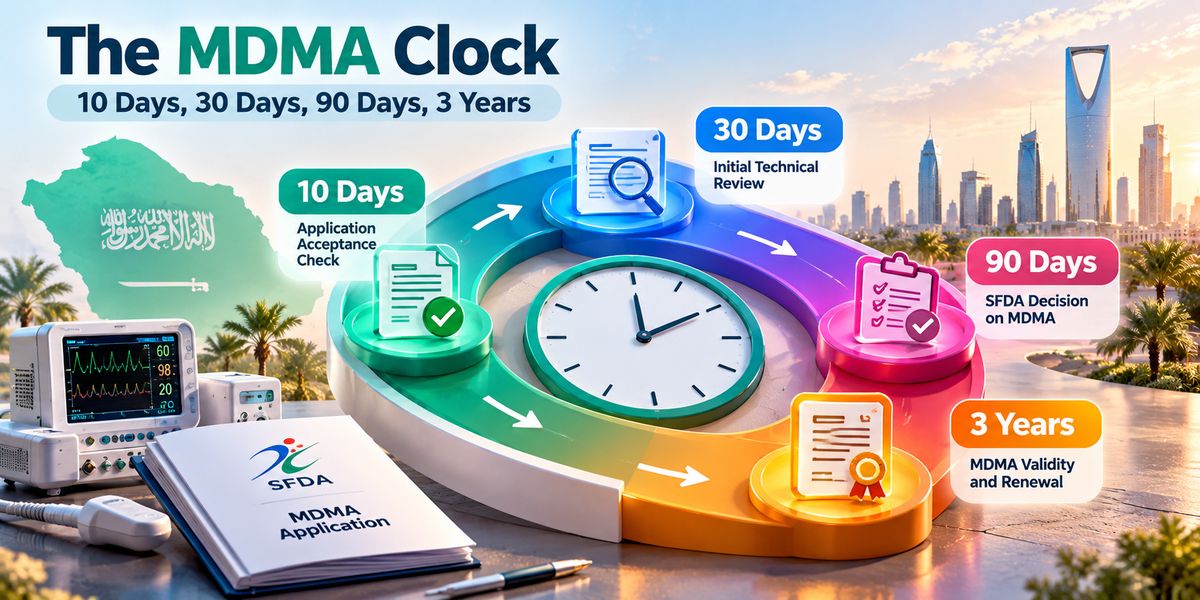
An SFDA MDMA remains valid until its stated expiry date. Therefore, manufacturers should plan renewals early, up to 90 days before expiry under MDS-REQ 1.
Download Requirements for Medical Devices Marketing Authorization (MDS-REQ 1) Here
The Authorized Representative and the MDMA File
A strong MDMA application starts with the right regulatory partner and technical evidence. Overseas manufacturers may appoint a Saudi authorized representative (AR), who must obtain an SFDA license and sign a formal manufacturer agreement. Moreover, MDS-REQ 1 requires technical documentation proving device safety, performance, and compliance. Therefore, applicants must prepare an accurate file through the GHAD system before seeking market authorization.
Core MDMA technical file items include:
- Device description, intended use, and risk classification.
- Labels, instructions for use (IFU), and relevant Saudi-language requirements.
- Design and manufacturing information.
- Essential Principles checklist and conformity evidence.
- Risk management, testing, and clinical or performance evidence.
- Post-market surveillance documentation and applicable QMS evidence.
The table below explains the key Saudi-specific AR licensing and MDMA documentation requirements manufacturers must address.
| SFDA Requirement | What Applicants Must Prepare |
|---|---|
|
AR Licensing |
Register through GHAD and obtain a separate SFDA AR license for each represented manufacturer. |
|
AR Agreement |
Sign a written agreement covering responsibilities, device groups, and post-market surveillance. |
|
Technical File |
Prepare documentation under MDS-REQ 1 Annex 3, or Annex 4 for IVDs. |
|
Saudi Labeling |
Provide compliant labels and IFUs. Meet applicable Arabic and English requirements. |
|
Safety Evidence |
Include risk management, testing, and clinical or performance evidence relevant to the device. |
|
QMS Compliance |
Maintain ISO 13485-aligned QMS documentation and applicable SFDA conformity evidence. |
|
GHAD Submission |
Submit the MDMA application and required supporting documents electronica |
Post-Market Duties That Keep the MDMA Valid
SFDA compliance does not end with MDMA approval. Manufacturers must report device changes, provide requested technical documents within 10 days, and submit incidents and complaints to the NCMDR. Moreover, they must maintain traceable records, including device destruction records for at least three years where applicable. Therefore, effective post-market surveillance supports patient safety and continued market access.
The infographic highlights four key SFDA deadlines for change notifications, MDMA renewal, and record retention, helping manufacturers maintain regulatory compliance.
Final Words
SFDA inspections of medical device manufacturers increased by 64% from 2024 to 2025, highlighting growing regulatory oversight. Therefore, successful medical device registration in Saudi Arabia requires more than initial approval. The manufacturers must have compliant QMS, accurate documentation and effective post-market controls. Ultimately, continuous compliance protects patients, minimizes regulatory risk and lays the foundation for sustainable market access.

Medical Devices & IVDs EU Registration
We guide companies through medical device and IVD EU registration by supporting MDR and IVDR requirements, technical documentation, and structured processes for compliant market access.
FAQ
Applicants must submit device specifications, risk classification, technical documentation, safety and performance evidence, labeling, and applicable QMS records. MDS-REQ 1 defines the requirements based on device type and risk class.
Yes. The SFDA requires manufacturers to establish and maintain a documented QMS aligned with ISO 13485:2016 or an identical adopted standard. Supporting evidence must meet applicable regulatory requirements.
The SFDA requires reporting within 2 working days for serious public health threats, 10 working days for unexpected deaths or serious injuries, and 30 calendar days for lower-risk incidents, depending on their severity.
references

Alireza Zarei is the founder and CEO of Zamann Pharma Support GmbH in Germany. He pairs 20 years in GMP—beginning in a lab in 2005—with front-line global project delivery for companies such as Boehringer Ingelheim, Roche, BioNTech, Takeda, Fresenius Medical Care, Biotest, ratiopharm and others. He focuses on innovative validation and qualification procedures, master data management strategies, end-to-end LIMS implementation and care, with pragmatic advice on general Quality Management topics and management level OpEx consulting. Together with his team he also created Pharmuni.com as the leading GMP learning platform in the industry.