
South Korea recorded 7,675 medical device approvals, certifications, and notifications in 2025, according to the MFDS. However, entering this competitive market requires more than applying. Medical device registration in Korea demands accurate classification, reliable technical documentation, and compliance with applicable KGMP requirements. Manufacturers must thus be aware of UDI labeling regulations, local license holder obligations, and MFDS approval processes. To assist regulatory teams, avoid delays and get ready for a successful market debut, this document outlines the necessary prerequisites.
Inhaltsverzeichnis
What Is Medical Device Registration in Korea?
Medical device registration in Korea is the regulatory process manufacturers must complete before placing their products on the South Korean market. Under the Medical Devices Act, the Ministry of Food and Drug Safety (MFDS) oversees device notification, certification, and approval to ensure safety and performance. For Instance, Class I devices generally require notification, Class II devices may need certification or approval, and Classes III and IV require formal approval. Previously known as the Korea Food and Drug Administration (KFDA), the authority became the MFDS in 2013.
Why KGMP Certification Is Critical to Medical Device Registration
KGMP certification makes MFDS medical device registration more than a document review. For devices subject to KGMP, manufacturers must demonstrate compliance with Korean Good Manufacturing Practice requirements before market entry. Moreover, certification involves a quality system assessment and requires renewal every 3 years. Therefore, manufacturers should maintain audit-ready records to demonstrate ongoing compliance and avoid regulatory delays.
Key records for KGMP inspection readiness include:
- Quality Management System (QMS): Approved procedures, quality manuals, and training records.
- Design and Risk Management: Design controls, risk assessments, and verification and validation evidence.
- Manufacturing and Quality Control: Production records, supplier controls, CAPA, and complaint investigations.
The Four Gates Between Your Device and the Korean Market
It takes meticulous preparation and regulatory compliance to enter the South Korean medical device market. Manufacturers are required to submit technical documentation, demonstrate KGMP compliance when appropriate, and comply with MFDS medical device registration criteria. However, depending on its classification and degree of risk, every device has a unique regulatory path. Additionally, while eligibility determines priority audit methods, MDSAP audit results may make some GMP assessments easier.
To navigate these requirements and avoid costly delays, manufacturers should understand four key regulatory checkpoints:
- Gate 1: Notification, Certification or Approval (Available PDF)
- Gate 2: Technical Documentation in STED Format (Available PDF)
- Gate 3: KGMP Certification (Available PDF)
- Gate 4: MDSAP Combined Audits and Priority GMP Audits (Available PDF)
Gate 1: Notification, Certification or Approval (Available PDF)
South Korea classifies medical devices into four risk classes, each with different MFDS registration requirements. Class I generally requires notification, Class II requires certification or approval, and Classes III–IV require approval.
Gate 2: Technical Documentation in STED Format (Available PDF)
The Summary Technical Documentation (STED) format organizes evidence of a medical device’s safety, performance, and risk management. Therefore, manufacturers should prepare complete technical files that meet applicable MFDS requirements and support regulatory review.
Download Guide to Preparing Medical Device Summary Technical Documentation (STED) Here
Gate 3: KGMP Certification (Available PDF)
KGMP certification assesses whether manufacturers maintain an effective quality management system that meets Korean regulatory standards. Moreover, applicable manufacturing sites must demonstrate compliance and undergo periodic reassessment, generally every three years.
Gate 4: MDSAP Combined Audits and Priority GMP Audits (Available PDF)
Eligible manufacturers can use MDSAP audit evidence or request combined KGMP–MDSAP assessments to reduce duplicated audit activities. Furthermore, qualifying manufacturers may request priority GMP assessments under specified Korean regulatory conditions.
Korea License Holder and Import Business Permission
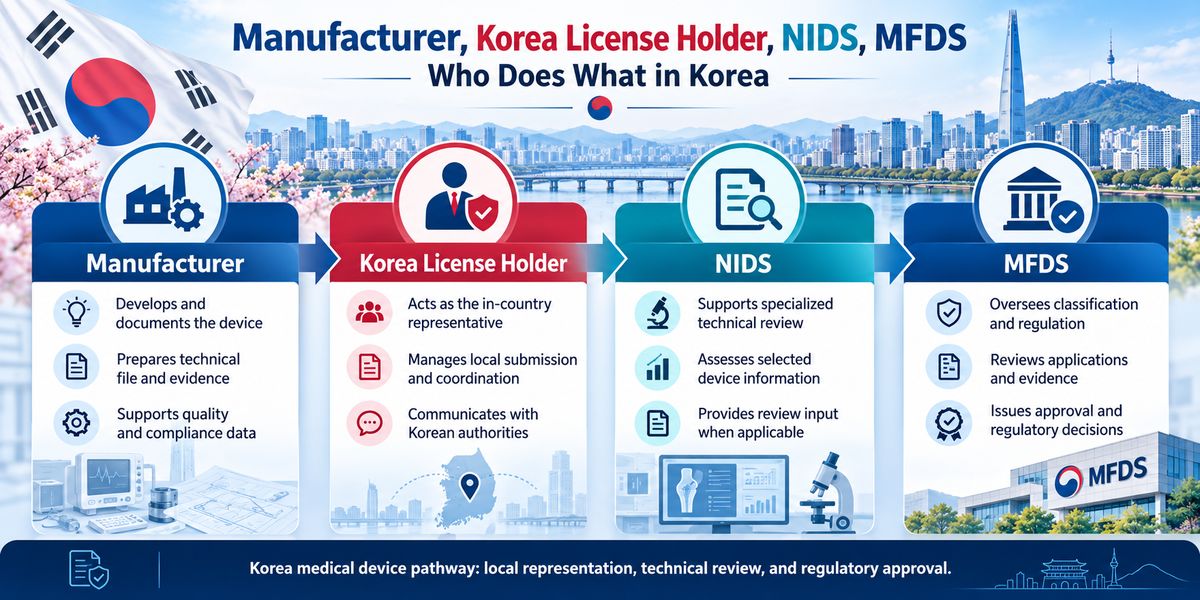
Foreign manufacturers need to meet local regulatory responsibilities via Korea License Holder (KLH) before importing medical devices. Under Article 15 of the Medical Devices Act, the licensed importer must obtain MFDS import business permission and complete the applicable product registration process. Moreover, manufacturers must ensure that device labels and instructions meet Korean-language requirements. Therefore, selecting a qualified local partner is essential for regulatory submissions, post-market compliance, and communication with Korean authorities.
Key Requirements for a Korea License Holder
| Requirement | Regulatory Responsibility |
|---|---|
|
Local legal presence |
Operate through a Korea-based business authorized to import medical devices. |
|
Import Business Permission |
Obtain MFDS permission alongside at least one product notification, certification, or approval application. |
|
Korean-Language Requirements |
Ensure labels, instructions for use, and required product information comply with Korean-language rules. |
|
Post-Market Compliance |
Maintain required quality controls, report relevant safety issues, and coordinate recalls when necessary. |
Understanding each organization’s responsibilities helps manufacturers coordinate submissions, meet MFDS approval requirements, and avoid unnecessary regulatory delays.
Post-Market Controls That Keep MFDS Approval Valid
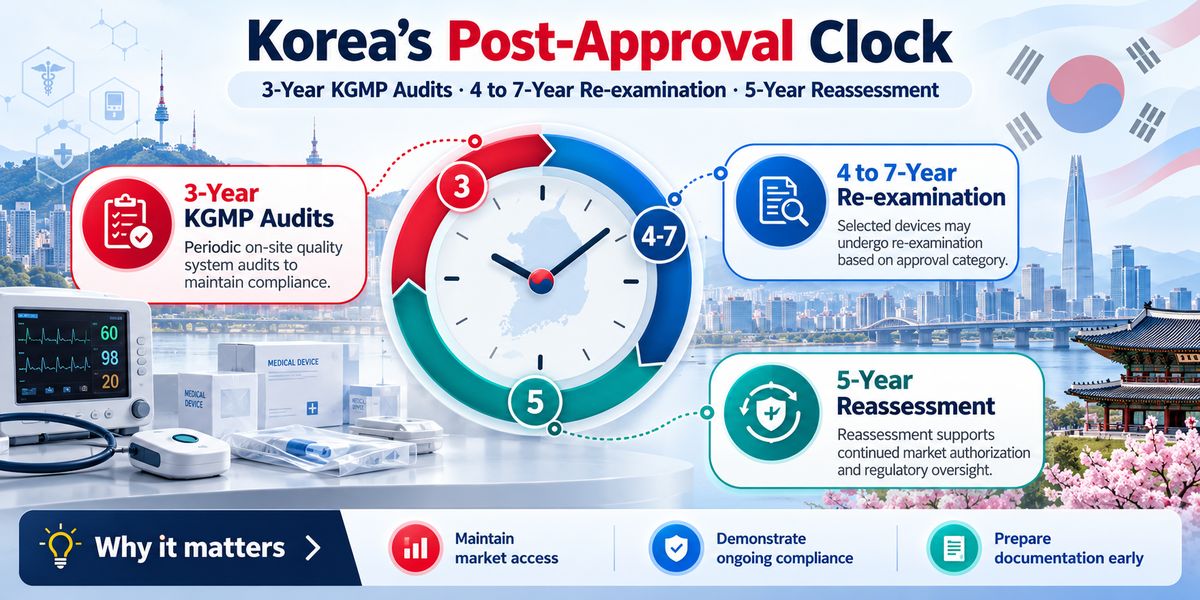
MFDS approval is not the last step in medical device compliance. After market entry, manufacturers and importers must maintain Unique Device Identification (UDI) records, submit applicable supply reports, and track designated medical devices. Moreover, they must monitor safety issues and maintain records for regulatory inspections. Therefore, companies should plan for three-year KGMP inspections, any required four-to-seven-year post-market investigations, and five-year registration renewals. These controls help maintain regulatory compliance and protect continued market access in South Korea.
This infographic compares Korea’s key post-approval timelines, helping manufacturers prepare for KGMP audits, post-market investigations, and MFDS registration renewals.
Final Words
South Korea is moving toward more efficient, evidence-based medical device inspections. According to the MFDS, 44 manufacturing sites qualified for document-only GMP reviews using valid MDSAP reports by August 2025, compared with 19 sites in 2024. However, streamlined inspections do not reduce regulatory responsibilities. Therefore, successful medical device registration in Korea requires reliable quality records, continuous post-market monitoring, and inspection readiness beyond initial approval.

Medical Devices & IVDs EU Registration
We guide companies through medical device and IVD EU registration by supporting MDR and IVDR requirements, technical documentation, and structured processes for compliant market access.
FAQ
Not directly. Foreign manufacturers need a Korea-based licensed importer, either a local subsidiary or an authorized partner. The importer must obtain MFDS import business permission and complete the required product registration process.
No. MDSAP certification does not automatically replace KGMP requirements. However, eligible MDSAP audit reports may support simplified KGMP assessments and reduce duplicate on-site inspections. Manufacturers must still meet applicable Korean quality system requirements.
No. Many Class II devices qualify for NIDS certification, but certain products require direct MFDS approval. These include devices requiring clinical evidence or special regulatory review. Therefore, manufacturers should confirm their MFDS classification before submitting technical documentation.
references

Alireza Zarei is the founder and CEO of Zamann Pharma Support GmbH in Germany. He pairs 20 years in GMP—beginning in a lab in 2005—with front-line global project delivery for companies such as Boehringer Ingelheim, Roche, BioNTech, Takeda, Fresenius Medical Care, Biotest, ratiopharm and others. He focuses on innovative validation and qualification procedures, master data management strategies, end-to-end LIMS implementation and care, with pragmatic advice on general Quality Management topics and management level OpEx consulting. Together with his team he also created Pharmuni.com as the leading GMP learning platform in the industry.