
In 2024, Singapore’s Health Sciences Authority (HSA) approved 1,270 new medical devices, the highest yearly total in recent years, while Class B registrations alone jumped by 25%. Clearly, more manufacturers now see Singapore as their gateway to Asia. However, a busier register also brings closer scrutiny, so a weak dossier or the wrong risk class can delay a launch by months. For this reason, medical device registration in Singapore needs careful planning from day one. In this guide, we explain how HSA classifies devices, which evaluation routes can shorten your review, and what an ASEAN CSDT dossier must include. Finally, we cover dealer’s licences and the post-market duties that keep your products on the Singapore Medical Device Register.
Table of Contents
What Is Medical Device Registration in Singapore?
In simple terms, medical device registration in Singapore is the legal gateway that lets a product reach local patient. Under the Health Products Act and the Health Products (Medical Devices) Regulations 2010, companies must register their devices with the Health Sciences Authority (HSA) before they place them on the Singapore market. However, the law exempts certain products, most notably low-risk Class A devices, from product registration. In practice, a local Registrant submits the application, and HSA then reviews the evidence on safety, quality and performance. Once HSA approves a device, it lists the product on the Singapore Medical Device Register (SMDR), the official public record of registered devices. As a result, hospitals, distributors and regulators can quickly check whether a device is legally on the market.
Why HSA Compliance Starts Before You Submit?
The Immediate Class B Registration (IBR) route lists your device on the SMDR as soon as you submit and pay, but HSA verifies your claims afterwards. Therefore, you must confirm every eligibility criterion before you file. If your application fails even one, HSA cancels the registration without a refund, and you must reapply through another route. Moreover, knowingly making a false declaration is an offence under Section 30(10) of the Health Products Act.
4 Checks That Decide Your HSA Evaluation Route
Choosing an HSA evaluation route is not guesswork; instead, it depends on what your device is and what evidence you already hold. HSA offers Full, Abridged, Expedited and Immediate routes, and generally, strong prior approvals earn a faster review. However, the wrong choice can lead to queries, delays or extra fees. For this reason, regulatory teams should test their device against a few key factors before they open an application in SHARE.
Below, we break down the four checks that shape this decision, starting with your device’s risk class and moving through reference agency approvals, the ASEAN CSDT dossier and HSA’s clinical evidence expectations.
- Confirming the HSA Risk Class (Available PDF)
- Mapping Your Reference Agency Approvals (Available PDF)
- Building the ASEAN CSDT Dossier (Available PDF)
- Meeting HSA Clinical Evidence Expectations (Available PDF)
Confirming the HSA Risk Class (Available PDF)
HSA classifies medical devices from Class A (low risk) to Class D (high risk) based on intended use, invasiveness, contact duration and energy delivery. Risk classification determines registration requirements and available evaluation routes.
Download HSA’s GN-13 Risk Classification Guidance (R2.1, 2018) Here
Mapping Your Reference Agency Approvals (Available PDF)
HSA offers faster Abridged, Expedited and Immediate routes using approvals from the US FDA, EU Notified Bodies, Health Canada, TGA and MHLW. Eligibility depends on matching approved intended uses and the number of qualifying approvals.
Building the ASEAN CSDT Dossier (Available PDF)
HSA requires ASEAN CSDT dossiers for Class B, C and D devices, covering essential principles, design verification, clinical evidence, labelling, risk analysis and manufacturer details. Documentation requirements vary by evaluation route.
Meeting HSA Clinical Evidence Expectations (Available PDF)
HSA expects a clinical evaluation report that critically reviews literature, clinical experience and, where needed, clinical investigation data for your device. The depth of evidence grows with risk, so novel and high-risk devices usually need their own clinical investigation data.
Download GN-20: Guidance on Clinical Evaluation (Revision 2, November 2022) Here
Registrant, Dealer’s Licences and Class A Notification
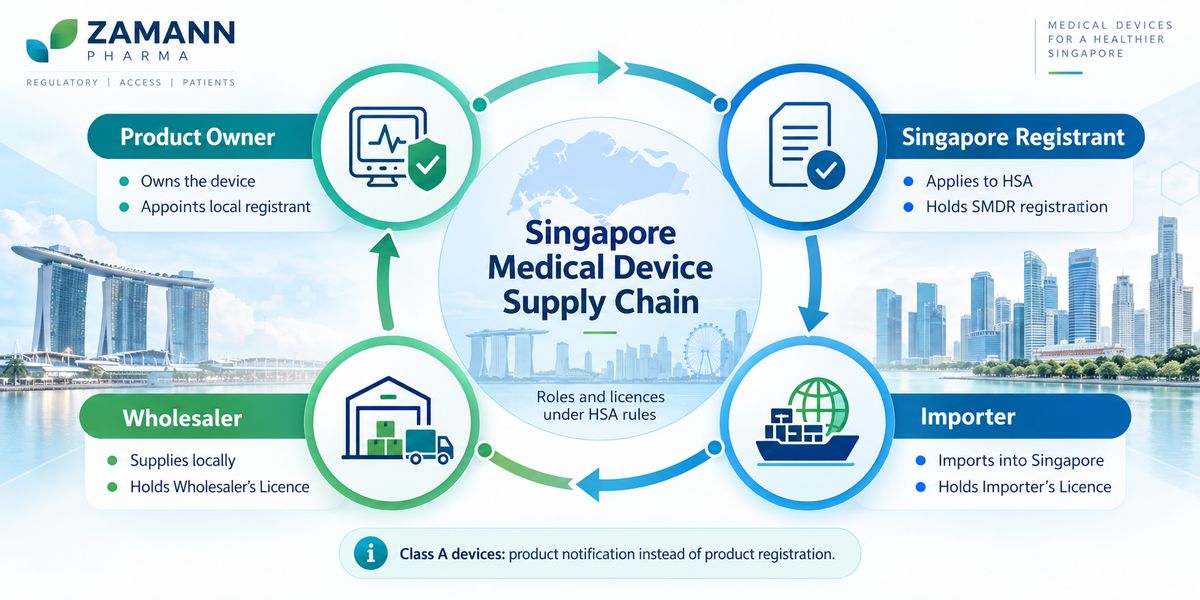
Before a device reaches the Singapore market, three requirements must be in place. First, the Singapore Registrant is the local company that applies for and obtains the registration. In addition, every manufacturer, importer and wholesaler needs an HSA dealer’s licence, even for Class A devices. However, Class A devices skip product registration; instead, their manufacturers and importers submit a product notification to list them on HSA’s Class A database.
The infographic below shows who holds each role and licence in Singapore’s device supply chain, from the product owner to the local wholesaler, so you can spot compliance gaps before HSA does.
Post-Market Duties That Keep the SMDR Listing Active
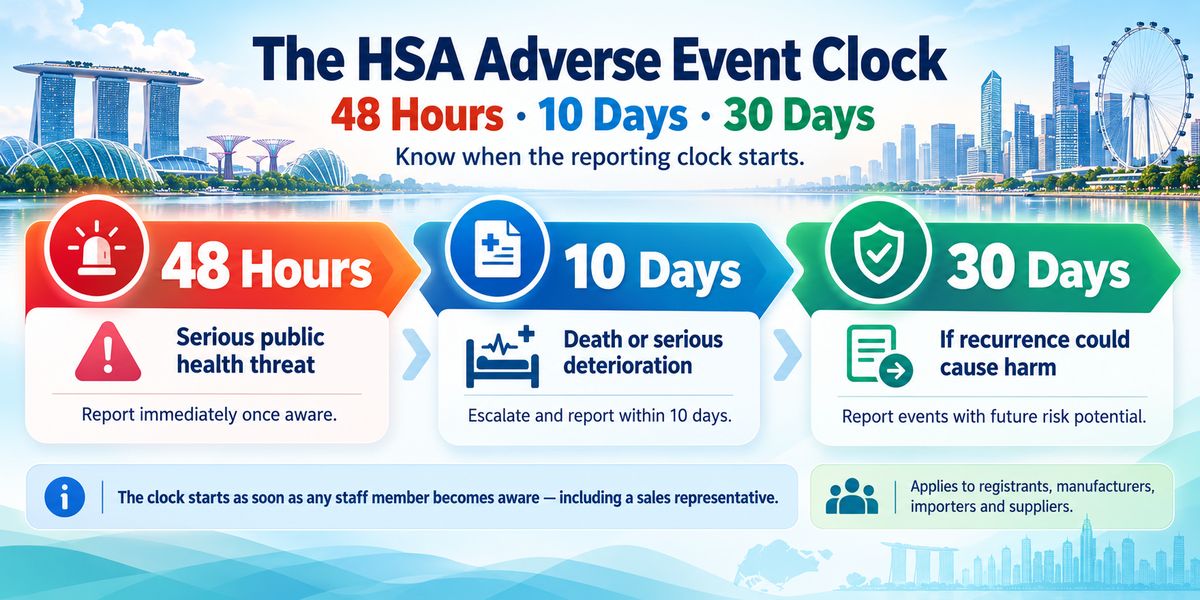
Registration is only the start, because HSA expects every SMDR listing to stay accurate and active. First, the registrant must file a change notification for any change that could affect a device’s safety, quality or efficacy. In addition, dealers must report adverse events on time, and the clock starts as soon as any staff member, including a sales representative, learns of the event. Finally, HSA cancels the listing if the retention fee is not paid within 60 days of the due date.
The table below sums up the main post-market duties, who owns each one and the deadlines that keep your SMDR listing active.
| Post-Market Duty | Who Is Responsible | Deadline or Trigger | Key Point |
|---|---|---|---|
|
Change notification |
Registrant |
Before the change is put in place |
HSA sorts changes into Technical, Review, Administrative and Notification types. Class A devices no longer need change notifications. |
|
Adverse event reporting |
Registrants, manufacturers, importers and suppliers |
48 hours for serious public health threats, 10 days for deaths or serious deterioration, 30 days for events that could cause harm if they recur |
The clock starts once any staff member, including a sales representative, learns of the event. |
|
Field safety corrective action (FSCA), including recalls |
Registrant or dealer that manufactured, imported or supplied the device |
Before the FSCA starts in Singapore |
Dealers notify HSA through the OSCAR system and can then proceed without waiting for approval. |
|
Annual retention fee |
Registrant |
By the annual due date |
HSA cancels the listing if the fee is not paid within 60 days of the due date. |
The infographic below breaks down HSA’s three adverse event reporting deadlines, so your team knows exactly how long it has once the clock starts.
Final Words
HSA continues to target unregistered devices, especially those sold through online channels. In just two weeks in March 2026, HSA removed 959 illegal health product listings from local e-commerce and social media platforms, and unregistered contact lenses, which are regulated medical devices, made up more than 82% of them. For registrants and dealers, the message is clear: compliance does not end with approval. Instead, a valid SMDR listing, the right dealer’s licenses and disciplined post-market reporting work as one continuous system. Ultimately, companies that treat medical device registration in Singapore as an ongoing responsibility, rather than a one-off filing, will be best placed to protect patients and keep their products on the market.

Medical Devices & IVDs EU Registration
We guide companies through medical device and IVD EU registration by supporting MDR and IVDR requirements, technical documentation, and structured processes for compliant market access.
FAQ
No. Class A devices are exempt from product registration. However, manufacturers and importers must list them on HSA’s Class A database through a product notification and hold a valid dealer’s licence.
Approvals from the US FDA, EU Notified Bodies, Health Canada, Australia’s TGA and Japan’s MHLW qualify. The approved labelled use must match the one intended for Singapore.
HSA accepts ISO 13485 or MDSAP certificates for each manufacturing and sterilisation site. For sites without them, comparable audit reports, such as US FDA QSR or Japan MHLW Ordinance 169, are accepted.
references

Alireza Zarei is the founder and CEO of Zamann Pharma Support GmbH in Germany. He pairs 20 years in GMP—beginning in a lab in 2005—with front-line global project delivery for companies such as Boehringer Ingelheim, Roche, BioNTech, Takeda, Fresenius Medical Care, Biotest, ratiopharm and others. He focuses on innovative validation and qualification procedures, master data management strategies, end-to-end LIMS implementation and care, with pragmatic advice on general Quality Management topics and management level OpEx consulting. Together with his team he also created Pharmuni.com as the leading GMP learning platform in the industry.