
India’s regulator has licensed around 30,000 medical devices in recent years, yet only 117 of them were novel technologies. In other words, established device types dominate the market. At the same time, the Drugs Controller General of India has announced tougher facility audits now that the transition period under the Medical Devices Rules has ended. As a result, CDSCO medical devices registration has become a test of inspection readiness, not just paperwork. For manufacturers and importers, this means the risk class, the Device Master File and the quality system must all hold up when inspectors arrive. Therefore, this guide explains how medical device registration works in India, from classification and licensing to the compliance gaps that delay approval.
Table of Contents
What Is CDSCO Medical Device Registration?
CDSCO medical devices registration is the licensing system that controls market entry under the Medical Devices Rules 2017. However, true registration applies only to non-sterile, non-measuring Class A devices. Every other device needs a licence instead. For example, Class A and B manufacturers apply to their State Licensing Authority, while Class C and D manufacturers and all importers apply to the Central Licensing Authority. In short, registration in India usually means securing the right licence for your risk class.
Why Device Licensing Matters for GMP and Inspection Readiness
A CDSCO licence does more than open the market. Once approved, the dossier becomes the baseline auditors use to judge every batch, record and process. In particular, inspectors check the site against the Fifth Schedule QMS, which closely mirrors ISO 13485. As a result, a certificate alone rarely satisfies them, because the documented system must work on the shop floor. Moreover, State Licensing Authorities run unannounced inspections on at least 2% of notified body audits. When gaps appear, the authority can suspend or cancel the licence and publish the order on its website, so one failed audit quickly becomes public.
How CDSCO Medical Device Classification Decides Your Licensing Route
Under the Medical Devices Rules 2017, the device class decides almost everything that follows. First, only the Central Licensing Authority can assign a risk class, and it bases that decision on the device’s intended use. The class then sets the licensing authority, the application form and the timing of the site audit. If your device doesn’t appear on CDSCO’s published classification lists, you must ask the Central Licensing Authority to classify it before you apply. Consequently, a wrong class at the start can delay the entire licence.
Because each risk class follows its own path to market, the sections below walk through the four factors that decide where, how and when you apply:
- Class A Non-Sterile and Non-Measuring Devices (Available PDF)
- Class A Sterile, Measuring and Class B Devices (Available PDF)
- Class C and Class D Devices Under Central Review (Available PDF)
- Device Grouping and Its Effect on Your Application (Available PDF)
For a quick comparison, the table below shows how each class moves from application to license.
| Device class | Licensing authority | Application form | Licence form | Site audit timing |
|---|---|---|---|---|
|
Class A, non-sterile and non-measuring |
Online registration only |
Portal upload |
Registration number |
No audit before registration |
|
Class A, sterile or measuring |
State Licensing Authority |
MD-3 |
MD-5 |
Notified body audit within 120 days after the licence is granted |
|
Class B |
State Licensing Authority |
MD-3 |
MD-5 |
Notified body audit before the licence is granted |
|
Class C and D |
Central Licensing Authority |
MD-7 |
MD-9 |
Inspection by Medical Device Officers within 60 days of application |
|
Imports (licensable classes) |
Central Licensing Authority |
MD-14 |
MD-15 |
Overseas site inspection at CDSCO’s discretion |
Class A Non-Sterile and Non-Measuring Devices (Available PDF)
These low-risk devices need no licence, only mandatory registration on the Medical Devices Online portal. The portal then issues a registration number free of charge.
Class A Sterile, Measuring and Class B Devices (Available PDF)
The State Licensing Authority licenses both classes through Form MD-3. However, a notified body audits Class A sterile or measuring sites within 120 days after the licence, but audits Class B sites before it is granted.
Class C and Class D Devices Under Central Review (Available PDF)
The Central Licensing Authority reviews these devices through Form MD-7 and grants the licence in Form MD-9. The application needs a Plant Master File, a full Device Master File, a Fifth Schedule QMS undertaking and certificates for three consecutive batches.
Download the CDSCO Class C and D Manufacturing Licence Checklist Here
Device Grouping and Its Effect on Your Application (Available PDF)
Grouping lets you file related devices with a similar intended use or shared technology in one licence application. The grouping category decides your number of applications and fees, and all devices in a family must share the same risk class.
CDSCO Import License Requirements for Foreign Manufacturers
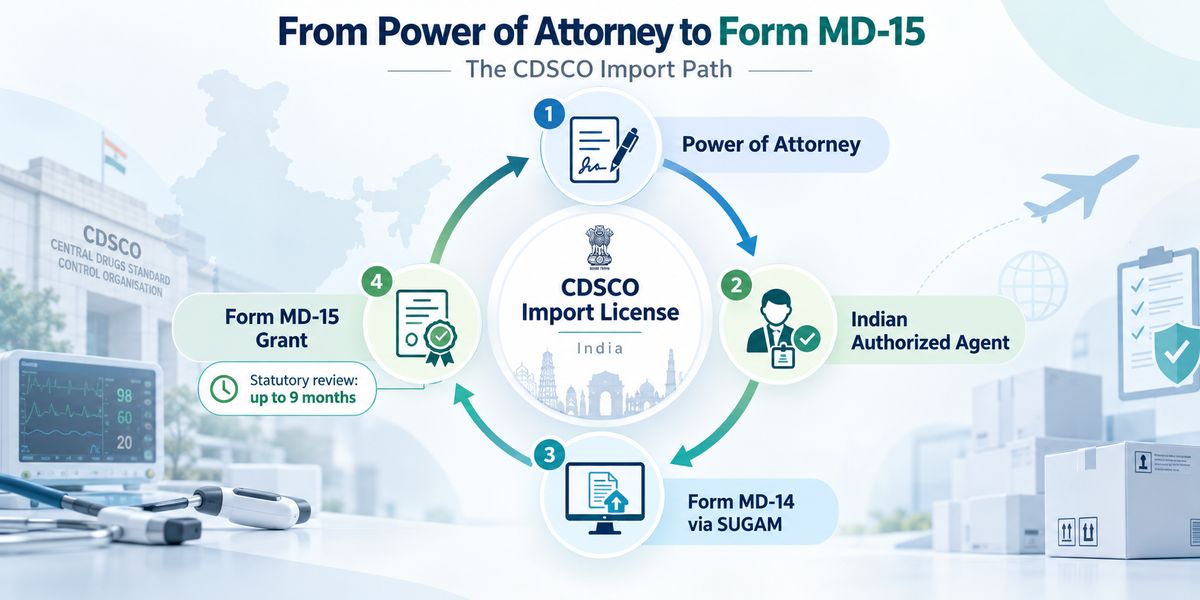
Foreign manufacturers can’t apply to CDSCO directly. Instead, they appoint a licensed Indian Authorized Agent, who files Form MD-14 on the SUGAM portal. The Central Licensing Authority then grants the CDSCO import license in Form MD-15 within nine months. Importantly, a free sale certificate from the EU, UK, USA, Canada, Australia or Japan removes the need for a clinical investigation in India.
The infographic below maps the four steps from appointing an Indian agent to receiving Form MD-15, so foreign manufacturers can plan each stage before the nine-month review clock starts.
Post-Approval Compliance and What Auditors Check
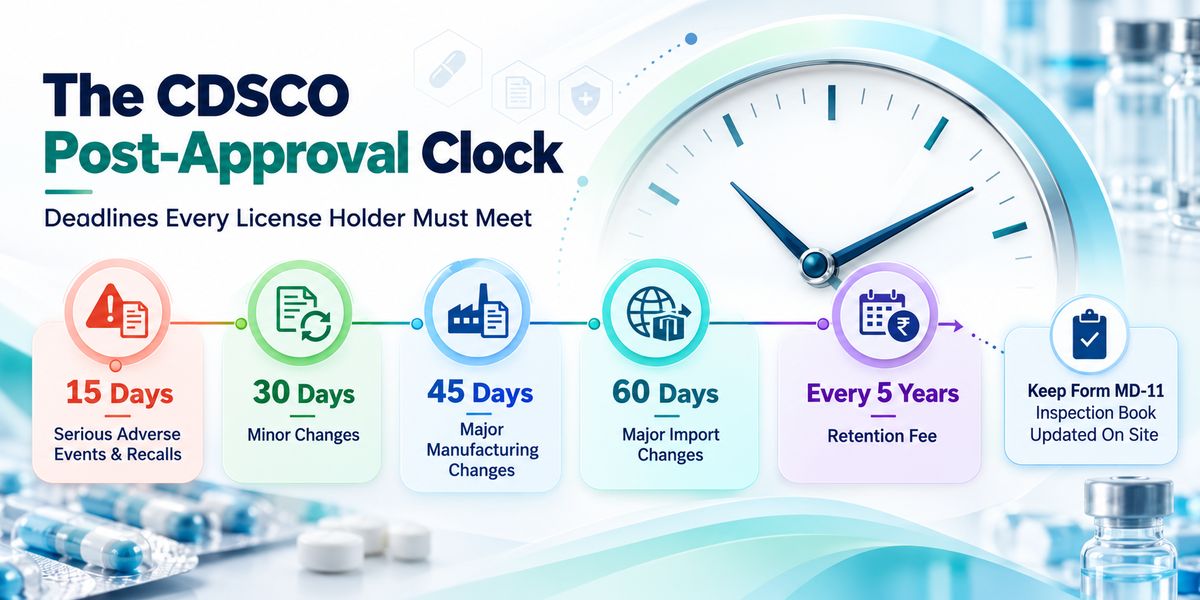
After approval, every licence duty becomes an audit checkpoint. First, you must get CDSCO approval before any major change listed in the Sixth Schedule and report minor changes within 30 days. Next, you must report suspected unexpected serious adverse events, including recalls, within 15 days. In addition, auditors expect an up-to-date Form MD-11 inspection book on site. Meanwhile, the licence stays valid only if you pay the retention fee every five years. Because state inspectors make unannounced visits on at least 2% of notified body audits, these records must be ready every day.
The infographic below sets out the key post-approval deadlines on one timeline, so licence holders can see which obligations auditors will check first.
Final Words
CDSCO is now building the capacity to back its tougher stance. It has recruited 20 new medical device officers to strengthen oversight of around 800 manufacturing facilities across India. As a result, inspection readiness is becoming a permanent condition of market access, not a one-time hurdle. For manufacturers and importers, CDSCO medical devices registration now succeeds only when the risk class, the Device Master File and the quality system tell the same story on paper and on the shop floor. Ultimately, companies that treat every license as an ongoing audit are best placed to secure and keep their place in the Indian market.

Medical Devices & IVDs EU Registration
We guide companies through medical device and IVD EU registration by supporting MDR and IVDR requirements, technical documentation, and structured processes for compliant market access.
FAQ
Only some do. Class A devices that are non-sterile and non-measuring need registration on the Medical Devices Online portal, not a licence. However, sterile or measuring Class A devices need a manufacturing licence in Form MD-5 from the State Licensing Authority, followed by a notified body audit within 120 days.
Yes. If the device holds a free sale certificate from the EU, UK, USA, Canada, Australia or Japan, CDSCO grants the Form MD-15 import licence without a clinical investigation in India. The Indian Authorized Agent files Form MD-14, and the statutory review period is nine months.
Not on its own. The Fifth Schedule QMS mirrors ISO 13485, but manufacturers must submit a signed Fifth Schedule compliance undertaking, and auditors verify that the system works on site. They check the Device Master File, batch records and CAPA evidence against the approved dossier.
references

Alireza Zarei is the founder and CEO of Zamann Pharma Support GmbH in Germany. He pairs 20 years in GMP—beginning in a lab in 2005—with front-line global project delivery for companies such as Boehringer Ingelheim, Roche, BioNTech, Takeda, Fresenius Medical Care, Biotest, ratiopharm and others. He focuses on innovative validation and qualification procedures, master data management strategies, end-to-end LIMS implementation and care, with pragmatic advice on general Quality Management topics and management level OpEx consulting. Together with his team he also created Pharmuni.com as the leading GMP learning platform in the industry.