
Since December 2022, India’s drug regulators have run risk-based inspections at more than 1,040 manufacturing premises and taken over 950 regulatory actions, from show cause notices to licence cancellations. In other words, a costly finding is now a real risk for every site, not just a few outliers. At the same time, Revised Schedule M has made WHO-aligned GMP legal baseline since January 2026. Meanwhile, USFDA and EU inspectors keep raising the bar for export sites. As a result, choosing a consulting partner has become a compliance decision rather than a purchase. However, pharma consulting companies in India vary widely, from firms that supply documents to teams that rebuild quality systems. This guide therefore shows how to judge pharma consultancy services by one standard: what still holds when the inspector walks in.
Table of Contents
Pharma Consulting Companies in India Build Systems, Not Binders
Most GMP inspectors know the scene. A site hands over a thick binder of SOPs, yet the operator on the line cannot explain a deviation logged last week. That gap is where the real work of pharma consultants in India begins. Good consultants still write documents, but they also build the habits behind them. For example, they coach analysts to review audit trails, help QA close CAPAs with real evidence, and test whether change control holds up on a busy night shift. In short, they leave behind a system the site can run on its own. By contrast, some pharmaceutical consulting firms in India still measure success in pages delivered. Inspectors usually spot the difference fast, because they question people, not folders.
Inspectors Test the System Your Consultant Leaves Behind
When an FDA investigator opens the batch records, the consultant is usually not the one answering. Instead, the site’s own team must defend every decision. The investigator asks an analyst why they repeated a test and then follows the audit trail back to the raw data. This is where weak consulting shows. For instance, a borrowed SOP that nobody follows quickly turns into an observation. Worse, the same gap often returns on the next visit as a repeat observation, which signals a quality system that never learned. Likewise, a Form 483 response that promises retraining but proves nothing rarely convinces the agency, and the file can move toward a warning letter. Real USFDA inspection readiness therefore means a system your team can explain without a script.
4 Services That Shape Your Next Inspection Outcome
Inspectors rarely judge a site on one document. Instead, they look for the same weakness across systems, so a CAPA gap in QA often reappears in the lab and on the shop floor. For this reason, the best GMP consultants in India focus on four connected services rather than isolated fixes. Each one closes a door that investigators like to open.
Together, these services cover the ground inspectors test first: where your gaps sit, whether your data can be trusted, how your computerized systems stay in control and how well your quality system learns from its mistakes.
- GMP Gap Assessment and USFDA Inspection Readiness (Available PDF)
- Data Integrity Remediation (Available PDF)
- Computer System Validation Across the Lifecycle (Available PDF)
- Pharmaceutical Quality System and eQMS Support (Available PDF)
The infographic below maps each service to reduce the inspection risk, so you can see briefly where a consulting partner should add value.
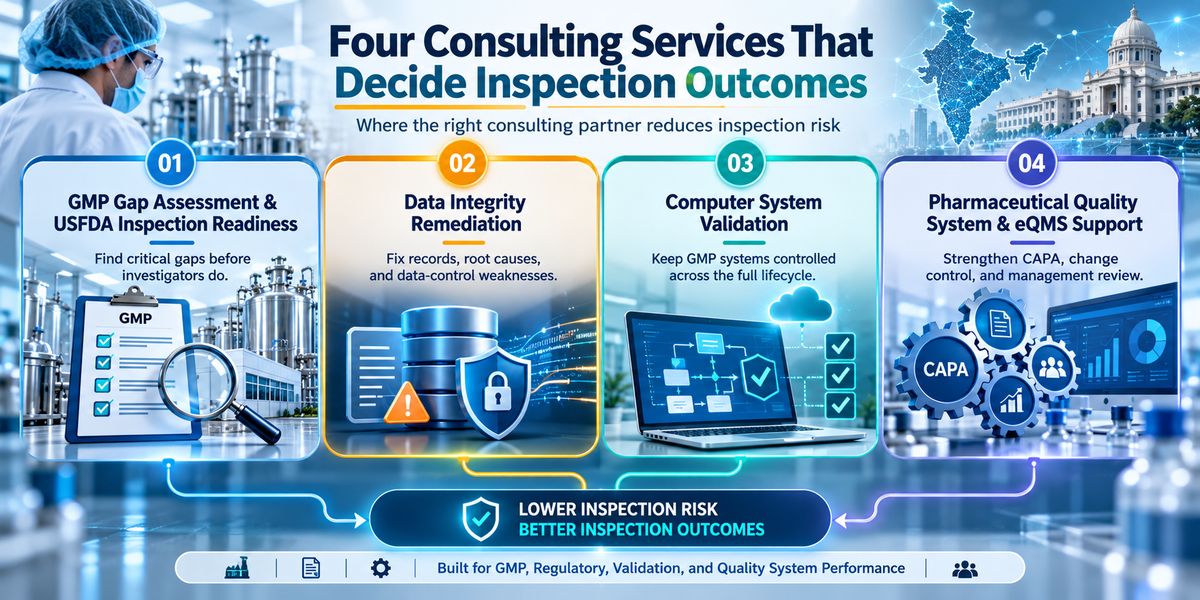
GMP Gap Assessment and USFDA Inspection Readiness (Available PDF)
A GMP gap assessment compares how a site actually works against current CGMP expectations, system by system, before an investigator does it for you. USFDA inspection readiness then means closing those gaps in quality, production and laboratory systems while there is still time to fix them.
Data Integrity Remediation (Available PDF)
Data integrity remediation starts when a site, or an inspector, finds records that are incomplete, unattributable or quietly altered. Effective remediation goes beyond software settings and addresses scope, root cause, risk to released batches and the culture that let the problem grow.
Computer System Validation Across the Lifecycle (Available PDF)
Computer system validation proves that a GMP system does what it should, from user requirements through testing, go-live and retirement. Validation does not end at release, because change control, periodic review and audit trail checks are what keep the system in a validated state.
Pharmaceutical Quality System and eQMS Support (Available PDF)
A pharmaceutical quality system links CAPA, change management, process monitoring and management review into one system that learns from its own data. An eQMS makes that system faster and more traceable, but only when it is built around real processes and validated for its intended use.
How to Shortlist Pharmaceutical Consulting Firms in India
A polished website tells you little about how a consultant performs on inspection day. Instead, judge pharmaceutical consulting firms in India by the evidence they can put on the table. Ask for anonymized Form 483 responses, real remediation plans and sample validation deliverables, then check them against the standards inspectors actually use. In addition, look at what stays behind when the project ends, because regulators hold your company, not the consultant, responsible for outsourced work. The framework below turns those checks into clear questions for any shortlisting meeting.
The table below links each evaluation criterion to the evidence you should request and the regulatory expectation behind it, so you can see which answers will hold up during an inspection.
| Evaluation Criterion | Evidence to Request | Regulatory Expectation Behind It | Inspection Benefit |
|---|---|---|---|
|
Inspection track record |
Anonymized Form 483 responses and the final inspection outcomes they supported |
FDA classifies inspections as NAI, VAI or OAI, and OAI findings can lead to warning letters |
Shows the firm has guided sites through real classification decisions, not only mock audits |
|
Data integrity remediation depth |
A sample remediation plan covering scope, root cause, risk assessment and a global corrective action plan |
FDA’s data integrity guidance expects investigation of scope and root causes, a risk assessment and a management strategy with a global CAPA |
Produces remediation that convinces the agency instead of patching individual records |
|
Computer system validation competence |
A risk-based validation approach with traceable user requirements and periodic review records |
EU GMP Annex 11 requires risk management across the lifecycle, traceable requirements and periodic evaluation |
Keeps systems in a validated state long after go-live |
|
CAPA effectiveness and follow-up |
A plan for effectiveness checks after the Form 483 response is submitted |
FDA’s compliance program expects CAPAs to be documented and their effectiveness evaluated |
Reduces the risk of repeat observations on the next visit |
|
Revised Schedule M coverage |
A gap assessment covering PQS, quality risk management, product quality review, and qualification and validation |
Revised Schedule M adds PQS, QRM, PQR, equipment qualification and validation requirements |
Prepares the site for CDSCO and state risk-based inspections |
Revised Schedule M Is Reshaping Consulting Scope at Indian Sites
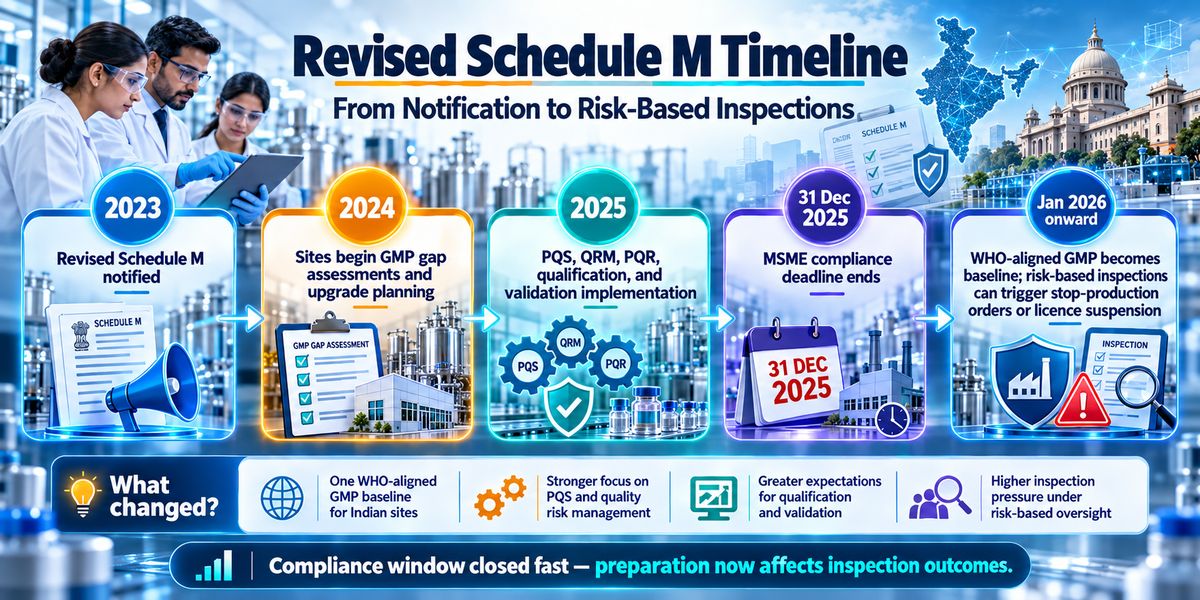
For years, many Indian plants ran on two standards: WHO GMP for exports and the old Schedule M for everything else. Revised Schedule M compliance ends that split, and from January 2026 every unit must meet a WHO-aligned standard. As a result, MSME sites now need a working PQS, quality risk management that drives decisions, product quality reviews, and stronger qualification and validation. However, the hardest fixes are often physical, especially plant layouts that need structural changes. Sites that already hold WHO GMP certification simply start closer to the finish line.
The timeline below traces Revised Schedule M from its 2023 notification to the risk-based inspections of 2026, so you can see how quickly the compliance window closed.
Final Words
The sharpest inspection trend right now is not a new regulation. Instead, it is old habits failing under closer scrutiny. In fiscal 2026, Indian sites received 20 FDA drug manufacturing warning letters, and at least 12 of them described records that were altered, backfilled, discarded or never created. At the same time, CDSCO’s risk-based inspections now hold domestic sites to a WHO-aligned bar. So, the choice among pharma consulting companies in India comes down to one question: will your system still tell the truth when nobody from the consultancy is in the room? Choose the partner whose work your own team can defend, line by line, long after the project ends.

Quality Management System
We work with pharmaceutical teams to design, implement, and run effective Quality Management Systems, covering change control, CAPA, deviations, and audits to support consistent GMP compliance.
FAQ
A strong Form 483 response arrives within 15 business days and covers every observation with root cause, scope and a dated CAPA plan. It should also include objective evidence of completed actions and a plan to verify CAPA effectiveness.
Define the full scope of the lapse, identify root causes, including behavioral ones, and assess the risk to released batches and submissions. Then implement a global corrective action plan, often verified by an independent third-party auditor.
Review audit trails as often as the data they protect, for example before batch release. Where CGMP sets no frequency, base it on a documented risk assessment. The quality unit stays responsible for the review.
It requires WHO-aligned GMP, including a pharmaceutical quality system, quality risk management, product quality reviews, and qualification and validation. The MSME deadline ended on 31 December 2025. Since January 2026, risk-based inspections can lead to stop-production orders or licence suspension.
references

Marco Klinger is Head of Quality Services at Zamann Pharma Support, where he leads consulting teams through complex regulatory and quality-driven projects. He brings more than 15 years of hands-on compliance experience across regulated industries. His work includes close collaboration with companies such as Reckitt, Sanofi, Biotech, Biotest, and others. Marco has deep expertise in medical device development, aseptic manufacturing, and the design, implementation, and management of complete quality management systems within GMP-regulated environments.