
In just the first few months after QMSR took effect on February 2, 2026, FDA investigators completed more than 100 device inspections under the new rule, and risk management quickly emerged as the biggest weak spot. For diagnostic manufacturers, this shift raises the stakes. Today, inspectors can review internal audits, supplier audits, and management reviews that were once off-limits. At the same time, reviewers still expect strong analytical validation, solid clinical performance data, and clear labeling in every 510(k). As a result, gaps anywhere from IVD registration to post-market reporting can now surface in a single inspection. This guide, therefore, breaks down the latest FDA IVD guidance so your team knows exactly what FDA expects, from submission to inspection day.
Table of Contents
Reading FDA IVD Guidance the Way FDA Reviewers Do
FDA IVD regulation works in two layers. The first layer is the law itself. Under 21 CFR Part 809, you must meet specific labeling and product requirements, and Part 820, now the QMSR, ties your quality system to ISO 13485:2016. The second layer is guidance. Strictly speaking, you don’t have to follow it. But reviewers read your file against it, so if you take a different path, you need data that shows why. Then there’s risk. FDA places every test in Class I, II or III by asking a blunt question: what happens to the patient if this result is wrong? The worse the answer, the more evidence you’ll need.
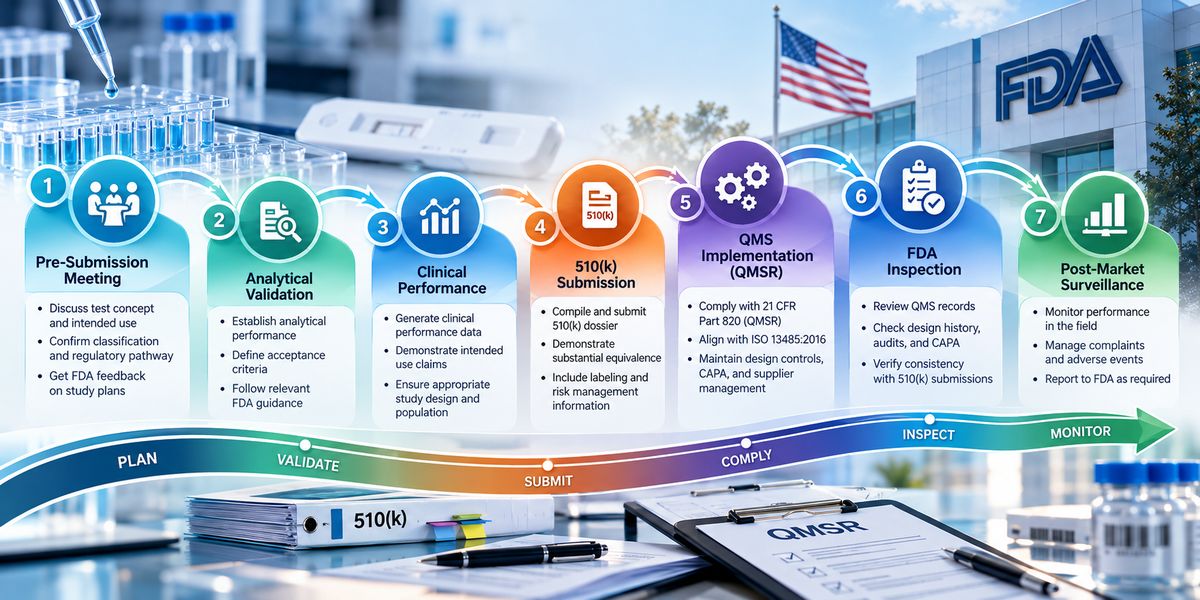
The infographic below follows one test from its first pre-submission meeting to its first QMSR inspection, so you can see exactly where the evidence you build early on will be checked again later.

From Review Desk to Inspection Floor: Where IVD Compliance Is Really Tested
A 510(k) reviewer and an FDA investigator rarely meet, yet they check the same story. The reviewer starts at the front of your IVD 510(k) submission and asks one thing: do your analytical validation and clinical performance data actually support your claims? Months later, the investigator arrives from the other end. They pull your design history, complaint files and CAPA records, then compare them with what you told the agency. So, if your label claims 98% sensitivity but your verification report was built on a smaller or different sample, someone will notice. In practice, your submission and your QMS records must tell one story, in the same words. When they don’t, a cleared test can still walk away with a Form 483.
4 Checkpoints Every IVD File Must Survive
Most IVD files don’t fail because of one big mistake. Instead, they fail at a few predictable points where the evidence stops lining up. A reviewer spots a predicate that doesn’t quite match, or a precision study that skipped a key sample type. Later, an investigator finds a label claim that no report supports, or a CAPA that never made it back into design. On its own, each gap looks small. Together, though, they decide whether your test clears smoothly or gets stuck in round after round of FDA questions.
Here are the four checkpoints where FDA pushes back most often, and what each one needs from your file to get through:
- Choosing the Right Premarket Pathway (Available PDF)
- Analytical Validation and Clinical Performance Evidence (Available PDF)
- Labeling That Matches Performance Data (Available PDF)
- QMSR and ISO 13485:2016 Under Inspection (Available PDF)
The infographic below puts all four checkpoints side by side, so you can test your own IVD file against each one before an FDA reviewer or investigator does.
Choosing the Right Premarket Pathway (Available PDF)
Your pathway depends on two things: the risk class of your test and whether a valid predicate exists. With a predicate, a 510(k) is usually the route; without one, you’ll need De Novo or, for high-risk tests, a PMA.
Analytical Validation and Clinical Performance Evidence (Available PDF)
Analytical studies show that your test measures the analyte accurately and consistently, while clinical studies show that it gets the right answer in real patients. FDA expects both, reported with sound statistics and the correct terminology.
Labeling That Matches Performance Data (Available PDF)
Under 21 CFR 809.10, your package insert must state the intended use, limitations and performance characteristics of the test. Every number on that insert needs a validation report behind it.
QMSR and ISO 13485:2016 Under Inspection (Available PDF)
Since February 2026, FDA inspects device makers against the QMSR, which builds on ISO 13485:2016. Investigators now follow a risk-based model and can review internal audits, supplier audits and management reviews.
Laboratory Developed Tests After the 2025 Rule Reversal
For a while, every clinical lab in the US wondered whether it was about to become a device manufacturer. Now that question has an answer. A federal court vacated FDA’s LDT rule on March 31, 2025, and on September 19, 2025, FDA restored the earlier wording of 21 CFR 809.3, dropping the phrase that pulled laboratories into the definition of a manufacturer. So a test that a lab designs, makes and runs in-house falls mainly under CLIA again, not FDA. The line still matters, though. Once you sell your assay as a kit to other labs, you’re making an in vitro diagnostic device, and the full FDA rulebook applies, from 510(k) to QMSR inspection.
Common Inspection Gaps for IVD Manufacturers
FDA investigators rarely surprise anyone. Year after year, the same few systems fill device Form 483s, and FY2025 was no exception. In fact, CAPA, design controls and complaint handling alone made up more than a third of all device citations. For IVD makers, these gaps usually look very specific: a lot-to-lot shift closed without a root cause, a reagent change released without new verification, or a false-negative complaint that never reached an MDR decision. Under QMSR, the questions stay largely the same. Now, however, your proof must follow ISO 13485 and sit in records investigators can open, including internal audits and management reviews.
The table below maps the most-cited areas from FDA’s FY2025 device Form 483 data to the QMSR clause that now covers each one, and to the evidence an IVD site should have ready.
| Form 483 area (QSR citation) | FY2025 device citations | Where it sits under QMSR | Evidence an IVD site should show |
|---|---|---|---|
|
CAPA (820.100) |
342 |
ISO 13485 clauses 8.5.2 and 8.5.3 |
Root cause analysis for failed QC lots and out-of-spec results, plus documented effectiveness checks |
|
Design controls (820.30) |
315 |
ISO 13485 clause 7.3 |
Analytical verification (precision, LoD, interference), clinical validation and re-verification after reagent or software changes |
|
Complaint handling (820.198) |
286 |
ISO 13485 clause 8.2.2, plus FDA record content in 820.35 |
Complaint files that assess false or erroneous results and record a documented MDR decision |
|
Purchasing controls (820.50) |
190 |
ISO 13485 clause 7.4 |
Supplier qualification and incoming checks for critical materials such as antibodies, antigens and calibrators |
Final Words
FDA is not slowing down. In FY2025, the agency issued 791 device Form 483s, up from 672 the year before, and that was before QMSR opened internal audits and management reviews to investigators. Now, inspectors also plan each visit around data they already hold, such as your MDRs, and choose what to check from there. As a result, the IVD makers who do well are not the ones with the thickest binders. Instead, they are the ones whose 510(k) claims, labels and QMS records tell the same story. So treat FDA IVD guidance as the reviewer’s checklist, keep your medical device registration and listing up to date, and test your own file before an investigator does.

Medical Devices & IVDs EU Registration
We guide companies through medical device and IVD EU registration by supporting MDR and IVDR requirements, technical documentation, and structured processes for compliant market access.
FAQ
It does if the change could significantly affect safety or effectiveness, or if it changes the intended use, as set out in 21 CFR 807.81(a)(3). Changes to reagent formulation, cut-offs or algorithms often meet that bar because they can shift analytical and clinical performance. Assess every change using FDA’s guidance on when to submit a 510(k) for a device change, and record the decision and re-verification data in your design change records.
Yes. Since QMSR took effect on February 2, 2026, the old 21 CFR 820.180(c) exemption no longer applies, so investigators can review internal audits, supplier audits and management reviews. An ISO 13485:2016 certificate does not exempt a site from FDA inspection. Make sure these records are complete, show corrective actions, and stay consistent with your CAPA system.
No. A federal court vacated the LDT rule on March 31, 2025, and on September 19, 2025, FDA restored the earlier text of 21 CFR 809.3. Tests that a single CLIA-certified laboratory designs, makes and uses in-house remain under CLIA oversight. However, once a lab sells its assay as a kit to other labs, the product is an IVD and needs the applicable FDA premarket submission.
references

Alireza Zarei is the founder and CEO of Zamann Pharma Support GmbH in Germany. He pairs 20 years in GMP—beginning in a lab in 2005—with front-line global project delivery for companies such as Boehringer Ingelheim, Roche, BioNTech, Takeda, Fresenius Medical Care, Biotest, ratiopharm and others. He focuses on innovative validation and qualification procedures, master data management strategies, end-to-end LIMS implementation and care, with pragmatic advice on general Quality Management topics and management level OpEx consulting. Together with his team he also created Pharmuni.com as the leading GMP learning platform in the industry.