
By February 2026, EU notified bodies had issued only 2,318 IVDR certificates, while many legacy diagnostics were still waiting for one. As a result, every IVD registration now faces tighter scrutiny, and QA and regulatory teams enter audits with far less margin for error. The pressure keeps rising, too: the Class C agreement deadline passed in September 2026, and Class D legacy devices must hold IVDR certificates by the end of 2027. Meanwhile, the FDA applies its own premarket rules to the same assays. Therefore, IVD regulations now decide market access on both sides of the Atlantic. This guide shows what auditors check first and why a successful file starts with evidence that holds up under review.
Table of Contents
How IVD Registration Differs from Medical Device Approval
A scalpel can harm a patient directly. An IVD never touches the patient, yet a wrong result can still lead to the wrong treatment. For this reason, the IVDR sets risk by the consequence of an incorrect result, not by contact with the body. In practice, this changes the evidence as well. Instead of a clinical evaluation, manufacturers build a performance evaluation that proves scientific validity, analytical performance and clinical performance. The intended user matters too. A test run by trained laboratory staff carries a different risk than one a patient uses at home, so most self-tests land in Class C. Companion diagnostics add one more step, because the notified body must consult a medicines authority before it issues a certificate. As a result, a registration plan copied from a medical device file rarely survives an IVD audit.
Why IVDR Compliance Shapes Audit and Inspection Outcomes?
Auditors rarely start with the regulation. Instead, they pick one label claim and trace it back through the performance evaluation, risk file and QMS records. If one link is missing, that claim becomes a finding. Moreover, promotional materials count too, because MDCG guidance treats them as part of the intended purpose. As a result, IVDR compliance depends on the proof behind each claim, not on document volume. The stakes are high: a major nonconformity against an ineffective IVDR QMS blocks every legacy device under that system until it closes.
Read Your File Like a Notified Body: 4 Evidence Tests
A notified body rarely reads an IVD regulatory file from start to finish. Instead, it asks a few hard questions in order, and each answer decides whether the next one matters. For example, a wrong class changes the conformity assessment route, so even strong performance data cannot save the file. Similarly, solid evidence means little if a legacy device has already lost its transition status. For this reason, experienced QA teams run the same checks internally before the audit starts and close the gaps while there is still time.
The four tests below follow that order, starting with the device class and ending with whether the same evidence can also support a US submission.
- Test 1: Does the Class Hold Up Under IVDR Classification Rules? (Available PDF)
- Test 2: Does the Performance Evaluation Report Support Every Claim? (Available PDF)
- Test 3: Does the Device Still Qualify for the IVDR Transition Period? (Available PDF)
- Test 4: Can the Same Evidence Carry an FDA 510(k)? (Available PDF)
Test 1: Does the Class Hold Up Under IVDR Classification Rules? (Available PDF)
The class decides everything that follows: the conformity assessment route, how closely the notified body reviews the file, and how often it returns. Auditors check whether the intended purpose supports the chosen class under all seven rules, and vague claims can push a device into a higher class.
Download MDCG 2020-16 rev.5 IVDR Classification Guidance Here
Test 2: Does the Performance Evaluation Report Support Every Claim? (Available PDF)
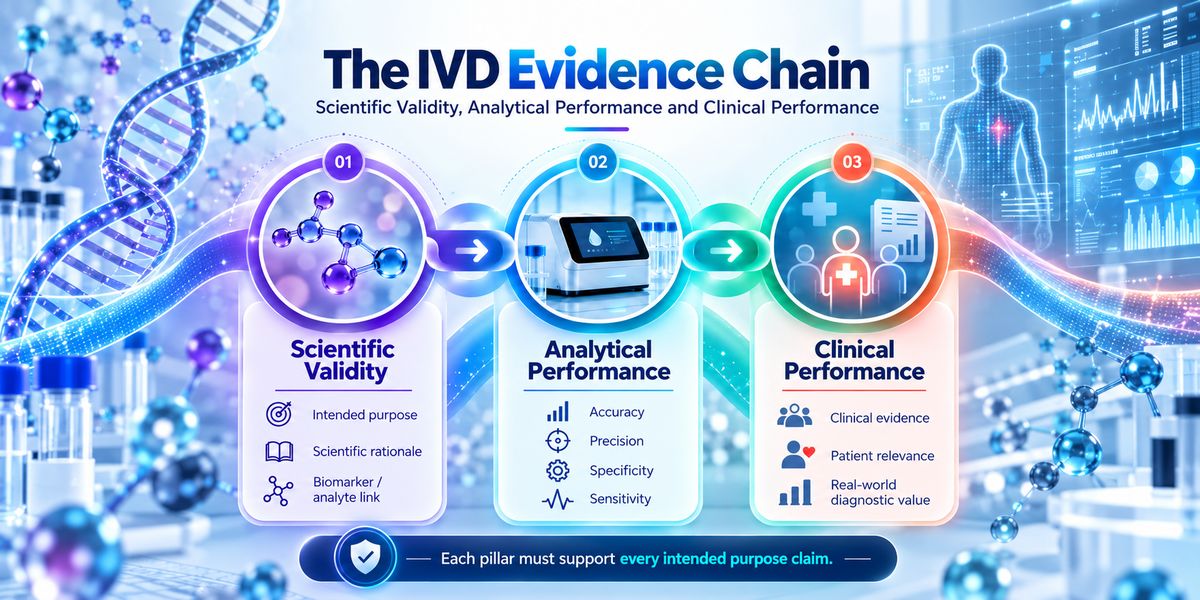
Every claim in the IFU needs proof on three levels: scientific validity, analytical performance and clinical performance. For Class C and D devices, the report never closes, because it must be updated at least once a year.
Download MDCG 2022-2 IVD Clinical Evidence Guidance Here
The infographic below shows how scientific validity, analytical performance and clinical performance build on each other, and why a gap in any one link weakens the whole file.
Test 3: Does the Device Still Qualify for the IVDR Transition Period? (Available PDF)
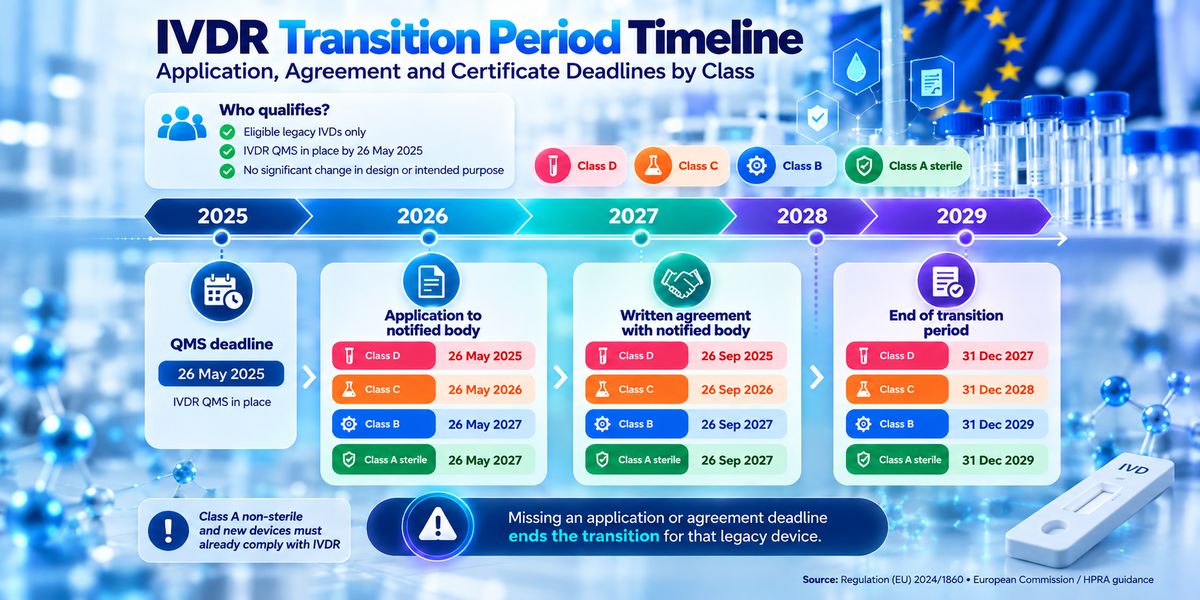
A legacy device stays on the EU market only while the manufacturer meets every condition: an IVDR-compliant QMS, a formal application and a signed agreement with a notified body by the class deadline. If the application is withdrawn or the agreement ends, the transition period stops for that device.
Download the European Commission’s IVDR Transition Q&A (2024) Here
The timeline below maps every application, agreement and certificate deadline by risk class, so you can see at a glance which windows have already closed, and which are still open.
Test 4: Can the Same Evidence Carry an FDA 510(k)? (Available PDF)
FDA asks a different question: is the assay substantially equivalent to a legally marketed predicate? For IVDs, FDA usually starts with analytical studies on accuracy, precision, specificity and sensitivity, so much of the IVDR data can carry over once it is mapped against a predicate.
Download FDA’s 510(k) Substantial Equivalence Guidance (2014) Here
IVDR and FDA Requirements Side by Side
Many manufacturers plan their EU and US submissions as two separate projects. In reality, the two systems ask for much of the same proof, but they judge it differently. The IVDR asks whether the evidence supports every claim on its own merits. The FDA, by contrast, usually asks whether the assay matches a device already on the market. As a result, the same analytical study can pass one review and raise questions in the other. For this reason, teams that map both sets of requirements early avoid duplicate testing and late surprises.
The table below shows, row by row, where the two systems align and where a single evidence package needs extra work.
| Requirement | EU IVDR | US FDA |
|---|---|---|
|
Risk classification |
Classes A, B, C and D under seven rules in Annex VIII |
Classes I, II and III under device classification regulations (21 CFR Parts 862–866) |
|
Market route |
CE marking after notified body assessment for Class B, C, D and A sterile; Class A non-sterile is self-declared |
510(k) clearance, De Novo classification or PMA approval; most Class I devices are exempt |
|
Core evidence |
Performance evaluation report covering scientific validity, analytical performance and clinical performance |
Analytical studies on accuracy, precision, specificity and sensitivity, plus clinical data when FDA requests it |
|
Quality system |
QMS under Article 10(8), usually certified to EN ISO 13485 |
QMSR (21 CFR Part 820), which incorporates ISO 13485:2016 as of 2 February 2026 |
|
Post-market duties |
PMS plan, PMPF and an annual PSUR for Class C and D; serious incidents reported within 15 days |
Medical Device Reporting under 21 CFR Part 803, generally within 30 days, or 5 workdays when remedial action is needed |
Common IVDR Compliance Gaps Auditors Flag
Most IVDR audit findings start with files that tell different stories, not with bad science. In fact, Team-NB names incomplete and poorly structured submissions as the top reasons for review delays. Fortunately, the same five gaps keep coming back, and each one has a clear fix.
- Incomplete documentation: Missing evidence triggers extra review cycles. Link every GSPR to its proof.
- Inconsistent intended purpose: Key documents describe the device differently. Align all of them to one master statement.
- Ambiguous claims: Vague wording can raise the class. Write precise claims with clear limitations.
- Weak performance evaluation: Claims rest on a few references. Trace each claim to all three evidence pillars.
- Outdated reports: Class C and D updates fall behind. Build PMPF into the PMS plan with fixed triggers.
Final Words
Across notified bodies, one trend stands out: certification still takes time, and weak files take even longer. In the latest Team-NB survey, 61% of new IVDR certificates took 13 to 18 months to issue. Meanwhile, the Class D deadline at the end of 2027 is now just over a year away. As a result, teams that succeed under IVD regulations treat audit readiness as part of their daily quality work. A defensible class, traceable evidence and a clear transition plan protect every IVD registration, and the same discipline strengthens each medical device registration across the wider portfolio.

Medical Devices & IVDs EU Registration
We guide companies through medical device and IVD EU registration by supporting MDR and IVDR requirements, technical documentation, and structured processes for compliant market access.
FAQ
The device loses the extended IVDR transition period. For self-declared Class C devices, the written agreement with a notified body had to be signed by 26 September 2026. Without it, the legacy device cannot stay on the EU market until it receives a full IVDR certificate.
They check whether the evidence supports every claim in the intended purpose. Reviewers trace each claim to scientific validity, analytical performance and clinical performance, and they expect a performance evaluation plan behind the report. For Class C and D devices, the report must be updated at least once a year.
Yes, in part. Analytical data on accuracy, precision, specificity and sensitivity often carries over, but FDA judges it against a legally marketed predicate device. Manufacturers usually need a predicate comparison, US-specific labeling and, in some cases, additional clinical data.
references

Alireza Zarei is the founder and CEO of Zamann Pharma Support GmbH in Germany. He pairs 20 years in GMP—beginning in a lab in 2005—with front-line global project delivery for companies such as Boehringer Ingelheim, Roche, BioNTech, Takeda, Fresenius Medical Care, Biotest, ratiopharm and others. He focuses on innovative validation and qualification procedures, master data management strategies, end-to-end LIMS implementation and care, with pragmatic advice on general Quality Management topics and management level OpEx consulting. Together with his team he also created Pharmuni.com as the leading GMP learning platform in the industry.